
Rahi__K
3.8k Публикации

Rahi__K
Отправить жалобу
Заблокировать пользователя
"Security is not a one-time event, it's an ongoing process."
"Stay secure, stay safe."
"I invested in crypto. Only what you afford to lose, right?"
1.3K+ подписок(и/а)
1.1K+ подписчиков(а)
162 понравилось
Посты
·
--
Статья
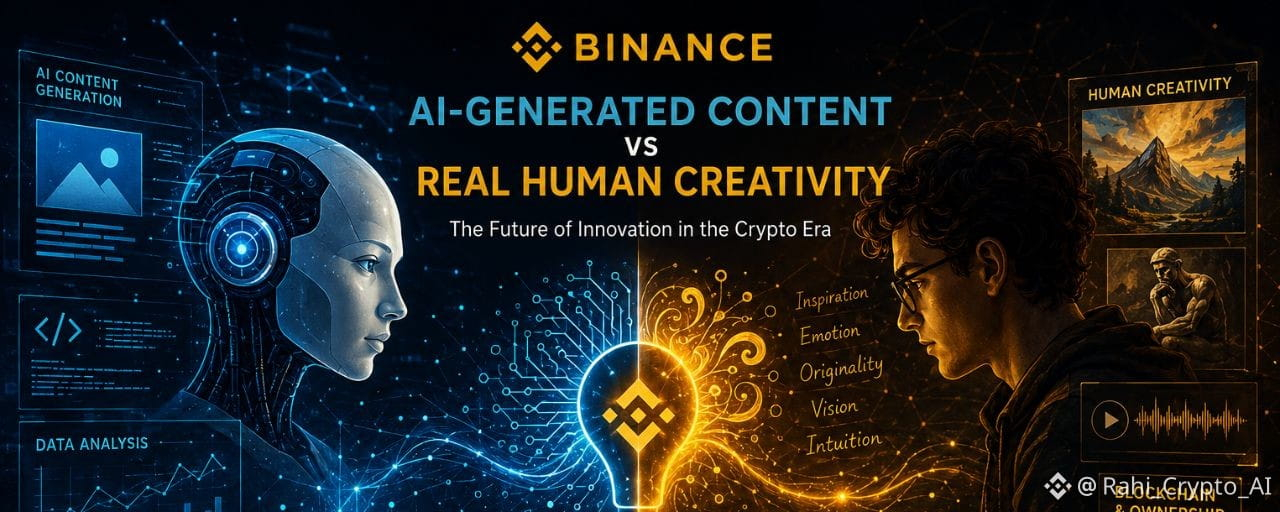
AI-Generated Content vs Human Creativity: Shaping the Future of Innovation in the Crypto Era$BTC $ETH $BNB
{future}(ETHUSDT)
{future}(BTCUSDT)
{spot}(BNBUSDT)
Introduction
Artificial Intelligence is no longer a futuristic concept—it is rapidly becoming a cornerstone of the digital economy. From generating artwork and writing articles to creating software and analyzing financial markets, AI is transforming how people create, communicate, and innovate.
As AI continues to evolve, a question that sparks intense debate across industries remains:
Can artificial intelligence truly replace human creativity?
The answer is more complex than a simple yes or no.
In the rapidly expanding world of blockchain and cryptocurrency, AI and human creativity are not merely coexisting—they are increasingly working together. Rather than competing for dominance, these two forces are creating new opportunities that could redefine innovation, ownership, and digital value creation for generations to come.
The Rise of AI-Generated Content
AI-generated content refers to any digital material—including text, images, music, videos, software code, and virtual assets—created with the assistance of machine learning models trained on massive datasets.
Today, AI can:
Write comprehensive articles within secondsGenerate realistic digital artworkCreate marketing campaigns and advertisementsProduce video scripts and multimedia contentAssist in software developmentDesign immersive virtual environments for gaming and metaverse platforms
For blockchain startups and crypto projects, these capabilities offer significant advantages.
Key Benefits of AI in the Crypto Industry
✅ Accelerated content creation
✅ Reduced operational costs
✅ AI-powered customer support
✅ Advanced market analysis and research
✅ Scalable educational resources for blockchain adoption
✅ Improved productivity across development and marketing teams
By automating repetitive tasks and enhancing efficiency, AI enables blockchain projects to focus more resources on innovation and community growth.
The Irreplaceable Value of Human Creativity
Despite AI's remarkable capabilities, human creativity remains one of humanity's most powerful and distinctive strengths.
Human creators contribute qualities that machines cannot genuinely replicate:
Emotion and empathyPersonal experiencesCultural awarenessEthical reasoningIntuition and instinctVisionary thinking
While AI can generate thousands of paintings or articles based on patterns learned from existing data, it cannot truly experience ambition, curiosity, passion, or inspiration.
History's most transformative innovations—from groundbreaking scientific discoveries to revolutionary artistic movements—were born from human imagination, courage, and a willingness to challenge conventional thinking.
Creativity is not merely the ability to produce content; it is the ability to create meaning.
And meaning remains deeply human.
AI as a Creative Partner, Not a Competitor
The future is unlikely to be defined by a conflict between humans and machines.
Instead, it will be shaped by collaboration.
AI functions best as a powerful creative assistant that enhances human capabilities rather than replacing them.
Examples of Human-AI Collaboration
Writers use AI to accelerate research and drafting.Artists use AI to generate concepts and explore new styles.Developers leverage AI to optimize coding workflows.Blockchain teams automate repetitive operations and data analysis.Educators use AI to create personalized learning experiences.
In this partnership, humans provide vision, strategy, and purpose, while AI contributes speed, scalability, and computational power.
The most successful innovators of the future will not be those who reject AI, but those who learn to harness it effectively.
Blockchain: Protecting Creativity in the Age of AI
As AI-generated content becomes increasingly common, questions surrounding ownership and authenticity are becoming more important than ever.
Key concerns include:
Who owns AI-generated artwork?How can creators prove originality?How can intellectual property be protected in a digital world?How should royalties be distributed fairly?
Blockchain technology offers promising solutions.
Proof of Ownership
Blockchain enables creators to establish immutable records of authorship by timestamping their work on-chain.
Transparent Licensing
Smart contracts can automate licensing agreements and royalty payments without intermediaries.
Digital Scarcity
NFTs provide verifiable ownership and authenticity for digital assets.
Creator Empowerment
Blockchain allows creators to monetize their work directly, reducing dependence on centralized platforms and intermediaries.
Together, AI and blockchain have the potential to create a more transparent, efficient, and creator-focused digital economy.
Opportunities at the Intersection of AI and Crypto
The convergence of artificial intelligence and blockchain technology is opening entirely new markets and business models.
AI-Powered Trading and Analytics
Machine learning systems can analyze vast amounts of market data, identify trends, and assist traders in making more informed decisions.
Decentralized AI Infrastructure
Blockchain networks can distribute computing resources and reduce dependence on centralized AI providers.
AI-Generated NFTs
Artists and developers are already experimenting with AI-assisted NFT collections that combine machine-generated creativity with human direction.
Intelligent Smart Contracts
Future smart contracts may incorporate AI capabilities, allowing them to adapt dynamically to real-world conditions and user behavior.
Autonomous Digital Economies
The combination of AI agents and blockchain technology could eventually enable self-operating digital marketplaces and decentralized ecosystems.
These developments have the potential to redefine how value is created, exchanged, and governed in the digital age.
Challenges and Ethical Considerations
While the opportunities are enormous, significant challenges remain.
The rapid growth of AI introduces important concerns such as:
Misinformation and fake contentDeepfakes and digital impersonationCopyright and intellectual property disputesData privacy risksAlgorithmic biasEthical use of autonomous systems
Addressing these challenges will require collaboration between developers, creators, regulators, businesses, and communities.
Innovation must be balanced with responsibility.
Without trust, even the most advanced technologies struggle to achieve long-term adoption.
AI-Generated Content vs Human Creativity: Shaping the Future of Innovation in the Crypto Era
$BTC $ETH $BNB
Introduction
Artificial Intelligence is no longer a futuristic concept—it is rapidly becoming a cornerstone of the digital economy. From generating artwork and writing articles to creating software and analyzing financial markets, AI is transforming how people create, communicate, and innovate.
As AI continues to evolve, a question that sparks intense debate across industries remains:
Can artificial intelligence truly replace human creativity?
The answer is more complex than a simple yes or no.
In the rapidly expanding world of blockchain and cryptocurrency, AI and human creativity are not merely coexisting—they are increasingly working together. Rather than competing for dominance, these two forces are creating new opportunities that could redefine innovation, ownership, and digital value creation for generations to come.
The Rise of AI-Generated Content
AI-generated content refers to any digital material—including text, images, music, videos, software code, and virtual assets—created with the assistance of machine learning models trained on massive datasets.
Today, AI can:
Write comprehensive articles within secondsGenerate realistic digital artworkCreate marketing campaigns and advertisementsProduce video scripts and multimedia contentAssist in software developmentDesign immersive virtual environments for gaming and metaverse platforms
For blockchain startups and crypto projects, these capabilities offer significant advantages.
Key Benefits of AI in the Crypto Industry
✅ Accelerated content creation
✅ Reduced operational costs
✅ AI-powered customer support
✅ Advanced market analysis and research
✅ Scalable educational resources for blockchain adoption
✅ Improved productivity across development and marketing teams
By automating repetitive tasks and enhancing efficiency, AI enables blockchain projects to focus more resources on innovation and community growth.
The Irreplaceable Value of Human Creativity
Despite AI's remarkable capabilities, human creativity remains one of humanity's most powerful and distinctive strengths.
Human creators contribute qualities that machines cannot genuinely replicate:
Emotion and empathyPersonal experiencesCultural awarenessEthical reasoningIntuition and instinctVisionary thinking
While AI can generate thousands of paintings or articles based on patterns learned from existing data, it cannot truly experience ambition, curiosity, passion, or inspiration.
History's most transformative innovations—from groundbreaking scientific discoveries to revolutionary artistic movements—were born from human imagination, courage, and a willingness to challenge conventional thinking.
Creativity is not merely the ability to produce content; it is the ability to create meaning.
And meaning remains deeply human.
AI as a Creative Partner, Not a Competitor
The future is unlikely to be defined by a conflict between humans and machines.
Instead, it will be shaped by collaboration.
AI functions best as a powerful creative assistant that enhances human capabilities rather than replacing them.
Examples of Human-AI Collaboration
Writers use AI to accelerate research and drafting.Artists use AI to generate concepts and explore new styles.Developers leverage AI to optimize coding workflows.Blockchain teams automate repetitive operations and data analysis.Educators use AI to create personalized learning experiences.
In this partnership, humans provide vision, strategy, and purpose, while AI contributes speed, scalability, and computational power.
The most successful innovators of the future will not be those who reject AI, but those who learn to harness it effectively.
Blockchain: Protecting Creativity in the Age of AI
As AI-generated content becomes increasingly common, questions surrounding ownership and authenticity are becoming more important than ever.
Key concerns include:
Who owns AI-generated artwork?How can creators prove originality?How can intellectual property be protected in a digital world?How should royalties be distributed fairly?
Blockchain technology offers promising solutions.
Proof of Ownership
Blockchain enables creators to establish immutable records of authorship by timestamping their work on-chain.
Transparent Licensing
Smart contracts can automate licensing agreements and royalty payments without intermediaries.
Digital Scarcity
NFTs provide verifiable ownership and authenticity for digital assets.
Creator Empowerment
Blockchain allows creators to monetize their work directly, reducing dependence on centralized platforms and intermediaries.
Together, AI and blockchain have the potential to create a more transparent, efficient, and creator-focused digital economy.
Opportunities at the Intersection of AI and Crypto
The convergence of artificial intelligence and blockchain technology is opening entirely new markets and business models.
AI-Powered Trading and Analytics
Machine learning systems can analyze vast amounts of market data, identify trends, and assist traders in making more informed decisions.
Decentralized AI Infrastructure
Blockchain networks can distribute computing resources and reduce dependence on centralized AI providers.
AI-Generated NFTs
Artists and developers are already experimenting with AI-assisted NFT collections that combine machine-generated creativity with human direction.
Intelligent Smart Contracts
Future smart contracts may incorporate AI capabilities, allowing them to adapt dynamically to real-world conditions and user behavior.
Autonomous Digital Economies
The combination of AI agents and blockchain technology could eventually enable self-operating digital marketplaces and decentralized ecosystems.
These developments have the potential to redefine how value is created, exchanged, and governed in the digital age.
Challenges and Ethical Considerations
While the opportunities are enormous, significant challenges remain.
The rapid growth of AI introduces important concerns such as:
Misinformation and fake contentDeepfakes and digital impersonationCopyright and intellectual property disputesData privacy risksAlgorithmic biasEthical use of autonomous systems
Addressing these challenges will require collaboration between developers, creators, regulators, businesses, and communities.
Innovation must be balanced with responsibility.
Without trust, even the most advanced technologies struggle to achieve long-term adoption.
Introduction
Artificial Intelligence is no longer a futuristic concept—it is rapidly becoming a cornerstone of the digital economy. From generating artwork and writing articles to creating software and analyzing financial markets, AI is transforming how people create, communicate, and innovate.
As AI continues to evolve, a question that sparks intense debate across industries remains:
Can artificial intelligence truly replace human creativity?
The answer is more complex than a simple yes or no.
In the rapidly expanding world of blockchain and cryptocurrency, AI and human creativity are not merely coexisting—they are increasingly working together. Rather than competing for dominance, these two forces are creating new opportunities that could redefine innovation, ownership, and digital value creation for generations to come.
The Rise of AI-Generated Content
AI-generated content refers to any digital material—including text, images, music, videos, software code, and virtual assets—created with the assistance of machine learning models trained on massive datasets.
Today, AI can:
Write comprehensive articles within secondsGenerate realistic digital artworkCreate marketing campaigns and advertisementsProduce video scripts and multimedia contentAssist in software developmentDesign immersive virtual environments for gaming and metaverse platforms
For blockchain startups and crypto projects, these capabilities offer significant advantages.
Key Benefits of AI in the Crypto Industry
✅ Accelerated content creation
✅ Reduced operational costs
✅ AI-powered customer support
✅ Advanced market analysis and research
✅ Scalable educational resources for blockchain adoption
✅ Improved productivity across development and marketing teams
By automating repetitive tasks and enhancing efficiency, AI enables blockchain projects to focus more resources on innovation and community growth.
The Irreplaceable Value of Human Creativity
Despite AI's remarkable capabilities, human creativity remains one of humanity's most powerful and distinctive strengths.
Human creators contribute qualities that machines cannot genuinely replicate:
Emotion and empathyPersonal experiencesCultural awarenessEthical reasoningIntuition and instinctVisionary thinking
While AI can generate thousands of paintings or articles based on patterns learned from existing data, it cannot truly experience ambition, curiosity, passion, or inspiration.
History's most transformative innovations—from groundbreaking scientific discoveries to revolutionary artistic movements—were born from human imagination, courage, and a willingness to challenge conventional thinking.
Creativity is not merely the ability to produce content; it is the ability to create meaning.
And meaning remains deeply human.
AI as a Creative Partner, Not a Competitor
The future is unlikely to be defined by a conflict between humans and machines.
Instead, it will be shaped by collaboration.
AI functions best as a powerful creative assistant that enhances human capabilities rather than replacing them.
Examples of Human-AI Collaboration
Writers use AI to accelerate research and drafting.Artists use AI to generate concepts and explore new styles.Developers leverage AI to optimize coding workflows.Blockchain teams automate repetitive operations and data analysis.Educators use AI to create personalized learning experiences.
In this partnership, humans provide vision, strategy, and purpose, while AI contributes speed, scalability, and computational power.
The most successful innovators of the future will not be those who reject AI, but those who learn to harness it effectively.
Blockchain: Protecting Creativity in the Age of AI
As AI-generated content becomes increasingly common, questions surrounding ownership and authenticity are becoming more important than ever.
Key concerns include:
Who owns AI-generated artwork?How can creators prove originality?How can intellectual property be protected in a digital world?How should royalties be distributed fairly?
Blockchain technology offers promising solutions.
Proof of Ownership
Blockchain enables creators to establish immutable records of authorship by timestamping their work on-chain.
Transparent Licensing
Smart contracts can automate licensing agreements and royalty payments without intermediaries.
Digital Scarcity
NFTs provide verifiable ownership and authenticity for digital assets.
Creator Empowerment
Blockchain allows creators to monetize their work directly, reducing dependence on centralized platforms and intermediaries.
Together, AI and blockchain have the potential to create a more transparent, efficient, and creator-focused digital economy.
Opportunities at the Intersection of AI and Crypto
The convergence of artificial intelligence and blockchain technology is opening entirely new markets and business models.
AI-Powered Trading and Analytics
Machine learning systems can analyze vast amounts of market data, identify trends, and assist traders in making more informed decisions.
Decentralized AI Infrastructure
Blockchain networks can distribute computing resources and reduce dependence on centralized AI providers.
AI-Generated NFTs
Artists and developers are already experimenting with AI-assisted NFT collections that combine machine-generated creativity with human direction.
Intelligent Smart Contracts
Future smart contracts may incorporate AI capabilities, allowing them to adapt dynamically to real-world conditions and user behavior.
Autonomous Digital Economies
The combination of AI agents and blockchain technology could eventually enable self-operating digital marketplaces and decentralized ecosystems.
These developments have the potential to redefine how value is created, exchanged, and governed in the digital age.
Challenges and Ethical Considerations
While the opportunities are enormous, significant challenges remain.
The rapid growth of AI introduces important concerns such as:
Misinformation and fake contentDeepfakes and digital impersonationCopyright and intellectual property disputesData privacy risksAlgorithmic biasEthical use of autonomous systems
Addressing these challenges will require collaboration between developers, creators, regulators, businesses, and communities.
Innovation must be balanced with responsibility.
Without trust, even the most advanced technologies struggle to achieve long-term adoption.
1
50
·
--

Статья
My Binance Journey: A Story of Return and GratitudeI joine Binance on 10/09/2022, and it has now been 1166 days since my journey began. From the beginning, I was happy to be part of such a trusted and innovative platform.
During this journey, there was a time when I had to leave Binance for personal reasons. Stepping away helped me reflect and learn, and it made me realize the true value of the platform. After some time, I returned to Binance a few days ago with renewed confidence and motivation.
Coming back felt like a fresh start while still carrying the experience of the past. Binance continues to offer powerful tools, opportunities, and a strong global community that supports growth and learning.
These 1166 days represent more than just time—they represent experience, lessons, and progress. I am truly thankful to Binance for being part of my journey, even through moments of departure and return. I look forward to moving ahead with positivity and growth.
{spot}(BTCUSDT)
{spot}(SOLUSDT)
{spot}(BNBUSDT)
My Binance Journey: A Story of Return and Gratitude
I joine Binance on 10/09/2022, and it has now been 1166 days since my journey began. From the beginning, I was happy to be part of such a trusted and innovative platform.
During this journey, there was a time when I had to leave Binance for personal reasons. Stepping away helped me reflect and learn, and it made me realize the true value of the platform. After some time, I returned to Binance a few days ago with renewed confidence and motivation.
Coming back felt like a fresh start while still carrying the experience of the past. Binance continues to offer powerful tools, opportunities, and a strong global community that supports growth and learning.
These 1166 days represent more than just time—they represent experience, lessons, and progress. I am truly thankful to Binance for being part of my journey, even through moments of departure and return. I look forward to moving ahead with positivity and growth.
During this journey, there was a time when I had to leave Binance for personal reasons. Stepping away helped me reflect and learn, and it made me realize the true value of the platform. After some time, I returned to Binance a few days ago with renewed confidence and motivation.
Coming back felt like a fresh start while still carrying the experience of the past. Binance continues to offer powerful tools, opportunities, and a strong global community that supports growth and learning.
These 1166 days represent more than just time—they represent experience, lessons, and progress. I am truly thankful to Binance for being part of my journey, even through moments of departure and return. I look forward to moving ahead with positivity and growth.
2
38
·
--
Welcome To The 2026 Let's Celebrate🎉 Happy New Year 2026,,,,, 💥🎁🎉With Free [Red Packet Giveaway.](https://app.binance.com/uni-qr/HwSMZeMR?utm_medium=web_share_copy)
Click [Claim](https://app.binance.com/uni-qr/HwSMZeMR?utm_medium=web_share_copy) Button to Claim Your Free Reward. & Share To Your Friend For Free Reward & Also More Extra Reward Waiting To You...... $DUSK ( $USDT )
{future}(DUSKUSDT)
Welcome To The 2026 Let's Celebrate🎉 Happy New Year 2026,,,,, 💥🎁🎉With Free Red Packet Giveaway.
Click Claim Button to Claim Your Free Reward. & Share To Your Friend For Free Reward & Also More Extra Reward Waiting To You...... $DUSK ( $USDT )
Click Claim Button to Claim Your Free Reward. & Share To Your Friend For Free Reward & Also More Extra Reward Waiting To You...... $DUSK ( $USDT )

2
12
12
·
--
Статья
Binance Exchange Se Binance Web3 Wallet Me BNB Coin Kaise Transfer KareOpen Binance App (Log In ) GoTo ExchangeClick AssetsConvert Your $BNB In Spot (In Situation Your Fund In Other Wallet Then)Conform Your Assets In SpotGoto Home & Click Wallet (Uppar Side Show Exchange & Wallet)Check Are Your In Wallet Home. Then Click Receive Click Transfer From Binance ExchangeSelect BNBClick BNB Smart Chain (BEP20) (White Mark Show Then Choose)Click Continue Then Show Adress & Network Conform That.Enter Amount (How Much BNB)Click Transfer (Some Network Fees Cut In Your Amount & Other Amount Receive)Check All & Then Click ConformClick Verify Again (Use Your Passkey or Fingerprint Through Payment)Show In Display Withdrawal Processing & Also Showing Amount View History ? Goto Binance Wallet Click AnyOne Of That
or
GoTo Wallet Assets (Your Amount Showing There)
Binance Exchange Se Binance Web3 Wallet Me BNB Coin Kaise Transfer Kare
Open Binance App (Log In ) GoTo ExchangeClick AssetsConvert Your $BNB In Spot (In Situation Your Fund In Other Wallet Then)Conform Your Assets In SpotGoto Home & Click Wallet (Uppar Side Show Exchange & Wallet)Check Are Your In Wallet Home. Then Click Receive Click Transfer From Binance ExchangeSelect BNBClick BNB Smart Chain (BEP20) (White Mark Show Then Choose)Click Continue Then Show Adress & Network Conform That.Enter Amount (How Much BNB)Click Transfer (Some Network Fees Cut In Your Amount & Other Amount Receive)Check All & Then Click ConformClick Verify Again (Use Your Passkey or Fingerprint Through Payment)Show In Display Withdrawal Processing & Also Showing Amount View History ? Goto Binance Wallet Click AnyOne Of That
or
GoTo Wallet Assets (Your Amount Showing There)
or
GoTo Wallet Assets (Your Amount Showing There)
3
42
·
--
Статья
New Offchain Computing Course with MarlinComplete the free course now on Binance Academy and share 2,000,000 POND in rewards.
1.How To Participate
2.Questions & Answers
3. Certificate
How To Participate Home => Notification ( Msg Inbox ) => [Marketing & Activities](https://www.binance.com/en/messages/v2/group/d14o5jb71n0jauledjq0) => Check Course related Topic Click There & Participate To [Learn & Earn](https://www.binance.com/en/academy/track/injective-the-layer-1-blockchain-built-for-finance).
Questions & Answers :-
1) What is the definition of "offchain computing"?
ANS :- Computation performed offchain, with results verified on-chain.
2) "Centralization concerns" and "Challenge periods" are "Cons" for which technology?
ANS :- Layer 2 scaling (rollups)
3) Which of the following is listed as a component of a coprocessor’s general architecture?
ANS :- Relay Contracts
4) How do we distinguish coprocessors from rollups?
ANS :- Rollups are described as sandboxed and "blockchain-esque," while coprocessors are compared to flexible VMs with attestations.
5) What "missing piece" in data protection does Confidential Computing address that Traditional Encryption leaves "Vulnerable"?
ANS :- Data "In Use"
6)What is the only primary "con" or disadvantage listed for TEE (Trusted Execution Environment) Coprocessors?
ANS :- Hardware vendor trust dependency
7) What is the primary goal of remote attestations?
ANS :- To verify that an attestation is valid, recent, and from a real enclave running a specific image.
8) Which TEE type is characterized by having "no persistent storage, external networking, or interactive access"?
ANS :- AWS Nitro Enclaves
9) According to the project overview, what is the primary reason for using Marlin's Oyster TEE coprocessors?
ANS :- To host verifiable AI (Llama 3.2) because blockchains cannot run AI and traditional APIs cannot be trusted.
10) What components are used to verify the TEE deployed AI's response onchain, as shown in the "Enclave Verification Data"?
ANS :- The "Oyster Signature" and the "Enclave Public Key".
11) According to the document, which computing model is characterized as "ephemeral," "stateless," and "event-driven"?
ANS :- Serverless Computing
12) Which of the following is listed as a "con" of using Confidential Virtual Machines (CVMs)?
ANS :- Upfront lease cost and longer cold start
13) What is the primary networking challenge associated with AWS Nitro Enclaves, and how does Oyster solve it?
ANS :- They only support vsock networking, so Oyster provides a simple IP interface to hide this complexity.
14)Which of the following is included in the checklist for verifying a decoded attestation document?
ANS :- Verify that the certificate chain's root is the AWS Nitro Enclaves Root certificate.
15)According to the document, what is the fundamental purpose of a Key Management System (KMS)?
ANS :- The lifecycle management of cryptographic keys, including their generation, storage, distribution, and rotation.
16) What is the core architectural difference between the Nautilus "Root Server" and "Derive Server"?
ANS :- The Root Server derives public keys (publicly), while the Derive Server derives private keys (inside the enclave).
17) Which of the following is listed as a key property of persistent storage in a TEE?
ANS :- Data persists across the enclave lifecycle and is cryptographically protected.
18) Which of the following is not a characteristic of "Contract-Based Persistent Storage"?
ANS :- It is a simple but rigid approach where the same code results in the same persistent keys.
19) What is the "Key Concept" of reproducible builds as defined in the document?
ANS :- Same source code + Same build environment = Identical binary output.
20) According to the document, what is the "gap" that Remote Attestation alone cannot solve, which reproducible builds address?
ANS :- Remote attestation verifies the binary (EIF) is running, but it doesn't prove what source code was used to create that binary.
21) What is the purpose of using npx pkg -t node18-alpine app.js in Step 2?
ANS :- To create a self-contained binary that runs without installing nodejs inside the enclave.
22) In Step 5, how is the deployed NodeJS server interacted with, and what is the expected response?
ANS :- By running curl <ip>:4000, expecting "Hello from Oyster Enclave!".
23) What is the primary security benefit of this decentralized frontend approach?
ANS :- It ensures that only enclaves running authorized images can request certificates for the domain, preventing tampering.
24) After fetching the subdomain, we have a waiting period of 4-5 minutes. What is happening during this time?
ANS :- The enclave is updating the DNS records.
25) In Step 3, what is the purpose of the --init-params ".env:1:1:file:./.env" flag in the oyster-cvm deploy command?
ANS :- To pass the environment variables file into the enclave during deployment.
26) How does a user interact with the deployed AI agent, according to Step 4?
ANS :- By running nc <Enclave_IP> 8080 and entering a prompt.
27) According to the "About the App" section, what is the primary role of the Marlin Oyster CVM enclave in this ZK-proof application?
ANS :- To secure the user's private inputs (age, BMI) so they cannot be leaked.
28) After deploying the server to a Marlin Oyster CVM, what command is used to perform a remote attestation to verify the enclave itself?
ANS :- oyster-cvm verify --enclave-ip <ip>
29) Where does the user go to deploy the minified JavaScript function for the Marlin Oyster Serverless service?
ANS :- They navigate to https://hub.marlin.org/oyster/serverless-sandbox/.
30) How is the deployed Marlin Oyster serverless function linked to the EthRate.sol smart contract before deployment?
ANS :- The "transaction hash" (codeHash) from the serverless deployment is added to the script/deploy/EthRate.ts file.
Certificate :-
New Offchain Computing Course with Marlin
Complete the free course now on Binance Academy and share 2,000,000 POND in rewards.
1.How To Participate
2.Questions & Answers
3. Certificate
How To Participate Home => Notification ( Msg Inbox ) => Marketing & Activities => Check Course related Topic Click There & Participate To Learn & Earn.
Questions & Answers :-
1) What is the definition of "offchain computing"?
ANS :- Computation performed offchain, with results verified on-chain.
2) "Centralization concerns" and "Challenge periods" are "Cons" for which technology?
ANS :- Layer 2 scaling (rollups)
3) Which of the following is listed as a component of a coprocessor’s general architecture?
ANS :- Relay Contracts
4) How do we distinguish coprocessors from rollups?
ANS :- Rollups are described as sandboxed and "blockchain-esque," while coprocessors are compared to flexible VMs with attestations.
5) What "missing piece" in data protection does Confidential Computing address that Traditional Encryption leaves "Vulnerable"?
ANS :- Data "In Use"
6)What is the only primary "con" or disadvantage listed for TEE (Trusted Execution Environment) Coprocessors?
ANS :- Hardware vendor trust dependency
7) What is the primary goal of remote attestations?
ANS :- To verify that an attestation is valid, recent, and from a real enclave running a specific image.
8) Which TEE type is characterized by having "no persistent storage, external networking, or interactive access"?
ANS :- AWS Nitro Enclaves
9) According to the project overview, what is the primary reason for using Marlin's Oyster TEE coprocessors?
ANS :- To host verifiable AI (Llama 3.2) because blockchains cannot run AI and traditional APIs cannot be trusted.
10) What components are used to verify the TEE deployed AI's response onchain, as shown in the "Enclave Verification Data"?
ANS :- The "Oyster Signature" and the "Enclave Public Key".
11) According to the document, which computing model is characterized as "ephemeral," "stateless," and "event-driven"?
ANS :- Serverless Computing
12) Which of the following is listed as a "con" of using Confidential Virtual Machines (CVMs)?
ANS :- Upfront lease cost and longer cold start
13) What is the primary networking challenge associated with AWS Nitro Enclaves, and how does Oyster solve it?
ANS :- They only support vsock networking, so Oyster provides a simple IP interface to hide this complexity.
14)Which of the following is included in the checklist for verifying a decoded attestation document?
ANS :- Verify that the certificate chain's root is the AWS Nitro Enclaves Root certificate.
15)According to the document, what is the fundamental purpose of a Key Management System (KMS)?
ANS :- The lifecycle management of cryptographic keys, including their generation, storage, distribution, and rotation.
16) What is the core architectural difference between the Nautilus "Root Server" and "Derive Server"?
ANS :- The Root Server derives public keys (publicly), while the Derive Server derives private keys (inside the enclave).
17) Which of the following is listed as a key property of persistent storage in a TEE?
ANS :- Data persists across the enclave lifecycle and is cryptographically protected.
18) Which of the following is not a characteristic of "Contract-Based Persistent Storage"?
ANS :- It is a simple but rigid approach where the same code results in the same persistent keys.
19) What is the "Key Concept" of reproducible builds as defined in the document?
ANS :- Same source code + Same build environment = Identical binary output.
20) According to the document, what is the "gap" that Remote Attestation alone cannot solve, which reproducible builds address?
ANS :- Remote attestation verifies the binary (EIF) is running, but it doesn't prove what source code was used to create that binary.
21) What is the purpose of using npx pkg -t node18-alpine app.js in Step 2?
ANS :- To create a self-contained binary that runs without installing nodejs inside the enclave.
22) In Step 5, how is the deployed NodeJS server interacted with, and what is the expected response?
ANS :- By running curl <ip>:4000, expecting "Hello from Oyster Enclave!".
23) What is the primary security benefit of this decentralized frontend approach?
ANS :- It ensures that only enclaves running authorized images can request certificates for the domain, preventing tampering.
24) After fetching the subdomain, we have a waiting period of 4-5 minutes. What is happening during this time?
ANS :- The enclave is updating the DNS records.
25) In Step 3, what is the purpose of the --init-params ".env:1:1:file:./.env" flag in the oyster-cvm deploy command?
ANS :- To pass the environment variables file into the enclave during deployment.
26) How does a user interact with the deployed AI agent, according to Step 4?
ANS :- By running nc <Enclave_IP> 8080 and entering a prompt.
27) According to the "About the App" section, what is the primary role of the Marlin Oyster CVM enclave in this ZK-proof application?
ANS :- To secure the user's private inputs (age, BMI) so they cannot be leaked.
28) After deploying the server to a Marlin Oyster CVM, what command is used to perform a remote attestation to verify the enclave itself?
ANS :- oyster-cvm verify --enclave-ip <ip>
29) Where does the user go to deploy the minified JavaScript function for the Marlin Oyster Serverless service?
ANS :- They navigate to https://hub.marlin.org/oyster/serverless-sandbox/.
30) How is the deployed Marlin Oyster serverless function linked to the EthRate.sol smart contract before deployment?
ANS :- The "transaction hash" (codeHash) from the serverless deployment is added to the script/deploy/EthRate.ts file.
Certificate :-
1.How To Participate
2.Questions & Answers
3. Certificate
How To Participate Home => Notification ( Msg Inbox ) => Marketing & Activities => Check Course related Topic Click There & Participate To Learn & Earn.
Questions & Answers :-
1) What is the definition of "offchain computing"?
ANS :- Computation performed offchain, with results verified on-chain.
2) "Centralization concerns" and "Challenge periods" are "Cons" for which technology?
ANS :- Layer 2 scaling (rollups)
3) Which of the following is listed as a component of a coprocessor’s general architecture?
ANS :- Relay Contracts
4) How do we distinguish coprocessors from rollups?
ANS :- Rollups are described as sandboxed and "blockchain-esque," while coprocessors are compared to flexible VMs with attestations.
5) What "missing piece" in data protection does Confidential Computing address that Traditional Encryption leaves "Vulnerable"?
ANS :- Data "In Use"
6)What is the only primary "con" or disadvantage listed for TEE (Trusted Execution Environment) Coprocessors?
ANS :- Hardware vendor trust dependency
7) What is the primary goal of remote attestations?
ANS :- To verify that an attestation is valid, recent, and from a real enclave running a specific image.
8) Which TEE type is characterized by having "no persistent storage, external networking, or interactive access"?
ANS :- AWS Nitro Enclaves
9) According to the project overview, what is the primary reason for using Marlin's Oyster TEE coprocessors?
ANS :- To host verifiable AI (Llama 3.2) because blockchains cannot run AI and traditional APIs cannot be trusted.
10) What components are used to verify the TEE deployed AI's response onchain, as shown in the "Enclave Verification Data"?
ANS :- The "Oyster Signature" and the "Enclave Public Key".
11) According to the document, which computing model is characterized as "ephemeral," "stateless," and "event-driven"?
ANS :- Serverless Computing
12) Which of the following is listed as a "con" of using Confidential Virtual Machines (CVMs)?
ANS :- Upfront lease cost and longer cold start
13) What is the primary networking challenge associated with AWS Nitro Enclaves, and how does Oyster solve it?
ANS :- They only support vsock networking, so Oyster provides a simple IP interface to hide this complexity.
14)Which of the following is included in the checklist for verifying a decoded attestation document?
ANS :- Verify that the certificate chain's root is the AWS Nitro Enclaves Root certificate.
15)According to the document, what is the fundamental purpose of a Key Management System (KMS)?
ANS :- The lifecycle management of cryptographic keys, including their generation, storage, distribution, and rotation.
16) What is the core architectural difference between the Nautilus "Root Server" and "Derive Server"?
ANS :- The Root Server derives public keys (publicly), while the Derive Server derives private keys (inside the enclave).
17) Which of the following is listed as a key property of persistent storage in a TEE?
ANS :- Data persists across the enclave lifecycle and is cryptographically protected.
18) Which of the following is not a characteristic of "Contract-Based Persistent Storage"?
ANS :- It is a simple but rigid approach where the same code results in the same persistent keys.
19) What is the "Key Concept" of reproducible builds as defined in the document?
ANS :- Same source code + Same build environment = Identical binary output.
20) According to the document, what is the "gap" that Remote Attestation alone cannot solve, which reproducible builds address?
ANS :- Remote attestation verifies the binary (EIF) is running, but it doesn't prove what source code was used to create that binary.
21) What is the purpose of using npx pkg -t node18-alpine app.js in Step 2?
ANS :- To create a self-contained binary that runs without installing nodejs inside the enclave.
22) In Step 5, how is the deployed NodeJS server interacted with, and what is the expected response?
ANS :- By running curl <ip>:4000, expecting "Hello from Oyster Enclave!".
23) What is the primary security benefit of this decentralized frontend approach?
ANS :- It ensures that only enclaves running authorized images can request certificates for the domain, preventing tampering.
24) After fetching the subdomain, we have a waiting period of 4-5 minutes. What is happening during this time?
ANS :- The enclave is updating the DNS records.
25) In Step 3, what is the purpose of the --init-params ".env:1:1:file:./.env" flag in the oyster-cvm deploy command?
ANS :- To pass the environment variables file into the enclave during deployment.
26) How does a user interact with the deployed AI agent, according to Step 4?
ANS :- By running nc <Enclave_IP> 8080 and entering a prompt.
27) According to the "About the App" section, what is the primary role of the Marlin Oyster CVM enclave in this ZK-proof application?
ANS :- To secure the user's private inputs (age, BMI) so they cannot be leaked.
28) After deploying the server to a Marlin Oyster CVM, what command is used to perform a remote attestation to verify the enclave itself?
ANS :- oyster-cvm verify --enclave-ip <ip>
29) Where does the user go to deploy the minified JavaScript function for the Marlin Oyster Serverless service?
ANS :- They navigate to https://hub.marlin.org/oyster/serverless-sandbox/.
30) How is the deployed Marlin Oyster serverless function linked to the EthRate.sol smart contract before deployment?
ANS :- The "transaction hash" (codeHash) from the serverless deployment is added to the script/deploy/EthRate.ts file.
Certificate :-
2
9
9
·
--

Статья
Red Packet Giveaway[Free Red Packet](https://app.binance.com/uni-qr/RtAtCQwm?utm_medium=web_share_copy)
Click [Claim](https://app.binance.com/uni-qr/RtAtCQwm?utm_medium=web_share_copy) Button to Claim Your Free Reward. & Share To Your Friend For Free Reward & Also More Extra Reward Waiting To You......
Red Packet Giveaway
Free Red Packet
Click Claim Button to Claim Your Free Reward. & Share To Your Friend For Free Reward & Also More Extra Reward Waiting To You......
Click Claim Button to Claim Your Free Reward. & Share To Your Friend For Free Reward & Also More Extra Reward Waiting To You......
7
22
·
--
Статья
New Course with Injective Learn & EarnComplete the free course now on Binance Academy and earn your share of INJ during launch week.
Join Course Study First & Solve Given Quiz Answers & Claim Certificate & Also Some Shares Of Injective.
Click Injective word & Join :- [Injective](https://www.binance.com/en/academy/track/injective-the-layer-1-blockchain-built-for-finance)
Chapter 1. Answers
Chapter 2. Answers
New Course with Injective Learn & Earn
Complete the free course now on Binance Academy and earn your share of INJ during launch week.
Join Course Study First & Solve Given Quiz Answers & Claim Certificate & Also Some Shares Of Injective.
Click Injective word & Join :- Injective
Chapter 1. Answers
Chapter 2. Answers
Join Course Study First & Solve Given Quiz Answers & Claim Certificate & Also Some Shares Of Injective.
Click Injective word & Join :- Injective
Chapter 1. Answers
Chapter 2. Answers
2
5
Войдите, чтобы посмотреть больше материала
Присоединяйтесь к пользователям криптовалют по всему миру на Binance Square
⚡️ Получайте новейшую и полезную информацию о криптоактивах.
💬 Нам доверяет крупнейшая в мире криптобиржа.
👍 Получите достоверные аналитические данные от верифицированных создателей контента.
Эл. почта/номер телефона
В тренде
FedRateWatch
Просмотров: 1.4M
6,664 обсуждают
Share & Win Traffic Reward in our Trending Hashtag Campaign
✨Topic: FOMC September, What's The Fed's Next Move?
👉How to Join:
Publish a short post or article with hashtag #FedRateWatch
Create content based on the below angles:
- August core CPI rose 0.3% month-over-month, and the odds of a 25bp hike this week are now close to 90%. Do you anticipate a rate hike this week? Is it a one-off, or the start of a longer hiking cycle?
- If the hike lands, how does it play out for BTC, tech stocks, and gold? Bullish or bearish?
- How are you planning to trade next? Share your BTC, stocks or gold trade/holdings with our trade sharing widget.
⏰Campaign Period:
- 2026-09-15 11:00 - 2026-09-17 3:00 UTC
🎁Reward:
- Qualified posts that comply with the above guidelines and contain more than 100 words will be reviewed and may receive a random traffic boost of 500 to 3,000 views. You will receive a notification from your feed secretary if your post is selected.
- Get a chance to have your article featured on Binance Square Official
Need ideas for your post? Visit the topic page #FedRateWatch or the Square Guide on How to Post for Better Reach.
Binance Square Official
·Лайков: 644
·Просмотров: 1.6M
ZcashRises6%
Просмотров: 47,078
622 обсуждают
XRPSinks10%
Просмотров: 31,967
409 обсуждают