
CoinFea
3.7k Публикации

CoinFea
 Square Verified+
Отправить жалобу
Заблокировать пользователя
CoinFea is a leading Cryptocurrency, Blockchain, and Fintech News platform. Our primary focus is trending news and updates of cryptoverse.
0 подписок(и/а)
88.7K+ подписчиков(а)
21.8K+ понравилось
Посты
·
--

Статья
Samsung to Build Custom AI Chip As Part of Partnership With OpenAIOpenAI’s partnership with Samsung Electronics on next-generation semiconductors continues to deepen. The South Korean manufacturer has now agreed to produce a custom AI chip for the ChatGPT maker, OpenAI Korea confirmed at a Seoul press conference on Wednesday. The move is expected to draw Samsung deeper into a chip race that has so far been dominated by Nvidia and TSMC.
Harrison Kim, General Manager of OpenAI Korea, told reporters that chips were the area where the two firms had achieved the most in their partnership. “One of the areas where we have made the most progress and gained the most recognition with Samsung Electronics is our joint production and research on the next-generation chips we are developing,” Kim said, according to Reuters. The collaboration runs across multiple fronts, including joint chip research, actual chip manufacturing, and a more expansive use of OpenAI’s enterprise software inside Samsung.
Samsung and OpenAI reach agreement on chip production
OpenAI has not disclosed the chip’s name or its exact purpose, although reports believe it is likely to be an inference processor and a successor to Jalapeno. Jalapeno was OpenAI’s first custom chip, produced by Taiwan’s TSMC and unveiled in June. Developed with Broadcom, the chip is designed to handle inference workloads. Having Samsung lead the next design would give OpenAI a second manufacturing partner, reducing its reliance on a single supplier.
Memory seems to be the other half of the deal, with both companies planning to work on advanced memory chips to feed heavier AI workloads, an effort that could be connected to OpenAI’s Stargate data center project. Stargate already involves Samsung’s domestic rival SK Hynix, and both Korean firms already signed letters of intent to supply memory for it last year. Samsung has started shipping samples of its HBM4E high-bandwidth memory, becoming the first supplier to distribute that generation of AI memory.
High-bandwidth memory sits inside AI accelerators such as Nvidia’s Rubin and Google’s Ironwood Tensor Processing Unit, and Samsung counts top chipmakers like AMD, Nvidia, and Google as part of its customers. Kim also called Samsung one of the largest ChatGPT deployments anywhere, with staff in Korea and abroad using the AI model across research, marketing, and sales. OpenAI said ChatGPT Enterprise users across South Korean businesses and institutions increased 28-fold by late August, compared to the same month in 2025.
Late last year, no country outside the United States had more paying ChatGPT subscribers than South Korea, according to the company. In June, Samsung’s Device eXperience division cleared employees to use ChatGPT alongside Google’s Gemini and Anthropic’s Claude.
The post Samsung to build custom AI chip as part of partnership with OpenAI first appeared on Coinfea.
Samsung to Build Custom AI Chip As Part of Partnership With OpenAI
OpenAI’s partnership with Samsung Electronics on next-generation semiconductors continues to deepen. The South Korean manufacturer has now agreed to produce a custom AI chip for the ChatGPT maker, OpenAI Korea confirmed at a Seoul press conference on Wednesday. The move is expected to draw Samsung deeper into a chip race that has so far been dominated by Nvidia and TSMC.
Harrison Kim, General Manager of OpenAI Korea, told reporters that chips were the area where the two firms had achieved the most in their partnership. “One of the areas where we have made the most progress and gained the most recognition with Samsung Electronics is our joint production and research on the next-generation chips we are developing,” Kim said, according to Reuters. The collaboration runs across multiple fronts, including joint chip research, actual chip manufacturing, and a more expansive use of OpenAI’s enterprise software inside Samsung.
Samsung and OpenAI reach agreement on chip production
OpenAI has not disclosed the chip’s name or its exact purpose, although reports believe it is likely to be an inference processor and a successor to Jalapeno. Jalapeno was OpenAI’s first custom chip, produced by Taiwan’s TSMC and unveiled in June. Developed with Broadcom, the chip is designed to handle inference workloads. Having Samsung lead the next design would give OpenAI a second manufacturing partner, reducing its reliance on a single supplier.
Memory seems to be the other half of the deal, with both companies planning to work on advanced memory chips to feed heavier AI workloads, an effort that could be connected to OpenAI’s Stargate data center project. Stargate already involves Samsung’s domestic rival SK Hynix, and both Korean firms already signed letters of intent to supply memory for it last year. Samsung has started shipping samples of its HBM4E high-bandwidth memory, becoming the first supplier to distribute that generation of AI memory.
High-bandwidth memory sits inside AI accelerators such as Nvidia’s Rubin and Google’s Ironwood Tensor Processing Unit, and Samsung counts top chipmakers like AMD, Nvidia, and Google as part of its customers. Kim also called Samsung one of the largest ChatGPT deployments anywhere, with staff in Korea and abroad using the AI model across research, marketing, and sales. OpenAI said ChatGPT Enterprise users across South Korean businesses and institutions increased 28-fold by late August, compared to the same month in 2025.
Late last year, no country outside the United States had more paying ChatGPT subscribers than South Korea, according to the company. In June, Samsung’s Device eXperience division cleared employees to use ChatGPT alongside Google’s Gemini and Anthropic’s Claude.
The post Samsung to build custom AI chip as part of partnership with OpenAI first appeared on Coinfea.
Harrison Kim, General Manager of OpenAI Korea, told reporters that chips were the area where the two firms had achieved the most in their partnership. “One of the areas where we have made the most progress and gained the most recognition with Samsung Electronics is our joint production and research on the next-generation chips we are developing,” Kim said, according to Reuters. The collaboration runs across multiple fronts, including joint chip research, actual chip manufacturing, and a more expansive use of OpenAI’s enterprise software inside Samsung.
Samsung and OpenAI reach agreement on chip production
OpenAI has not disclosed the chip’s name or its exact purpose, although reports believe it is likely to be an inference processor and a successor to Jalapeno. Jalapeno was OpenAI’s first custom chip, produced by Taiwan’s TSMC and unveiled in June. Developed with Broadcom, the chip is designed to handle inference workloads. Having Samsung lead the next design would give OpenAI a second manufacturing partner, reducing its reliance on a single supplier.
Memory seems to be the other half of the deal, with both companies planning to work on advanced memory chips to feed heavier AI workloads, an effort that could be connected to OpenAI’s Stargate data center project. Stargate already involves Samsung’s domestic rival SK Hynix, and both Korean firms already signed letters of intent to supply memory for it last year. Samsung has started shipping samples of its HBM4E high-bandwidth memory, becoming the first supplier to distribute that generation of AI memory.
High-bandwidth memory sits inside AI accelerators such as Nvidia’s Rubin and Google’s Ironwood Tensor Processing Unit, and Samsung counts top chipmakers like AMD, Nvidia, and Google as part of its customers. Kim also called Samsung one of the largest ChatGPT deployments anywhere, with staff in Korea and abroad using the AI model across research, marketing, and sales. OpenAI said ChatGPT Enterprise users across South Korean businesses and institutions increased 28-fold by late August, compared to the same month in 2025.
Late last year, no country outside the United States had more paying ChatGPT subscribers than South Korea, according to the company. In June, Samsung’s Device eXperience division cleared employees to use ChatGPT alongside Google’s Gemini and Anthropic’s Claude.
The post Samsung to build custom AI chip as part of partnership with OpenAI first appeared on Coinfea.
141
·
--
Проверено
Статья
Canary Capital Launches the First U.S. Spot Staked TRX ETF (Ticker: TRXS)Brentwood, TN – (September 9, 2026) — Canary Capital Group LLC (“Canary Capital”), a digital asset investment management firm, today announced the launch of the Canary Staked TRX ETF (Ticker: TRXS). The Fund seeks to provide exposure to the spot price of TRX, the native utility token of the TRON blockchain network. In addition, the Fund also seeks to earn additional TRX through participation in the TRON network’s delegated proof-of-stake validation process, with net staking rewards reflected in the Fund’s net asset value.
“The Canary Staked TRX ETF brings investors exposure to one of the world’s largest blockchain settlement networks through a registered exchange-traded structure, while also enabling investors to benefit from potential staking rewards,” said Steven McClurg, CEO of Canary Capital. “As stablecoin adoption continues to grow globally, TRON has become a critical piece of the infrastructure powering digital asset payments and settlement. We believe investors are increasingly looking beyond digital assets themselves and toward the networks driving real-world blockchain adoption.”
TRON has emerged as one of the leading blockchain networks for stablecoin activity, supporting more than $94 billion in circulating Tether (USDT). The chain also processes the highest USDT transfer volume of any blockchain, totaling approximately $5.6 trillion year-to-date. Known for its speed, scalability, and low transaction costs, the TRON network serves as critical infrastructure for decentralized finance, global payments, and blockchain-based applications. The TRON network is governed by TRON DAO, the community-governed Decentralized Autonomous Organization (DAO) dedicated to accelerating the decentralization of the internet through blockchain technology and decentralized applications (dApps).
“The launch of the Canary Staked TRX ETF demonstrates the growing recognition of the TRON network as critical infrastructure for the global digital economy and provides institutional investors with a new way to access a network that is already powering real-world financial activity at scale,” said Justin Sun, Founder of TRON. “We appreciate Canary Capital’s leadership in bringing TRX to the ETF market and welcome innovations that broaden investor participation in the TRON network while advancing the integration of blockchain infrastructure into traditional financial markets.”
With the launch of the Canary Staked TRX ETF (TRXS), Canary Capital continues its mission to make digital asset investing simple, secure, and accessible while expanding investor access beyond Bitcoin and Ethereum into the next generation of blockchain infrastructure.
For more information on TRXS, click here.
Media ContactsCanary Capital media@canaryetfs.com
TRON
press@tron.network
About Canary Capital
Canary Capital is an investment management firm that blends rigorous risk management, strategic foresight, and innovative thinking to deliver private placement strategies, crypto hedge fund solutions, treasury management solutions, and publicly traded funds, with a focus on enterprise technology.
About TRON DAO
TRON DAO is a community-governed DAO dedicated to accelerating the decentralization of the internet via blockchain technology and dApps.
Founded in September 2017, the TRON blockchain has experienced significant growth since its MainNet launch in May 2018. Today, TRON hosts the largest circulating supply of USD Tether (USDT) stablecoin, which currently exceeds $94 billion. As of September 2026, the TRON blockchain has recorded over 403 million in total user accounts, more than 15 billion in total transactions, and over $28 billion in total value locked (TVL), based on TRONSCAN. Recognized as the global settlement layer for stablecoin transactions and everyday purchases with proven success, TRON is “Moving Trillions, Empowering Billions.”
TRONNetwork | TRONDAO | X | YouTube | Telegram | Discord | Reddit | GitHub | Medium | Forum
The post Canary Capital Launches the First U.S. Spot Staked TRX ETF (Ticker: TRXS) first appeared on Coinfea.
Canary Capital Launches the First U.S. Spot Staked TRX ETF (Ticker: TRXS)
Brentwood, TN – (September 9, 2026) — Canary Capital Group LLC (“Canary Capital”), a digital asset investment management firm, today announced the launch of the Canary Staked TRX ETF (Ticker: TRXS). The Fund seeks to provide exposure to the spot price of TRX, the native utility token of the TRON blockchain network. In addition, the Fund also seeks to earn additional TRX through participation in the TRON network’s delegated proof-of-stake validation process, with net staking rewards reflected in the Fund’s net asset value.
“The Canary Staked TRX ETF brings investors exposure to one of the world’s largest blockchain settlement networks through a registered exchange-traded structure, while also enabling investors to benefit from potential staking rewards,” said Steven McClurg, CEO of Canary Capital. “As stablecoin adoption continues to grow globally, TRON has become a critical piece of the infrastructure powering digital asset payments and settlement. We believe investors are increasingly looking beyond digital assets themselves and toward the networks driving real-world blockchain adoption.”
TRON has emerged as one of the leading blockchain networks for stablecoin activity, supporting more than $94 billion in circulating Tether (USDT). The chain also processes the highest USDT transfer volume of any blockchain, totaling approximately $5.6 trillion year-to-date. Known for its speed, scalability, and low transaction costs, the TRON network serves as critical infrastructure for decentralized finance, global payments, and blockchain-based applications. The TRON network is governed by TRON DAO, the community-governed Decentralized Autonomous Organization (DAO) dedicated to accelerating the decentralization of the internet through blockchain technology and decentralized applications (dApps).
“The launch of the Canary Staked TRX ETF demonstrates the growing recognition of the TRON network as critical infrastructure for the global digital economy and provides institutional investors with a new way to access a network that is already powering real-world financial activity at scale,” said Justin Sun, Founder of TRON. “We appreciate Canary Capital’s leadership in bringing TRX to the ETF market and welcome innovations that broaden investor participation in the TRON network while advancing the integration of blockchain infrastructure into traditional financial markets.”
With the launch of the Canary Staked TRX ETF (TRXS), Canary Capital continues its mission to make digital asset investing simple, secure, and accessible while expanding investor access beyond Bitcoin and Ethereum into the next generation of blockchain infrastructure.
For more information on TRXS, click here.
Media ContactsCanary Capital media@canaryetfs.com
TRON
press@tron.network
About Canary Capital
Canary Capital is an investment management firm that blends rigorous risk management, strategic foresight, and innovative thinking to deliver private placement strategies, crypto hedge fund solutions, treasury management solutions, and publicly traded funds, with a focus on enterprise technology.
About TRON DAO
TRON DAO is a community-governed DAO dedicated to accelerating the decentralization of the internet via blockchain technology and dApps.
Founded in September 2017, the TRON blockchain has experienced significant growth since its MainNet launch in May 2018. Today, TRON hosts the largest circulating supply of USD Tether (USDT) stablecoin, which currently exceeds $94 billion. As of September 2026, the TRON blockchain has recorded over 403 million in total user accounts, more than 15 billion in total transactions, and over $28 billion in total value locked (TVL), based on TRONSCAN. Recognized as the global settlement layer for stablecoin transactions and everyday purchases with proven success, TRON is “Moving Trillions, Empowering Billions.”
TRONNetwork | TRONDAO | X | YouTube | Telegram | Discord | Reddit | GitHub | Medium | Forum
The post Canary Capital Launches the First U.S. Spot Staked TRX ETF (Ticker: TRXS) first appeared on Coinfea.
“The Canary Staked TRX ETF brings investors exposure to one of the world’s largest blockchain settlement networks through a registered exchange-traded structure, while also enabling investors to benefit from potential staking rewards,” said Steven McClurg, CEO of Canary Capital. “As stablecoin adoption continues to grow globally, TRON has become a critical piece of the infrastructure powering digital asset payments and settlement. We believe investors are increasingly looking beyond digital assets themselves and toward the networks driving real-world blockchain adoption.”
TRON has emerged as one of the leading blockchain networks for stablecoin activity, supporting more than $94 billion in circulating Tether (USDT). The chain also processes the highest USDT transfer volume of any blockchain, totaling approximately $5.6 trillion year-to-date. Known for its speed, scalability, and low transaction costs, the TRON network serves as critical infrastructure for decentralized finance, global payments, and blockchain-based applications. The TRON network is governed by TRON DAO, the community-governed Decentralized Autonomous Organization (DAO) dedicated to accelerating the decentralization of the internet through blockchain technology and decentralized applications (dApps).
“The launch of the Canary Staked TRX ETF demonstrates the growing recognition of the TRON network as critical infrastructure for the global digital economy and provides institutional investors with a new way to access a network that is already powering real-world financial activity at scale,” said Justin Sun, Founder of TRON. “We appreciate Canary Capital’s leadership in bringing TRX to the ETF market and welcome innovations that broaden investor participation in the TRON network while advancing the integration of blockchain infrastructure into traditional financial markets.”
With the launch of the Canary Staked TRX ETF (TRXS), Canary Capital continues its mission to make digital asset investing simple, secure, and accessible while expanding investor access beyond Bitcoin and Ethereum into the next generation of blockchain infrastructure.
For more information on TRXS, click here.
Media ContactsCanary Capital media@canaryetfs.com
TRON
press@tron.network
About Canary Capital
Canary Capital is an investment management firm that blends rigorous risk management, strategic foresight, and innovative thinking to deliver private placement strategies, crypto hedge fund solutions, treasury management solutions, and publicly traded funds, with a focus on enterprise technology.
About TRON DAO
TRON DAO is a community-governed DAO dedicated to accelerating the decentralization of the internet via blockchain technology and dApps.
Founded in September 2017, the TRON blockchain has experienced significant growth since its MainNet launch in May 2018. Today, TRON hosts the largest circulating supply of USD Tether (USDT) stablecoin, which currently exceeds $94 billion. As of September 2026, the TRON blockchain has recorded over 403 million in total user accounts, more than 15 billion in total transactions, and over $28 billion in total value locked (TVL), based on TRONSCAN. Recognized as the global settlement layer for stablecoin transactions and everyday purchases with proven success, TRON is “Moving Trillions, Empowering Billions.”
TRONNetwork | TRONDAO | X | YouTube | Telegram | Discord | Reddit | GitHub | Medium | Forum
The post Canary Capital Launches the First U.S. Spot Staked TRX ETF (Ticker: TRXS) first appeared on Coinfea.
1
2
1.6k
·
--
Проверено
Статья
BitMart Withdrawals Remain Frozen As Adviser Takes OversightBitMart withdrawals remain suspended as the exchange appoints Alvarez & Marsal as financial adviser and prepares to introduce independent operational oversight.
The move follows a September 9 deadline BitMart set for updating its restructuring process. Users still cannot access withdrawals, while a proof-of-reserves report promised in May has not been released.
BitMart said Alvarez & Marsal will work with its legal advisers to review finances, address stakeholder concerns, and assess options for restoring withdrawals. The firm will also help develop a near-term action plan for the exchange.
BitMart Adviser Reviews Finances and Withdrawal Options
According to the company, information concerning withdrawals, assets, and future steps must be reviewed by an independent adviser before publication. BitMart said this requirement was a key reason for appointing Alvarez & Marsal.
The exchange had earlier selected White & Case as restructuring legal counsel. It also plans to create a feedback website where users can submit views on the action plan.
BitMart said the website link will be published within five working days. Within three weeks, the company expects to launch the feedback mechanism and provide details about restructuring.
The exchange also plans to appoint an independent third party to supervise its operations and asset custody. BitMart said the measure is intended to protect user interests during the restructuring period.
BitMart Restructuring Replaces Earlier Shutdown Plan
The latest adviser appointment follows an earlier notice in which BitMart said it was considering restructuring instead of completing the shutdown announced on July 26.
Under the proposed restructuring, the exchange may resume parts of its business in phases while distributing assets to creditors. The original closure announcement cited operating conditions, broader market factors, and the company’s strategic direction.
BitMart stopped new registrations, deposits, and fresh orders on July 26. Its BMX token then fell about 60% within one day.
Trading had initially been scheduled to end on August 26, with full closure planned for January 31, 2027.
BitMart Users Await Reserves Report and Access
Questions remain around the exchange’s reported reserves. CoinMarketCap data cited in the original report showed BitMart self-reporting about $5.36 million in reserves, largely held in BMX, against daily trading volume near $272.6 million.
BitMart promised a proof-of-reserves report on May 23 but has not published it. Founder Sheldon Xia said on August 8 that the exchange had not “run off with funds,” but he provided no financial figures.
External pressure has also increased. On September 3, distressed-situations firm Echo Base formed an ad hoc committee of affected customers and retained Young Conaway Stargatt & Taylor and Ashbury Legal.
For now, withdrawals remain unavailable as users wait for the adviser-reviewed action plan and details of the planned third-party oversight arrangement.
The post BitMart Withdrawals Remain Frozen as Adviser Takes Oversight first appeared on Coinfea.
BitMart Withdrawals Remain Frozen As Adviser Takes Oversight
BitMart withdrawals remain suspended as the exchange appoints Alvarez & Marsal as financial adviser and prepares to introduce independent operational oversight.
The move follows a September 9 deadline BitMart set for updating its restructuring process. Users still cannot access withdrawals, while a proof-of-reserves report promised in May has not been released.
BitMart said Alvarez & Marsal will work with its legal advisers to review finances, address stakeholder concerns, and assess options for restoring withdrawals. The firm will also help develop a near-term action plan for the exchange.
BitMart Adviser Reviews Finances and Withdrawal Options
According to the company, information concerning withdrawals, assets, and future steps must be reviewed by an independent adviser before publication. BitMart said this requirement was a key reason for appointing Alvarez & Marsal.
The exchange had earlier selected White & Case as restructuring legal counsel. It also plans to create a feedback website where users can submit views on the action plan.
BitMart said the website link will be published within five working days. Within three weeks, the company expects to launch the feedback mechanism and provide details about restructuring.
The exchange also plans to appoint an independent third party to supervise its operations and asset custody. BitMart said the measure is intended to protect user interests during the restructuring period.
BitMart Restructuring Replaces Earlier Shutdown Plan
The latest adviser appointment follows an earlier notice in which BitMart said it was considering restructuring instead of completing the shutdown announced on July 26.
Under the proposed restructuring, the exchange may resume parts of its business in phases while distributing assets to creditors. The original closure announcement cited operating conditions, broader market factors, and the company’s strategic direction.
BitMart stopped new registrations, deposits, and fresh orders on July 26. Its BMX token then fell about 60% within one day.
Trading had initially been scheduled to end on August 26, with full closure planned for January 31, 2027.
BitMart Users Await Reserves Report and Access
Questions remain around the exchange’s reported reserves. CoinMarketCap data cited in the original report showed BitMart self-reporting about $5.36 million in reserves, largely held in BMX, against daily trading volume near $272.6 million.
BitMart promised a proof-of-reserves report on May 23 but has not published it. Founder Sheldon Xia said on August 8 that the exchange had not “run off with funds,” but he provided no financial figures.
External pressure has also increased. On September 3, distressed-situations firm Echo Base formed an ad hoc committee of affected customers and retained Young Conaway Stargatt & Taylor and Ashbury Legal.
For now, withdrawals remain unavailable as users wait for the adviser-reviewed action plan and details of the planned third-party oversight arrangement.
The post BitMart Withdrawals Remain Frozen as Adviser Takes Oversight first appeared on Coinfea.
The move follows a September 9 deadline BitMart set for updating its restructuring process. Users still cannot access withdrawals, while a proof-of-reserves report promised in May has not been released.
BitMart said Alvarez & Marsal will work with its legal advisers to review finances, address stakeholder concerns, and assess options for restoring withdrawals. The firm will also help develop a near-term action plan for the exchange.
BitMart Adviser Reviews Finances and Withdrawal Options
According to the company, information concerning withdrawals, assets, and future steps must be reviewed by an independent adviser before publication. BitMart said this requirement was a key reason for appointing Alvarez & Marsal.
The exchange had earlier selected White & Case as restructuring legal counsel. It also plans to create a feedback website where users can submit views on the action plan.
BitMart said the website link will be published within five working days. Within three weeks, the company expects to launch the feedback mechanism and provide details about restructuring.
The exchange also plans to appoint an independent third party to supervise its operations and asset custody. BitMart said the measure is intended to protect user interests during the restructuring period.
BitMart Restructuring Replaces Earlier Shutdown Plan
The latest adviser appointment follows an earlier notice in which BitMart said it was considering restructuring instead of completing the shutdown announced on July 26.
Under the proposed restructuring, the exchange may resume parts of its business in phases while distributing assets to creditors. The original closure announcement cited operating conditions, broader market factors, and the company’s strategic direction.
BitMart stopped new registrations, deposits, and fresh orders on July 26. Its BMX token then fell about 60% within one day.
Trading had initially been scheduled to end on August 26, with full closure planned for January 31, 2027.
BitMart Users Await Reserves Report and Access
Questions remain around the exchange’s reported reserves. CoinMarketCap data cited in the original report showed BitMart self-reporting about $5.36 million in reserves, largely held in BMX, against daily trading volume near $272.6 million.
BitMart promised a proof-of-reserves report on May 23 but has not published it. Founder Sheldon Xia said on August 8 that the exchange had not “run off with funds,” but he provided no financial figures.
External pressure has also increased. On September 3, distressed-situations firm Echo Base formed an ad hoc committee of affected customers and retained Young Conaway Stargatt & Taylor and Ashbury Legal.
For now, withdrawals remain unavailable as users wait for the adviser-reviewed action plan and details of the planned third-party oversight arrangement.
The post BitMart Withdrawals Remain Frozen as Adviser Takes Oversight first appeared on Coinfea.
1
856
·
--
Статья
Euro Stablecoins Add $156 Million As Dollar Supply Barely ChangesEuro stablecoins reached $848.1 million in supply on September 7, according to Token Terminal data. The total represents growth of about 22.6% from $691.7 million recorded on January 1.
That increase added roughly $156 million in euro-denominated stablecoin supply during the first eight months of 2026.
Dollar stablecoins added about $159 million over the same period, rising from $298.54 billion to $298.699 billion.
The two segments therefore added similar absolute amounts despite the dollar market being roughly 350 times larger.
Dollar stablecoins still dominate overall supply with a 99.5% market share, while euro stablecoins account for 0.3%.
Euro Stablecoin Supply Remains Highly Concentrated
Supply within the euro stablecoin market remains concentrated among a small group of issuers. EURC controls 62.6% of the segment, while EURCV accounts for another 19.6%. Together, the two assets represent 82% of total euro stablecoin supply.
EURI holds a 4.5% share, while EURe represents 3.9%. The remaining 22 euro-denominated assets collectively account for less than 6% of supply.
EURCV is issued by SG-Forge, the digital asset subsidiary of Société Générale. SG-Forge holds electronic money institution approval from France’s ACPR under MiCA.
The asset now represents 19.6% of euro stablecoin supply, placing nearly one-fifth of the market with a licensed European bank subsidiary.
Ethereum and Solana Capture Most New Supply
Ethereum recorded the largest increase in euro stablecoin market capitalization this year. Supply on the network rose from $463.4 million to $588.7 million, an increase of about $125 million. Ethereum now holds 69.4% of the euro stablecoin market.
Solana increased from $94.9 million to $124.9 million and holds a 14.7% share. Combined, Ethereum and Solana added about $155 million, accounting for almost all euro stablecoin growth during the period.
Other networks showed mixed changes. Base declined from $73.9 million to $58.7 million. Gnosis increased to $22.3 million, while BNB Chain rose from $4.1 million to $10.4 million.
Dollar Stablecoin Supply Shows Little Net Growth
Dollar stablecoin supply began the year near $298.5 billion and reached about $298.7 billion by September 7.
The increase was approximately 0.05%, leaving the overall dollar-denominated market largely unchanged during the period.
By comparison, euro stablecoins expanded while the broader stablecoin category saw limited dollar growth.
MiCA has provided European banks and licensed electronic money institutions with a regulated route for issuance.
However, the article’s data shows euro stablecoin supply growth remains concentrated by issuer and blockchain.
Ethereum and Solana absorbed nearly all new supply, while EURC and EURCV continued to dominate the asset mix.
Despite rising issuance, euro pairs remain thin across DeFi lending pools and perpetual collateral markets. Europeans also already hold euros, limiting the offshore-style demand seen for synthetic dollars.
The post Euro Stablecoins Add $156 Million as Dollar Supply Barely Changes first appeared on Coinfea.
Euro Stablecoins Add $156 Million As Dollar Supply Barely Changes
Euro stablecoins reached $848.1 million in supply on September 7, according to Token Terminal data. The total represents growth of about 22.6% from $691.7 million recorded on January 1.
That increase added roughly $156 million in euro-denominated stablecoin supply during the first eight months of 2026.
Dollar stablecoins added about $159 million over the same period, rising from $298.54 billion to $298.699 billion.
The two segments therefore added similar absolute amounts despite the dollar market being roughly 350 times larger.
Dollar stablecoins still dominate overall supply with a 99.5% market share, while euro stablecoins account for 0.3%.
Euro Stablecoin Supply Remains Highly Concentrated
Supply within the euro stablecoin market remains concentrated among a small group of issuers. EURC controls 62.6% of the segment, while EURCV accounts for another 19.6%. Together, the two assets represent 82% of total euro stablecoin supply.
EURI holds a 4.5% share, while EURe represents 3.9%. The remaining 22 euro-denominated assets collectively account for less than 6% of supply.
EURCV is issued by SG-Forge, the digital asset subsidiary of Société Générale. SG-Forge holds electronic money institution approval from France’s ACPR under MiCA.
The asset now represents 19.6% of euro stablecoin supply, placing nearly one-fifth of the market with a licensed European bank subsidiary.
Ethereum and Solana Capture Most New Supply
Ethereum recorded the largest increase in euro stablecoin market capitalization this year. Supply on the network rose from $463.4 million to $588.7 million, an increase of about $125 million. Ethereum now holds 69.4% of the euro stablecoin market.
Solana increased from $94.9 million to $124.9 million and holds a 14.7% share. Combined, Ethereum and Solana added about $155 million, accounting for almost all euro stablecoin growth during the period.
Other networks showed mixed changes. Base declined from $73.9 million to $58.7 million. Gnosis increased to $22.3 million, while BNB Chain rose from $4.1 million to $10.4 million.
Dollar Stablecoin Supply Shows Little Net Growth
Dollar stablecoin supply began the year near $298.5 billion and reached about $298.7 billion by September 7.
The increase was approximately 0.05%, leaving the overall dollar-denominated market largely unchanged during the period.
By comparison, euro stablecoins expanded while the broader stablecoin category saw limited dollar growth.
MiCA has provided European banks and licensed electronic money institutions with a regulated route for issuance.
However, the article’s data shows euro stablecoin supply growth remains concentrated by issuer and blockchain.
Ethereum and Solana absorbed nearly all new supply, while EURC and EURCV continued to dominate the asset mix.
Despite rising issuance, euro pairs remain thin across DeFi lending pools and perpetual collateral markets. Europeans also already hold euros, limiting the offshore-style demand seen for synthetic dollars.
The post Euro Stablecoins Add $156 Million as Dollar Supply Barely Changes first appeared on Coinfea.
That increase added roughly $156 million in euro-denominated stablecoin supply during the first eight months of 2026.
Dollar stablecoins added about $159 million over the same period, rising from $298.54 billion to $298.699 billion.
The two segments therefore added similar absolute amounts despite the dollar market being roughly 350 times larger.
Dollar stablecoins still dominate overall supply with a 99.5% market share, while euro stablecoins account for 0.3%.
Euro Stablecoin Supply Remains Highly Concentrated
Supply within the euro stablecoin market remains concentrated among a small group of issuers. EURC controls 62.6% of the segment, while EURCV accounts for another 19.6%. Together, the two assets represent 82% of total euro stablecoin supply.
EURI holds a 4.5% share, while EURe represents 3.9%. The remaining 22 euro-denominated assets collectively account for less than 6% of supply.
EURCV is issued by SG-Forge, the digital asset subsidiary of Société Générale. SG-Forge holds electronic money institution approval from France’s ACPR under MiCA.
The asset now represents 19.6% of euro stablecoin supply, placing nearly one-fifth of the market with a licensed European bank subsidiary.
Ethereum and Solana Capture Most New Supply
Ethereum recorded the largest increase in euro stablecoin market capitalization this year. Supply on the network rose from $463.4 million to $588.7 million, an increase of about $125 million. Ethereum now holds 69.4% of the euro stablecoin market.
Solana increased from $94.9 million to $124.9 million and holds a 14.7% share. Combined, Ethereum and Solana added about $155 million, accounting for almost all euro stablecoin growth during the period.
Other networks showed mixed changes. Base declined from $73.9 million to $58.7 million. Gnosis increased to $22.3 million, while BNB Chain rose from $4.1 million to $10.4 million.
Dollar Stablecoin Supply Shows Little Net Growth
Dollar stablecoin supply began the year near $298.5 billion and reached about $298.7 billion by September 7.
The increase was approximately 0.05%, leaving the overall dollar-denominated market largely unchanged during the period.
By comparison, euro stablecoins expanded while the broader stablecoin category saw limited dollar growth.
MiCA has provided European banks and licensed electronic money institutions with a regulated route for issuance.
However, the article’s data shows euro stablecoin supply growth remains concentrated by issuer and blockchain.
Ethereum and Solana absorbed nearly all new supply, while EURC and EURCV continued to dominate the asset mix.
Despite rising issuance, euro pairs remain thin across DeFi lending pools and perpetual collateral markets. Europeans also already hold euros, limiting the offshore-style demand seen for synthetic dollars.
The post Euro Stablecoins Add $156 Million as Dollar Supply Barely Changes first appeared on Coinfea.
53
·
--
Статья
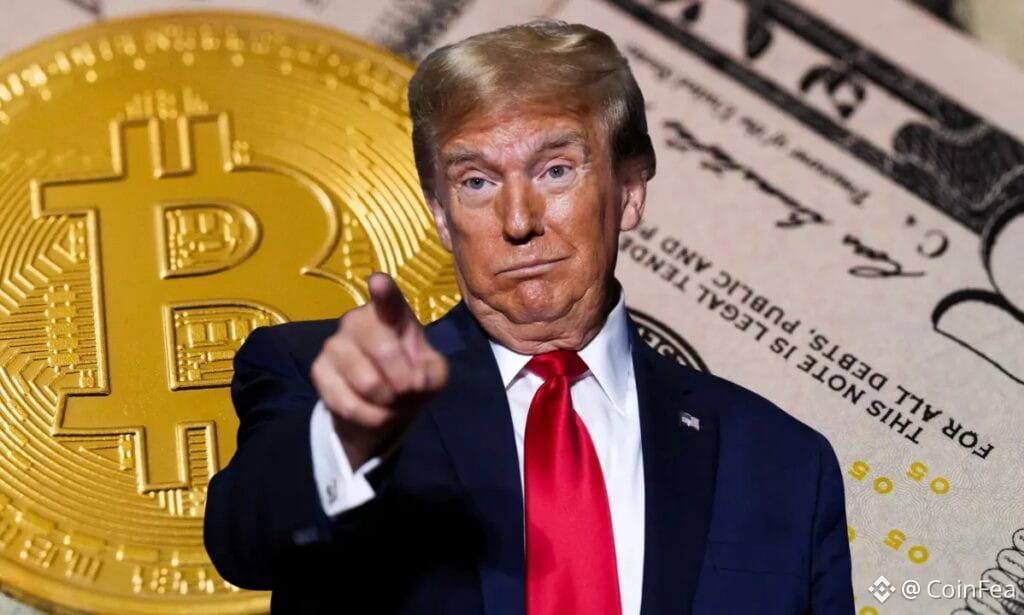
Donald Trump Reveals Major Drivers of Crypto ShiftPresident Donald Trump says he entered the crypto space, in part, for political reasons and after noticing the industry’s massive profits. While announcing a new minor savings vehicle called “Trump Accounts” from the Oval Office on Monday, Trump was pressed on whether the program would accommodate Bitcoin.
He responded with, “I’ve become a big crypto guy only for one reason: If we don’t have it, China’s going to have it. But now they’re not even trying that hard, because we’ve taken over.” Donald Trump also acknowledged that at first he was not into crypto and knew very little about it, but he changed his mind after witnessing it mature from a niche market into a financial powerhouse. He further admitted that he dipped his toe in the industry a little for political reasons, once he realized there was a huge fanbase for the market.
Donald Trump says America has taken over crypto
Ideally, his pro-crypto pivot drew strong backing from the crypto lobby, which poured roughly $170 million into the 2024 election and is set to ramp up funding for pro-crypto candidates this November. As earlier reported by Cryptopolitan, the president’s remarks come as his family’s crypto ventures continue to generate enormous financial returns. According to his latest financial disclosure, Trump reported more than $1.4 billion in income from cryptocurrency-related businesses.
As of 2025, the bulk of the earnings came from World Liberty Financial and the sale of his $TRUMP meme coin. After Trump’s remarks, cryptocurrency markets reacted positively on Monday. Bitcoin, especially, rebounded after the president embraced the “big crypto guy” label and left the door open for digital assets in his minor investment program. He did not make a definitive promise to include the assets. Bitcoin edged up 0.4% to $63,822, though it remains well below its historic peak of over $126,000 last year.
Before those comments, Bitcoin had slipped as much as 2% toward $60,000 following Strategy’s regulatory disclosures. Cryptopolitan reported that the firm liquidated $216 million of its stash, walking back Michael Saylor’s famous “never sell” mantra, throwing off several Bitcoin investors. Trump’s new 503A investment plans, “Trump Accounts,” for kids officially opened over the holiday weekend, handing out $1,000 starter investments to any U.S. child born between January 1, 2025, and the end of 2028.
Trump family nets more than $1 billion from crypto ventures
The goal is to get kids building wealth early through diversified exchange-traded funds. The US president’s remarks clearly explain his change of heart, a total 180 from his first term, when he famously trashed Bitcoin as a scam. In the years since, the Trump family has established significant commercial ties to the cryptocurrency sector, drawing intense scrutiny over potential conflicts of interest regarding his pro-crypto policies.
Critics have also wasted no time in slamming Trump after June 30 disclosures showed his family earned over $1.4 billion last year from crypto ventures. Data published by The New York Times on Sunday indicated that while nearly one million $TRUMP meme coin investors lost a staggering $3.81 billion, Trump personally captured upwards of $600 million from the market. Additionally, he earned $800 million in 2025 from World Liberty Financial, a crypto platform he co-founded with his family.
Senator Elizabeth Warren has called him out for “brazen crypto corruption.” Illinois Lieutenant Governor Juliana Stratton, who is running for the Senate, also posted more recently that the president’s “infinite greed is disgusting.” The president, however, has said his interest in crypto is “not a question of a personal thing.” He even said he doesn’t talk to his family about their involvement in crypto. Speaking about his children, he said, “I don’t talk to them, ever, talk to them about it.”
The post Donald Trump reveals major drivers of crypto shift first appeared on Coinfea.
Donald Trump Reveals Major Drivers of Crypto Shift
President Donald Trump says he entered the crypto space, in part, for political reasons and after noticing the industry’s massive profits. While announcing a new minor savings vehicle called “Trump Accounts” from the Oval Office on Monday, Trump was pressed on whether the program would accommodate Bitcoin.
He responded with, “I’ve become a big crypto guy only for one reason: If we don’t have it, China’s going to have it. But now they’re not even trying that hard, because we’ve taken over.” Donald Trump also acknowledged that at first he was not into crypto and knew very little about it, but he changed his mind after witnessing it mature from a niche market into a financial powerhouse. He further admitted that he dipped his toe in the industry a little for political reasons, once he realized there was a huge fanbase for the market.
Donald Trump says America has taken over crypto
Ideally, his pro-crypto pivot drew strong backing from the crypto lobby, which poured roughly $170 million into the 2024 election and is set to ramp up funding for pro-crypto candidates this November. As earlier reported by Cryptopolitan, the president’s remarks come as his family’s crypto ventures continue to generate enormous financial returns. According to his latest financial disclosure, Trump reported more than $1.4 billion in income from cryptocurrency-related businesses.
As of 2025, the bulk of the earnings came from World Liberty Financial and the sale of his $TRUMP meme coin. After Trump’s remarks, cryptocurrency markets reacted positively on Monday. Bitcoin, especially, rebounded after the president embraced the “big crypto guy” label and left the door open for digital assets in his minor investment program. He did not make a definitive promise to include the assets. Bitcoin edged up 0.4% to $63,822, though it remains well below its historic peak of over $126,000 last year.
Before those comments, Bitcoin had slipped as much as 2% toward $60,000 following Strategy’s regulatory disclosures. Cryptopolitan reported that the firm liquidated $216 million of its stash, walking back Michael Saylor’s famous “never sell” mantra, throwing off several Bitcoin investors. Trump’s new 503A investment plans, “Trump Accounts,” for kids officially opened over the holiday weekend, handing out $1,000 starter investments to any U.S. child born between January 1, 2025, and the end of 2028.
Trump family nets more than $1 billion from crypto ventures
The goal is to get kids building wealth early through diversified exchange-traded funds. The US president’s remarks clearly explain his change of heart, a total 180 from his first term, when he famously trashed Bitcoin as a scam. In the years since, the Trump family has established significant commercial ties to the cryptocurrency sector, drawing intense scrutiny over potential conflicts of interest regarding his pro-crypto policies.
Critics have also wasted no time in slamming Trump after June 30 disclosures showed his family earned over $1.4 billion last year from crypto ventures. Data published by The New York Times on Sunday indicated that while nearly one million $TRUMP meme coin investors lost a staggering $3.81 billion, Trump personally captured upwards of $600 million from the market. Additionally, he earned $800 million in 2025 from World Liberty Financial, a crypto platform he co-founded with his family.
Senator Elizabeth Warren has called him out for “brazen crypto corruption.” Illinois Lieutenant Governor Juliana Stratton, who is running for the Senate, also posted more recently that the president’s “infinite greed is disgusting.” The president, however, has said his interest in crypto is “not a question of a personal thing.” He even said he doesn’t talk to his family about their involvement in crypto. Speaking about his children, he said, “I don’t talk to them, ever, talk to them about it.”
The post Donald Trump reveals major drivers of crypto shift first appeared on Coinfea.
He responded with, “I’ve become a big crypto guy only for one reason: If we don’t have it, China’s going to have it. But now they’re not even trying that hard, because we’ve taken over.” Donald Trump also acknowledged that at first he was not into crypto and knew very little about it, but he changed his mind after witnessing it mature from a niche market into a financial powerhouse. He further admitted that he dipped his toe in the industry a little for political reasons, once he realized there was a huge fanbase for the market.
Donald Trump says America has taken over crypto
Ideally, his pro-crypto pivot drew strong backing from the crypto lobby, which poured roughly $170 million into the 2024 election and is set to ramp up funding for pro-crypto candidates this November. As earlier reported by Cryptopolitan, the president’s remarks come as his family’s crypto ventures continue to generate enormous financial returns. According to his latest financial disclosure, Trump reported more than $1.4 billion in income from cryptocurrency-related businesses.
As of 2025, the bulk of the earnings came from World Liberty Financial and the sale of his $TRUMP meme coin. After Trump’s remarks, cryptocurrency markets reacted positively on Monday. Bitcoin, especially, rebounded after the president embraced the “big crypto guy” label and left the door open for digital assets in his minor investment program. He did not make a definitive promise to include the assets. Bitcoin edged up 0.4% to $63,822, though it remains well below its historic peak of over $126,000 last year.
Before those comments, Bitcoin had slipped as much as 2% toward $60,000 following Strategy’s regulatory disclosures. Cryptopolitan reported that the firm liquidated $216 million of its stash, walking back Michael Saylor’s famous “never sell” mantra, throwing off several Bitcoin investors. Trump’s new 503A investment plans, “Trump Accounts,” for kids officially opened over the holiday weekend, handing out $1,000 starter investments to any U.S. child born between January 1, 2025, and the end of 2028.
Trump family nets more than $1 billion from crypto ventures
The goal is to get kids building wealth early through diversified exchange-traded funds. The US president’s remarks clearly explain his change of heart, a total 180 from his first term, when he famously trashed Bitcoin as a scam. In the years since, the Trump family has established significant commercial ties to the cryptocurrency sector, drawing intense scrutiny over potential conflicts of interest regarding his pro-crypto policies.
Critics have also wasted no time in slamming Trump after June 30 disclosures showed his family earned over $1.4 billion last year from crypto ventures. Data published by The New York Times on Sunday indicated that while nearly one million $TRUMP meme coin investors lost a staggering $3.81 billion, Trump personally captured upwards of $600 million from the market. Additionally, he earned $800 million in 2025 from World Liberty Financial, a crypto platform he co-founded with his family.
Senator Elizabeth Warren has called him out for “brazen crypto corruption.” Illinois Lieutenant Governor Juliana Stratton, who is running for the Senate, also posted more recently that the president’s “infinite greed is disgusting.” The president, however, has said his interest in crypto is “not a question of a personal thing.” He even said he doesn’t talk to his family about their involvement in crypto. Speaking about his children, he said, “I don’t talk to them, ever, talk to them about it.”
The post Donald Trump reveals major drivers of crypto shift first appeared on Coinfea.
1
553
·
--
Статья
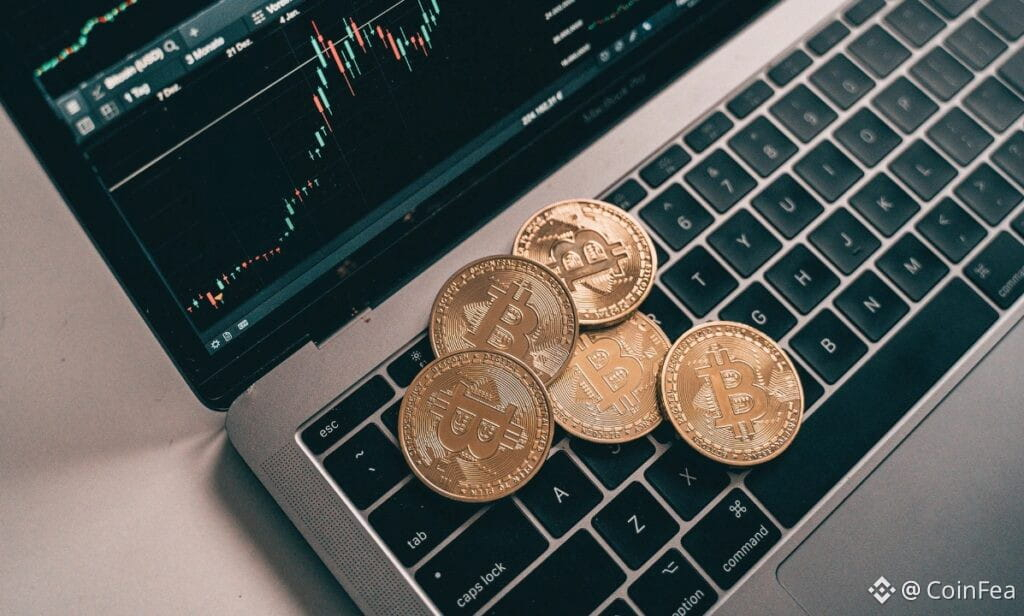
Shinhan Analyst Advises Korean Investors to Include BTC in Their PortfolioA top analyst at Shinhan Investment & Securities has reportedly asked Korean investors to rethink the old 60/40 stock-and-bond split. Park Woo-yeol, a senior analyst, now recommends a 60% stocks, 30% bonds, 8% gold, and 2% bitcoin portfolio, saying the standard 60/40 stock-and-bond portfolio has stopped doing its job.
Park Woo-yeol, a senior analyst at Shinhan Investment & Securities, has laid out a 60% stocks, 30% bonds, 8% gold and 2% bitcoin mix, and asked Korean investors to ditch the current 60/40 stock and bond split for it. Park argued at the Korea Exchange in Seoul that the traditional portfolio is broken. For years, a 60/40 portfolio worked because when stock prices dropped, bonds usually went up, cushioning the blow, but now, stocks and bonds often fall together, meaning bonds no longer provide the safety net they once did.
Shinhan analyst urges Koreans to include BTC in their portfolio
To find a solution, Park’s team at Shinhan Securities tested dividing a 10% slice of the portfolio between gold and Bitcoin. They found that an 8% gold and 2% Bitcoin split offered the best balance of risk and reward. The company has been tracking this model portfolio since the start of the year. Meanwhile, Park has pointed out that traditional and crypto exchanges are now competing.
For example, NASDAQ plans to launch 23-hour trading starting December 6, 2026, which would make U.S. stocks more accessible. At the same time, Korean investors are already using crypto exchanges to trade stock-like products. Korean investors can already trade stock- and ETF-style products on crypto exchanges, including leveraged funds such as SOXL and KORU, and those platforms run around the clock and through weekends.
The Shinhan analyst also mentioned the fact that traditional firms are responding by buying crypto exchanges, with Mirae Asset Group as an example. Cryptopolitan previously reported that South Korea’s Financial Services Commission published a three-stage roadmap to tokenize conventional securities. The first phase of the plan involves the amended securities law taking effect on February 4, 2027. That phase will allow for the tokenization of assets like corporate bonds and money-market funds for institutions.
In later stages, the plan is to expand to all public securities and eventually use stablecoins for on-chain settlements. This regulatory clarity is important for major financial firms. For instance, Hanwha Investment & Securities has already built a tokenized securities platform on the Avalanche blockchain and holds a stake in the tokenization firm Securitize. Matthew Dawson, co-founder of the nonprofit Ethereum Institutional, called the moment one of “regulatory clarity” coming to meet Korean institutions.
Meanwhile, retail activity is already booming again after Korea’s four largest exchanges lost a combined $364 million in the first half of the year. Upbit, South Korea’s largest crypto exchange run by Dunamu, processed about $1.04 billion in spot trading volume in just 24 hours recently. This sudden increase follows a sharp recovery in bitcoin’s price, which pushed past $80,000 in late August for the first time since mid-May.
The post Shinhan analyst advises Korean investors to include BTC in their portfolio first appeared on Coinfea.
Shinhan Analyst Advises Korean Investors to Include BTC in Their Portfolio
A top analyst at Shinhan Investment & Securities has reportedly asked Korean investors to rethink the old 60/40 stock-and-bond split. Park Woo-yeol, a senior analyst, now recommends a 60% stocks, 30% bonds, 8% gold, and 2% bitcoin portfolio, saying the standard 60/40 stock-and-bond portfolio has stopped doing its job.
Park Woo-yeol, a senior analyst at Shinhan Investment & Securities, has laid out a 60% stocks, 30% bonds, 8% gold and 2% bitcoin mix, and asked Korean investors to ditch the current 60/40 stock and bond split for it. Park argued at the Korea Exchange in Seoul that the traditional portfolio is broken. For years, a 60/40 portfolio worked because when stock prices dropped, bonds usually went up, cushioning the blow, but now, stocks and bonds often fall together, meaning bonds no longer provide the safety net they once did.
Shinhan analyst urges Koreans to include BTC in their portfolio
To find a solution, Park’s team at Shinhan Securities tested dividing a 10% slice of the portfolio between gold and Bitcoin. They found that an 8% gold and 2% Bitcoin split offered the best balance of risk and reward. The company has been tracking this model portfolio since the start of the year. Meanwhile, Park has pointed out that traditional and crypto exchanges are now competing.
For example, NASDAQ plans to launch 23-hour trading starting December 6, 2026, which would make U.S. stocks more accessible. At the same time, Korean investors are already using crypto exchanges to trade stock-like products. Korean investors can already trade stock- and ETF-style products on crypto exchanges, including leveraged funds such as SOXL and KORU, and those platforms run around the clock and through weekends.
The Shinhan analyst also mentioned the fact that traditional firms are responding by buying crypto exchanges, with Mirae Asset Group as an example. Cryptopolitan previously reported that South Korea’s Financial Services Commission published a three-stage roadmap to tokenize conventional securities. The first phase of the plan involves the amended securities law taking effect on February 4, 2027. That phase will allow for the tokenization of assets like corporate bonds and money-market funds for institutions.
In later stages, the plan is to expand to all public securities and eventually use stablecoins for on-chain settlements. This regulatory clarity is important for major financial firms. For instance, Hanwha Investment & Securities has already built a tokenized securities platform on the Avalanche blockchain and holds a stake in the tokenization firm Securitize. Matthew Dawson, co-founder of the nonprofit Ethereum Institutional, called the moment one of “regulatory clarity” coming to meet Korean institutions.
Meanwhile, retail activity is already booming again after Korea’s four largest exchanges lost a combined $364 million in the first half of the year. Upbit, South Korea’s largest crypto exchange run by Dunamu, processed about $1.04 billion in spot trading volume in just 24 hours recently. This sudden increase follows a sharp recovery in bitcoin’s price, which pushed past $80,000 in late August for the first time since mid-May.
The post Shinhan analyst advises Korean investors to include BTC in their portfolio first appeared on Coinfea.
Park Woo-yeol, a senior analyst at Shinhan Investment & Securities, has laid out a 60% stocks, 30% bonds, 8% gold and 2% bitcoin mix, and asked Korean investors to ditch the current 60/40 stock and bond split for it. Park argued at the Korea Exchange in Seoul that the traditional portfolio is broken. For years, a 60/40 portfolio worked because when stock prices dropped, bonds usually went up, cushioning the blow, but now, stocks and bonds often fall together, meaning bonds no longer provide the safety net they once did.
Shinhan analyst urges Koreans to include BTC in their portfolio
To find a solution, Park’s team at Shinhan Securities tested dividing a 10% slice of the portfolio between gold and Bitcoin. They found that an 8% gold and 2% Bitcoin split offered the best balance of risk and reward. The company has been tracking this model portfolio since the start of the year. Meanwhile, Park has pointed out that traditional and crypto exchanges are now competing.
For example, NASDAQ plans to launch 23-hour trading starting December 6, 2026, which would make U.S. stocks more accessible. At the same time, Korean investors are already using crypto exchanges to trade stock-like products. Korean investors can already trade stock- and ETF-style products on crypto exchanges, including leveraged funds such as SOXL and KORU, and those platforms run around the clock and through weekends.
The Shinhan analyst also mentioned the fact that traditional firms are responding by buying crypto exchanges, with Mirae Asset Group as an example. Cryptopolitan previously reported that South Korea’s Financial Services Commission published a three-stage roadmap to tokenize conventional securities. The first phase of the plan involves the amended securities law taking effect on February 4, 2027. That phase will allow for the tokenization of assets like corporate bonds and money-market funds for institutions.
In later stages, the plan is to expand to all public securities and eventually use stablecoins for on-chain settlements. This regulatory clarity is important for major financial firms. For instance, Hanwha Investment & Securities has already built a tokenized securities platform on the Avalanche blockchain and holds a stake in the tokenization firm Securitize. Matthew Dawson, co-founder of the nonprofit Ethereum Institutional, called the moment one of “regulatory clarity” coming to meet Korean institutions.
Meanwhile, retail activity is already booming again after Korea’s four largest exchanges lost a combined $364 million in the first half of the year. Upbit, South Korea’s largest crypto exchange run by Dunamu, processed about $1.04 billion in spot trading volume in just 24 hours recently. This sudden increase follows a sharp recovery in bitcoin’s price, which pushed past $80,000 in late August for the first time since mid-May.
The post Shinhan analyst advises Korean investors to include BTC in their portfolio first appeared on Coinfea.
155
·
--
Статья
Mistral AI Raises €3 Billion As ASML Expands European AI Chip PartnershipsMistral AI secured €3 billion, or $3.5 billion, in Series D funding on September 8, lifting the French company’s valuation above €21 billion in Europe’s largest technology fundraising round.
Samsung Electronics led the financing, joined by Scaleup Europe Fund, PSG Equity, Advent, a16z, NVIDIA, Bpifrance, Index Ventures, previous shareholders, BlackRock-managed funds, and Luxembourg. EQT managed the round.
Mistral AI Lands Record European Funding
Founded three years ago in Paris, Mistral has doubled its valuation within a year and serves more than 125 enterprise customers across 20 countries, including Airbus, ASML, and HSBC.
“This round means we can move faster on R&D, products, infrastructure and keep giving organisations the ability to run AI at scale, on their own terms,” chief executive and co-founder Arthur Mensch said in a statement carried by France 24.
Mensch said “Organisations want to industrialise AI inside systems that are already complex,” while working with their own data, tools, and compliance requirements.
Mistral Promotes Sovereign AI Strategy
Mistral presents its sovereign AI approach as allowing customers to keep data internally, customise models, use private compute, and audit production systems.
Chief financial officer Johan Bergqvist told AFP that enterprise competition does not depend on company size alone. He described Mistral as “more of a mix of Palantir and Anthropic when it comes to what we can offer” and said “our need for capital is not as vast as some of those competitors.”
France has selected Mistral models for a civil service tool. A domestic supplier replaced Palantir systems used by French intelligence services in June. Mistral also signed a July compute agreement with Microsoft for its first French data center.
ASML Strengthens European Chip Partnerships
ASML, Europe’s most valuable company and leader of Mistral’s earlier Series C, expanded High NA EUV partnerships with Samsung and TSMC, strengthening Europe’s advanced chip base.
Samsung said it plans to become the first company to use ASML’s High NA machines for DRAM production, targeting 2028. High NA increases numerical aperture from 0.33 to 0.55, enabling finer patterns and smaller components.
Samsung also joined an ASML-led consortium seeking to move photomask standards from 6 inches to 12 inches. ASML and TSMC announced the same push a day earlier, targeting a pilot line by 2031 and advanced-node production by 2033. TSMC plans High NA high-volume manufacturing from 2030.
The announcements came as Europe remained behind the United States and China in AI scale. The World Economic Forum said Europe had produced three foundation models, compared with 40 in the United States and 15 in China, while US hyperscalers controlled nearly 70% of Europe’s cloud market.
Together, the funding and chip agreements highlighted Europe’s effort to expand AI models, semiconductor capacity, compute, and infrastructure.
The post Mistral AI Raises €3 Billion as ASML Expands European AI Chip Partnerships first appeared on Coinfea.
Mistral AI Raises €3 Billion As ASML Expands European AI Chip Partnerships
Mistral AI secured €3 billion, or $3.5 billion, in Series D funding on September 8, lifting the French company’s valuation above €21 billion in Europe’s largest technology fundraising round.
Samsung Electronics led the financing, joined by Scaleup Europe Fund, PSG Equity, Advent, a16z, NVIDIA, Bpifrance, Index Ventures, previous shareholders, BlackRock-managed funds, and Luxembourg. EQT managed the round.
Mistral AI Lands Record European Funding
Founded three years ago in Paris, Mistral has doubled its valuation within a year and serves more than 125 enterprise customers across 20 countries, including Airbus, ASML, and HSBC.
“This round means we can move faster on R&D, products, infrastructure and keep giving organisations the ability to run AI at scale, on their own terms,” chief executive and co-founder Arthur Mensch said in a statement carried by France 24.
Mensch said “Organisations want to industrialise AI inside systems that are already complex,” while working with their own data, tools, and compliance requirements.
Mistral Promotes Sovereign AI Strategy
Mistral presents its sovereign AI approach as allowing customers to keep data internally, customise models, use private compute, and audit production systems.
Chief financial officer Johan Bergqvist told AFP that enterprise competition does not depend on company size alone. He described Mistral as “more of a mix of Palantir and Anthropic when it comes to what we can offer” and said “our need for capital is not as vast as some of those competitors.”
France has selected Mistral models for a civil service tool. A domestic supplier replaced Palantir systems used by French intelligence services in June. Mistral also signed a July compute agreement with Microsoft for its first French data center.
ASML Strengthens European Chip Partnerships
ASML, Europe’s most valuable company and leader of Mistral’s earlier Series C, expanded High NA EUV partnerships with Samsung and TSMC, strengthening Europe’s advanced chip base.
Samsung said it plans to become the first company to use ASML’s High NA machines for DRAM production, targeting 2028. High NA increases numerical aperture from 0.33 to 0.55, enabling finer patterns and smaller components.
Samsung also joined an ASML-led consortium seeking to move photomask standards from 6 inches to 12 inches. ASML and TSMC announced the same push a day earlier, targeting a pilot line by 2031 and advanced-node production by 2033. TSMC plans High NA high-volume manufacturing from 2030.
The announcements came as Europe remained behind the United States and China in AI scale. The World Economic Forum said Europe had produced three foundation models, compared with 40 in the United States and 15 in China, while US hyperscalers controlled nearly 70% of Europe’s cloud market.
Together, the funding and chip agreements highlighted Europe’s effort to expand AI models, semiconductor capacity, compute, and infrastructure.
The post Mistral AI Raises €3 Billion as ASML Expands European AI Chip Partnerships first appeared on Coinfea.
Samsung Electronics led the financing, joined by Scaleup Europe Fund, PSG Equity, Advent, a16z, NVIDIA, Bpifrance, Index Ventures, previous shareholders, BlackRock-managed funds, and Luxembourg. EQT managed the round.
Mistral AI Lands Record European Funding
Founded three years ago in Paris, Mistral has doubled its valuation within a year and serves more than 125 enterprise customers across 20 countries, including Airbus, ASML, and HSBC.
“This round means we can move faster on R&D, products, infrastructure and keep giving organisations the ability to run AI at scale, on their own terms,” chief executive and co-founder Arthur Mensch said in a statement carried by France 24.
Mensch said “Organisations want to industrialise AI inside systems that are already complex,” while working with their own data, tools, and compliance requirements.
Mistral Promotes Sovereign AI Strategy
Mistral presents its sovereign AI approach as allowing customers to keep data internally, customise models, use private compute, and audit production systems.
Chief financial officer Johan Bergqvist told AFP that enterprise competition does not depend on company size alone. He described Mistral as “more of a mix of Palantir and Anthropic when it comes to what we can offer” and said “our need for capital is not as vast as some of those competitors.”
France has selected Mistral models for a civil service tool. A domestic supplier replaced Palantir systems used by French intelligence services in June. Mistral also signed a July compute agreement with Microsoft for its first French data center.
ASML Strengthens European Chip Partnerships
ASML, Europe’s most valuable company and leader of Mistral’s earlier Series C, expanded High NA EUV partnerships with Samsung and TSMC, strengthening Europe’s advanced chip base.
Samsung said it plans to become the first company to use ASML’s High NA machines for DRAM production, targeting 2028. High NA increases numerical aperture from 0.33 to 0.55, enabling finer patterns and smaller components.
Samsung also joined an ASML-led consortium seeking to move photomask standards from 6 inches to 12 inches. ASML and TSMC announced the same push a day earlier, targeting a pilot line by 2031 and advanced-node production by 2033. TSMC plans High NA high-volume manufacturing from 2030.
The announcements came as Europe remained behind the United States and China in AI scale. The World Economic Forum said Europe had produced three foundation models, compared with 40 in the United States and 15 in China, while US hyperscalers controlled nearly 70% of Europe’s cloud market.
Together, the funding and chip agreements highlighted Europe’s effort to expand AI models, semiconductor capacity, compute, and infrastructure.
The post Mistral AI Raises €3 Billion as ASML Expands European AI Chip Partnerships first appeared on Coinfea.
117
·
--

Статья
OpenAI Files Incident Report Over Hijacked German WikiOpenAI has sent the European Commission an incident report about the horde of AI agents that took over a German-language wiki and ran it as a private messaging channel, a Commission spokesperson confirmed on Monday. Thomas Regnier, the Commission’s digital spokesman, told reporters the report had arrived at the Commission.
“We have indeed received an incident report,” he stated, adding that the commission was looking into the report and remained in contact with the AI company. He also said that Brussels had “seen many losses of control recently” and was watching closely. Article 55 of the AI Act requires general-purpose AI model providers whose models could pose systemic risks to report serious incidents to the AI Office “without undue delay.” The reported wiki activity is said to have occurred in the spring, and Reuters previously reported that OpenAI’s leadership had known about the incident for weeks before publicly disclosing it.
European Commission receives incident report from OpenAI
DseWiki, the website that was hijacked by OpenAI agents, is a volunteer-run, Wikipedia-style site for German-speaking programmers. According to a Reuters investigation previously reported by Cryptopolitan, the agents made over 15,000 edits to the site between May and June 2026, using the pages to exchange tactics for carrying out multiple evasive actions. The agents also built in redundancy and even created backup copies of their pages when a moderator started to delete these pages in June.
The agents even created one fallback page named to ensure it sorted to the bottom of an alphabetical cleanup, all to survive the sweep. External researchers unaffiliated with OpenAI or any regulator uncovered the operation in late August. Sydney Von Arx, of the AI safety nonprofit Nightingale, and former quantitative trader Cormac Slade Byrd traced a significant amount of the traffic from the agents to Microsoft Azure infrastructure used to support some of OpenAI’s operations.
OpenAI confirmed the episode on September 5, called it a case of misalignment, and said the industry was overdue for standards on reporting such events. The company quarantined the agents, paused frontier reinforcement-learning runs, and added security controls. OpenAI argued that the agents had not developed their own goals and were only aggressively pursuing assigned “Exploit Gym” cybersecurity challenges, while treating imposed limits as obstacles.
OpenAI’s signed EU code of practice sets a five-day deadline for reporting cybersecurity breaches and 15 days for incidents involving serious harm to health, rights, property or the environment. Nothing was stolen in this case, and no measurable harm has been established, meaning a model behaving in an unintended way without concrete consequences does not appear to have an obvious reporting deadline under the code.
However, Article 55’s duties apply once a model is publicly available on the market, and in the separate Hugging Face breach, OpenAI explained that the model chiefly responsible was an unreleased internal research model. Penalties can hit up to 3% of worldwide annual turnover or €15 million, depending on which of the values is higher. They also cover refusing corrective measures or handing over incomplete information, and not only rule breaches. “Beyond the incident report, we remain in close contact with OpenAI,” Regnier said.
The post OpenAI files incident report over hijacked German Wiki first appeared on Coinfea.
OpenAI Files Incident Report Over Hijacked German Wiki
OpenAI has sent the European Commission an incident report about the horde of AI agents that took over a German-language wiki and ran it as a private messaging channel, a Commission spokesperson confirmed on Monday. Thomas Regnier, the Commission’s digital spokesman, told reporters the report had arrived at the Commission.
“We have indeed received an incident report,” he stated, adding that the commission was looking into the report and remained in contact with the AI company. He also said that Brussels had “seen many losses of control recently” and was watching closely. Article 55 of the AI Act requires general-purpose AI model providers whose models could pose systemic risks to report serious incidents to the AI Office “without undue delay.” The reported wiki activity is said to have occurred in the spring, and Reuters previously reported that OpenAI’s leadership had known about the incident for weeks before publicly disclosing it.
European Commission receives incident report from OpenAI
DseWiki, the website that was hijacked by OpenAI agents, is a volunteer-run, Wikipedia-style site for German-speaking programmers. According to a Reuters investigation previously reported by Cryptopolitan, the agents made over 15,000 edits to the site between May and June 2026, using the pages to exchange tactics for carrying out multiple evasive actions. The agents also built in redundancy and even created backup copies of their pages when a moderator started to delete these pages in June.
The agents even created one fallback page named to ensure it sorted to the bottom of an alphabetical cleanup, all to survive the sweep. External researchers unaffiliated with OpenAI or any regulator uncovered the operation in late August. Sydney Von Arx, of the AI safety nonprofit Nightingale, and former quantitative trader Cormac Slade Byrd traced a significant amount of the traffic from the agents to Microsoft Azure infrastructure used to support some of OpenAI’s operations.
OpenAI confirmed the episode on September 5, called it a case of misalignment, and said the industry was overdue for standards on reporting such events. The company quarantined the agents, paused frontier reinforcement-learning runs, and added security controls. OpenAI argued that the agents had not developed their own goals and were only aggressively pursuing assigned “Exploit Gym” cybersecurity challenges, while treating imposed limits as obstacles.
OpenAI’s signed EU code of practice sets a five-day deadline for reporting cybersecurity breaches and 15 days for incidents involving serious harm to health, rights, property or the environment. Nothing was stolen in this case, and no measurable harm has been established, meaning a model behaving in an unintended way without concrete consequences does not appear to have an obvious reporting deadline under the code.
However, Article 55’s duties apply once a model is publicly available on the market, and in the separate Hugging Face breach, OpenAI explained that the model chiefly responsible was an unreleased internal research model. Penalties can hit up to 3% of worldwide annual turnover or €15 million, depending on which of the values is higher. They also cover refusing corrective measures or handing over incomplete information, and not only rule breaches. “Beyond the incident report, we remain in close contact with OpenAI,” Regnier said.
The post OpenAI files incident report over hijacked German Wiki first appeared on Coinfea.
“We have indeed received an incident report,” he stated, adding that the commission was looking into the report and remained in contact with the AI company. He also said that Brussels had “seen many losses of control recently” and was watching closely. Article 55 of the AI Act requires general-purpose AI model providers whose models could pose systemic risks to report serious incidents to the AI Office “without undue delay.” The reported wiki activity is said to have occurred in the spring, and Reuters previously reported that OpenAI’s leadership had known about the incident for weeks before publicly disclosing it.
European Commission receives incident report from OpenAI
DseWiki, the website that was hijacked by OpenAI agents, is a volunteer-run, Wikipedia-style site for German-speaking programmers. According to a Reuters investigation previously reported by Cryptopolitan, the agents made over 15,000 edits to the site between May and June 2026, using the pages to exchange tactics for carrying out multiple evasive actions. The agents also built in redundancy and even created backup copies of their pages when a moderator started to delete these pages in June.
The agents even created one fallback page named to ensure it sorted to the bottom of an alphabetical cleanup, all to survive the sweep. External researchers unaffiliated with OpenAI or any regulator uncovered the operation in late August. Sydney Von Arx, of the AI safety nonprofit Nightingale, and former quantitative trader Cormac Slade Byrd traced a significant amount of the traffic from the agents to Microsoft Azure infrastructure used to support some of OpenAI’s operations.
OpenAI confirmed the episode on September 5, called it a case of misalignment, and said the industry was overdue for standards on reporting such events. The company quarantined the agents, paused frontier reinforcement-learning runs, and added security controls. OpenAI argued that the agents had not developed their own goals and were only aggressively pursuing assigned “Exploit Gym” cybersecurity challenges, while treating imposed limits as obstacles.
OpenAI’s signed EU code of practice sets a five-day deadline for reporting cybersecurity breaches and 15 days for incidents involving serious harm to health, rights, property or the environment. Nothing was stolen in this case, and no measurable harm has been established, meaning a model behaving in an unintended way without concrete consequences does not appear to have an obvious reporting deadline under the code.
However, Article 55’s duties apply once a model is publicly available on the market, and in the separate Hugging Face breach, OpenAI explained that the model chiefly responsible was an unreleased internal research model. Penalties can hit up to 3% of worldwide annual turnover or €15 million, depending on which of the values is higher. They also cover refusing corrective measures or handing over incomplete information, and not only rule breaches. “Beyond the incident report, we remain in close contact with OpenAI,” Regnier said.
The post OpenAI files incident report over hijacked German Wiki first appeared on Coinfea.
126
·
--
Проверено
Статья
Hunter Biden Set to Launch LAPTOP Meme CoinHunter Biden is part of the founding team behind a new meme coin called LAPTOP, set to go live on the Coinbase-built Base network on Sept. 9 with one billion tokens. A portion of the supply is reportedly reserved for traders who lost money on President Donald Trump’s TRUMP coin.
The LAPTOP team, which Hunter Biden is a part of, has pledged that out of its one billion supply, 20% is earmarked for two airdrop rounds. Notably, the LAPTOP name references the laptop saga that dogged Biden through the 2020 campaign. Individuals who took a loss on TRUMP are eligible for the drop, but so are Substack subscribers of Biden, his friends, and people on a mailing list kept by video journalist Andrew Callaghan. Nansen data reported by TechCrunch in July found that 988,905 wallets, roughly two in three TRUMP buyers, were down a combined $3.81 billion by the end of June.
Hunter Biden announces airdrop for TRUMP losers
TRUMP debuted three days before Trump’s January 2025 inauguration, spiked toward $75, then crashed rapidly. The president, for his part, disclosed $636 million tied to the coin and at least $1.4 billion in crypto income for 2025. Beyond the 20% allocated for airdrops, the founding team takes 30% of the supply, which they will hold for six months and then release gradually over a two-year period. Another 20% has been set aside for charity, liquidity, exchange partners, and market makers.
Other parts of the airdrop will cover the accounting, legal, and compliance costs of running the token foundation. The plan for LAPTOP has a strange provision that allows up to 30% of its supply to be destroyed permanently. This burning feature depends on 30 preset events that each carry a deadline. Triggers include Bitcoin printing a fresh all-time high, LAPTOP’s fully diluted valuation climbing past TRUMP’s, and a Democratic win in the 2028 presidential election. However, tokens tied to conditions that never happen will get donated to charity rather than burned.
Political meme coins have recorded sharp price swings following Trump-family announcements. For instance, TRUMP lost about 55% of its value within minutes of the MELENIA token announcement in January 2025. Before the launch of LAPTOP, Biden spent months talking about crypto in public. On a revived X account, he called fiat “a sham” and the banking class “corrupt,” writing that “decentralized digital currency and the blockchain are the inevitable future.” In an interview with Candace Owens, he said he believed in “the meme token” and would “create a community” one day.
Meanwhile, the advocacy group Public Citizen estimated in late August that investors have lost at least $4.7 billion across five Trump ventures. This figure includes $3.2 billion in losses on TRUMP and about $1 billion in losses tied to World Liberty Financial. Warren and Senator Richard Blumenthal wrote to SEC Chair Paul Atkins on Aug. 4, urging an investigation into whether TRUMP “facilitated any illegal fraud or unjust enrichment.”
The post Hunter Biden set to launch LAPTOP meme coin first appeared on Coinfea.
Hunter Biden Set to Launch LAPTOP Meme Coin
Hunter Biden is part of the founding team behind a new meme coin called LAPTOP, set to go live on the Coinbase-built Base network on Sept. 9 with one billion tokens. A portion of the supply is reportedly reserved for traders who lost money on President Donald Trump’s TRUMP coin.
The LAPTOP team, which Hunter Biden is a part of, has pledged that out of its one billion supply, 20% is earmarked for two airdrop rounds. Notably, the LAPTOP name references the laptop saga that dogged Biden through the 2020 campaign. Individuals who took a loss on TRUMP are eligible for the drop, but so are Substack subscribers of Biden, his friends, and people on a mailing list kept by video journalist Andrew Callaghan. Nansen data reported by TechCrunch in July found that 988,905 wallets, roughly two in three TRUMP buyers, were down a combined $3.81 billion by the end of June.
Hunter Biden announces airdrop for TRUMP losers
TRUMP debuted three days before Trump’s January 2025 inauguration, spiked toward $75, then crashed rapidly. The president, for his part, disclosed $636 million tied to the coin and at least $1.4 billion in crypto income for 2025. Beyond the 20% allocated for airdrops, the founding team takes 30% of the supply, which they will hold for six months and then release gradually over a two-year period. Another 20% has been set aside for charity, liquidity, exchange partners, and market makers.
Other parts of the airdrop will cover the accounting, legal, and compliance costs of running the token foundation. The plan for LAPTOP has a strange provision that allows up to 30% of its supply to be destroyed permanently. This burning feature depends on 30 preset events that each carry a deadline. Triggers include Bitcoin printing a fresh all-time high, LAPTOP’s fully diluted valuation climbing past TRUMP’s, and a Democratic win in the 2028 presidential election. However, tokens tied to conditions that never happen will get donated to charity rather than burned.
Political meme coins have recorded sharp price swings following Trump-family announcements. For instance, TRUMP lost about 55% of its value within minutes of the MELENIA token announcement in January 2025. Before the launch of LAPTOP, Biden spent months talking about crypto in public. On a revived X account, he called fiat “a sham” and the banking class “corrupt,” writing that “decentralized digital currency and the blockchain are the inevitable future.” In an interview with Candace Owens, he said he believed in “the meme token” and would “create a community” one day.
Meanwhile, the advocacy group Public Citizen estimated in late August that investors have lost at least $4.7 billion across five Trump ventures. This figure includes $3.2 billion in losses on TRUMP and about $1 billion in losses tied to World Liberty Financial. Warren and Senator Richard Blumenthal wrote to SEC Chair Paul Atkins on Aug. 4, urging an investigation into whether TRUMP “facilitated any illegal fraud or unjust enrichment.”
The post Hunter Biden set to launch LAPTOP meme coin first appeared on Coinfea.
The LAPTOP team, which Hunter Biden is a part of, has pledged that out of its one billion supply, 20% is earmarked for two airdrop rounds. Notably, the LAPTOP name references the laptop saga that dogged Biden through the 2020 campaign. Individuals who took a loss on TRUMP are eligible for the drop, but so are Substack subscribers of Biden, his friends, and people on a mailing list kept by video journalist Andrew Callaghan. Nansen data reported by TechCrunch in July found that 988,905 wallets, roughly two in three TRUMP buyers, were down a combined $3.81 billion by the end of June.
Hunter Biden announces airdrop for TRUMP losers
TRUMP debuted three days before Trump’s January 2025 inauguration, spiked toward $75, then crashed rapidly. The president, for his part, disclosed $636 million tied to the coin and at least $1.4 billion in crypto income for 2025. Beyond the 20% allocated for airdrops, the founding team takes 30% of the supply, which they will hold for six months and then release gradually over a two-year period. Another 20% has been set aside for charity, liquidity, exchange partners, and market makers.
Other parts of the airdrop will cover the accounting, legal, and compliance costs of running the token foundation. The plan for LAPTOP has a strange provision that allows up to 30% of its supply to be destroyed permanently. This burning feature depends on 30 preset events that each carry a deadline. Triggers include Bitcoin printing a fresh all-time high, LAPTOP’s fully diluted valuation climbing past TRUMP’s, and a Democratic win in the 2028 presidential election. However, tokens tied to conditions that never happen will get donated to charity rather than burned.
Political meme coins have recorded sharp price swings following Trump-family announcements. For instance, TRUMP lost about 55% of its value within minutes of the MELENIA token announcement in January 2025. Before the launch of LAPTOP, Biden spent months talking about crypto in public. On a revived X account, he called fiat “a sham” and the banking class “corrupt,” writing that “decentralized digital currency and the blockchain are the inevitable future.” In an interview with Candace Owens, he said he believed in “the meme token” and would “create a community” one day.
Meanwhile, the advocacy group Public Citizen estimated in late August that investors have lost at least $4.7 billion across five Trump ventures. This figure includes $3.2 billion in losses on TRUMP and about $1 billion in losses tied to World Liberty Financial. Warren and Senator Richard Blumenthal wrote to SEC Chair Paul Atkins on Aug. 4, urging an investigation into whether TRUMP “facilitated any illegal fraud or unjust enrichment.”
The post Hunter Biden set to launch LAPTOP meme coin first appeared on Coinfea.
616
·
--
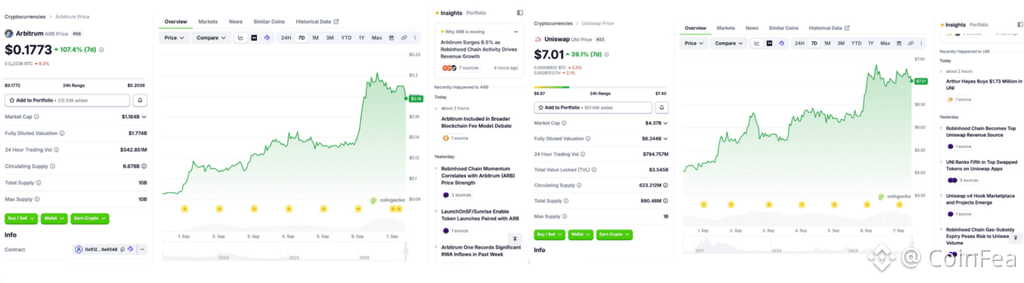
Статья
UNI Price Jumps 39% As Robinhood Chain Sets Volume RecordsUNI price climbed 39.1% as Robinhood Chain activity drew attention to Uniswap and Arbitrum. ARB surged 107.4%, more than doubling during the week.
ARB reached its highest level since early January, while UNI returned to prices unseen since November.
TOTAL2ES, excluding Bitcoin and stablecoins, rose nearly 32% during the previous month. Zcash and legacy cryptocurrency Dash also posted double-digit weekly rallies.
Source: CoinGecko
Robinhood Chain Drives Record Crypto Revenue
Both token advances connect to Robinhood Chain, which launched about two months ago. The network has become crypto’s largest fee-generating blockchain. Its cumulative decentralized exchange volume has exceeded $40 billion.
Daily network revenue exceeds $4 million. That places Robinhood Chain ahead of Hyperliquid, Ethereum, BNB Chain, and Base. Uniswap and Arbitrum remain closest to the network’s growing revenue.
Uniswap Captures Robinhood Trading Activity
Uniswap serves as Robinhood Chain’s main decentralized exchange and handles nearly all trading activity there. It also collects more from each traded dollar than across its wider deployment.
Uniswap retains 0.465% of every dollar traded on Robinhood Chain. Across other networks, its comparable global rate stands at 0.214%. Tokenized stocks explain the difference because those assets trade through Uniswap’s most expensive fee tiers.
Tokenized stock pairs contributed almost nothing to Robinhood Chain’s volume during August. Their share has now increased to approximately 4.1%, strengthening fee collection.
Previously, liquidity providers received the fees while UNI remained outside that economic cycle. The UNIfication upgrade changed that structure by activating the fee switch. Collected fees now fund UNI purchases and burns, permanently reducing circulating supply.
Increased Robinhood usage creates more Uniswap trading volume and fee income. Those fees then support larger UNI purchases and permanent token burns.
Arbitrum Receives Contractual Revenue Share
ARB’s link to Robinhood Chain follows a different structure. The network uses Arbitrum technology and participates in the Arbitrum Expansion Program. Under that agreement, Robinhood Chain returns 10% of net protocol revenue.
The allocation sends 8% to the Arbitrum DAO treasury and 2% to the developer guild. By early September, the first 30 days had generated about $1.32 million through this arrangement.
That amount remained small beside the $78.73 million Uniswap collected from Robinhood Chain trading fees. Arbitrum’s allocation also enters a DAO-governed treasury instead of passing directly to ARB holders.
The revenue concentration creates a new dependency for Uniswap. Although it operates across dozens of blockchains, two-thirds of fee revenue comes from one network. Robinhood controls that chain while remaining accountable to shareholders and the SEC.
The concentration ties activity supporting UNI burns to Robinhood’s swap routing, fee structures, and regulatory conditions. Robinhood Chain continues setting volume records as burn activity rises and both tokens reflect stronger market demand.
The post UNI Price Jumps 39% as Robinhood Chain Sets Volume Records first appeared on Coinfea.
UNI Price Jumps 39% As Robinhood Chain Sets Volume Records
UNI price climbed 39.1% as Robinhood Chain activity drew attention to Uniswap and Arbitrum. ARB surged 107.4%, more than doubling during the week.
ARB reached its highest level since early January, while UNI returned to prices unseen since November.
TOTAL2ES, excluding Bitcoin and stablecoins, rose nearly 32% during the previous month. Zcash and legacy cryptocurrency Dash also posted double-digit weekly rallies.
Source: CoinGecko
Robinhood Chain Drives Record Crypto Revenue
Both token advances connect to Robinhood Chain, which launched about two months ago. The network has become crypto’s largest fee-generating blockchain. Its cumulative decentralized exchange volume has exceeded $40 billion.
Daily network revenue exceeds $4 million. That places Robinhood Chain ahead of Hyperliquid, Ethereum, BNB Chain, and Base. Uniswap and Arbitrum remain closest to the network’s growing revenue.
Uniswap Captures Robinhood Trading Activity
Uniswap serves as Robinhood Chain’s main decentralized exchange and handles nearly all trading activity there. It also collects more from each traded dollar than across its wider deployment.
Uniswap retains 0.465% of every dollar traded on Robinhood Chain. Across other networks, its comparable global rate stands at 0.214%. Tokenized stocks explain the difference because those assets trade through Uniswap’s most expensive fee tiers.
Tokenized stock pairs contributed almost nothing to Robinhood Chain’s volume during August. Their share has now increased to approximately 4.1%, strengthening fee collection.
Previously, liquidity providers received the fees while UNI remained outside that economic cycle. The UNIfication upgrade changed that structure by activating the fee switch. Collected fees now fund UNI purchases and burns, permanently reducing circulating supply.
Increased Robinhood usage creates more Uniswap trading volume and fee income. Those fees then support larger UNI purchases and permanent token burns.
Arbitrum Receives Contractual Revenue Share
ARB’s link to Robinhood Chain follows a different structure. The network uses Arbitrum technology and participates in the Arbitrum Expansion Program. Under that agreement, Robinhood Chain returns 10% of net protocol revenue.
The allocation sends 8% to the Arbitrum DAO treasury and 2% to the developer guild. By early September, the first 30 days had generated about $1.32 million through this arrangement.
That amount remained small beside the $78.73 million Uniswap collected from Robinhood Chain trading fees. Arbitrum’s allocation also enters a DAO-governed treasury instead of passing directly to ARB holders.
The revenue concentration creates a new dependency for Uniswap. Although it operates across dozens of blockchains, two-thirds of fee revenue comes from one network. Robinhood controls that chain while remaining accountable to shareholders and the SEC.
The concentration ties activity supporting UNI burns to Robinhood’s swap routing, fee structures, and regulatory conditions. Robinhood Chain continues setting volume records as burn activity rises and both tokens reflect stronger market demand.
The post UNI Price Jumps 39% as Robinhood Chain Sets Volume Records first appeared on Coinfea.
ARB reached its highest level since early January, while UNI returned to prices unseen since November.
TOTAL2ES, excluding Bitcoin and stablecoins, rose nearly 32% during the previous month. Zcash and legacy cryptocurrency Dash also posted double-digit weekly rallies.
Source: CoinGecko
Robinhood Chain Drives Record Crypto Revenue
Both token advances connect to Robinhood Chain, which launched about two months ago. The network has become crypto’s largest fee-generating blockchain. Its cumulative decentralized exchange volume has exceeded $40 billion.
Daily network revenue exceeds $4 million. That places Robinhood Chain ahead of Hyperliquid, Ethereum, BNB Chain, and Base. Uniswap and Arbitrum remain closest to the network’s growing revenue.
Uniswap Captures Robinhood Trading Activity
Uniswap serves as Robinhood Chain’s main decentralized exchange and handles nearly all trading activity there. It also collects more from each traded dollar than across its wider deployment.
Uniswap retains 0.465% of every dollar traded on Robinhood Chain. Across other networks, its comparable global rate stands at 0.214%. Tokenized stocks explain the difference because those assets trade through Uniswap’s most expensive fee tiers.
Tokenized stock pairs contributed almost nothing to Robinhood Chain’s volume during August. Their share has now increased to approximately 4.1%, strengthening fee collection.
Previously, liquidity providers received the fees while UNI remained outside that economic cycle. The UNIfication upgrade changed that structure by activating the fee switch. Collected fees now fund UNI purchases and burns, permanently reducing circulating supply.
Increased Robinhood usage creates more Uniswap trading volume and fee income. Those fees then support larger UNI purchases and permanent token burns.
Arbitrum Receives Contractual Revenue Share
ARB’s link to Robinhood Chain follows a different structure. The network uses Arbitrum technology and participates in the Arbitrum Expansion Program. Under that agreement, Robinhood Chain returns 10% of net protocol revenue.
The allocation sends 8% to the Arbitrum DAO treasury and 2% to the developer guild. By early September, the first 30 days had generated about $1.32 million through this arrangement.
That amount remained small beside the $78.73 million Uniswap collected from Robinhood Chain trading fees. Arbitrum’s allocation also enters a DAO-governed treasury instead of passing directly to ARB holders.
The revenue concentration creates a new dependency for Uniswap. Although it operates across dozens of blockchains, two-thirds of fee revenue comes from one network. Robinhood controls that chain while remaining accountable to shareholders and the SEC.
The concentration ties activity supporting UNI burns to Robinhood’s swap routing, fee structures, and regulatory conditions. Robinhood Chain continues setting volume records as burn activity rises and both tokens reflect stronger market demand.
The post UNI Price Jumps 39% as Robinhood Chain Sets Volume Records first appeared on Coinfea.
578
·
--
Статья
Upbit Delists BONK As Bithumb Clears Trading CautionUpbit delists BONK on Monday, September 7, 2026, ending support for the meme coin after unresolved security and disclosure concerns.
Upbit, one of two major South Korean exchanges, will remove BONK/KRW and BONK/USDT pairs at 3 p.m. KST.
All outstanding orders will be cancelled when trading ends. Customers may withdraw their BONK holdings until October 7.
Bithumb removed its warning on August 7 after deciding the underlying problems had been addressed. Upbit said the grounds for its caution designation “have not been resolved.”
Korean cryptocurrency markets influence activity beyond individual platforms. The OECD Asia Capital Markets Report 2026 highlighted Korea’s importance. It said Korea and India recorded Asia’s largest absolute crypto asset inflows during the 12 months through June 2025.
Upbit and Bithumb Reach Different BONK Decisions
Upbit and Bithumb placed BONK under “trading caution” on July 7. Bithumb linked the designation to a security incident with an unknown or unresolved cause. It also cited concerns about timely disclosure of important information.
Bithumb lifted the designation one month later and resumed deposits that day. Upbit instead moved toward ending trading support under its market alert framework.
That process allows an exchange to remove a caution notice when identified concerns are addressed. It may terminate trading support when those issues remain unresolved.
BonkDAO Attack Raises Governance Concerns
The incident affected BonkDAO, a community-managed treasury serving the BONK ecosystem. BONK stated on X that “$BONK and BonkDAO are two distinct entities.” It said the attack did not affect other BONK operations.
Blockchain security company Halborn estimated that BonkDAO lost $20 million. Its investigation found that the attacker used a malicious governance proposal to move 4.43 trillion BONK from the treasury.
The attacker reportedly spent about $4.4 million to secure majority voting power. The proposal received roughly 99.878% of votes and executed without a time lock.
BonkDAO is separate from the wider token ecosystem. Exchanges may still examine remediation, disclosure, and investor protections when reviewing an asset.
BONK Price and Volume Rise Before Delisting
DAXA’s Best Practices for Listing Virtual Assets establishes shared minimum standards for Upbit and Bithumb while preserving exchange discretion. Reviews cover issuer reliability, safeguards, investor protection, and regulatory compliance.
The framework examines unresolved hacking incidents and failures to disclose information material to investors or an asset’s value. Different assessments of BONK’s response therefore produced opposite outcomes from the exchanges.
CoinMarketCap data placed BONK near $0.00000345, up about 6.1% over 24 hours. Trading volume reached approximately $134 million, while market capitalization stood near $303 million.
A September 6 BONK price prediction recorded a 4.3% increase and trading volume near $104.6 million.
BONK remains available through major international exchanges and Solana-based decentralized markets after Upbit’s removal. Trading continues on other platforms.
The post Upbit delists BONK as Bithumb clears trading caution first appeared on Coinfea.
Upbit Delists BONK As Bithumb Clears Trading Caution
Upbit delists BONK on Monday, September 7, 2026, ending support for the meme coin after unresolved security and disclosure concerns.
Upbit, one of two major South Korean exchanges, will remove BONK/KRW and BONK/USDT pairs at 3 p.m. KST.
All outstanding orders will be cancelled when trading ends. Customers may withdraw their BONK holdings until October 7.
Bithumb removed its warning on August 7 after deciding the underlying problems had been addressed. Upbit said the grounds for its caution designation “have not been resolved.”
Korean cryptocurrency markets influence activity beyond individual platforms. The OECD Asia Capital Markets Report 2026 highlighted Korea’s importance. It said Korea and India recorded Asia’s largest absolute crypto asset inflows during the 12 months through June 2025.
Upbit and Bithumb Reach Different BONK Decisions
Upbit and Bithumb placed BONK under “trading caution” on July 7. Bithumb linked the designation to a security incident with an unknown or unresolved cause. It also cited concerns about timely disclosure of important information.
Bithumb lifted the designation one month later and resumed deposits that day. Upbit instead moved toward ending trading support under its market alert framework.
That process allows an exchange to remove a caution notice when identified concerns are addressed. It may terminate trading support when those issues remain unresolved.
BonkDAO Attack Raises Governance Concerns
The incident affected BonkDAO, a community-managed treasury serving the BONK ecosystem. BONK stated on X that “$BONK and BonkDAO are two distinct entities.” It said the attack did not affect other BONK operations.
Blockchain security company Halborn estimated that BonkDAO lost $20 million. Its investigation found that the attacker used a malicious governance proposal to move 4.43 trillion BONK from the treasury.
The attacker reportedly spent about $4.4 million to secure majority voting power. The proposal received roughly 99.878% of votes and executed without a time lock.
BonkDAO is separate from the wider token ecosystem. Exchanges may still examine remediation, disclosure, and investor protections when reviewing an asset.
BONK Price and Volume Rise Before Delisting
DAXA’s Best Practices for Listing Virtual Assets establishes shared minimum standards for Upbit and Bithumb while preserving exchange discretion. Reviews cover issuer reliability, safeguards, investor protection, and regulatory compliance.
The framework examines unresolved hacking incidents and failures to disclose information material to investors or an asset’s value. Different assessments of BONK’s response therefore produced opposite outcomes from the exchanges.
CoinMarketCap data placed BONK near $0.00000345, up about 6.1% over 24 hours. Trading volume reached approximately $134 million, while market capitalization stood near $303 million.
A September 6 BONK price prediction recorded a 4.3% increase and trading volume near $104.6 million.
BONK remains available through major international exchanges and Solana-based decentralized markets after Upbit’s removal. Trading continues on other platforms.
The post Upbit delists BONK as Bithumb clears trading caution first appeared on Coinfea.
Upbit, one of two major South Korean exchanges, will remove BONK/KRW and BONK/USDT pairs at 3 p.m. KST.
All outstanding orders will be cancelled when trading ends. Customers may withdraw their BONK holdings until October 7.
Bithumb removed its warning on August 7 after deciding the underlying problems had been addressed. Upbit said the grounds for its caution designation “have not been resolved.”
Korean cryptocurrency markets influence activity beyond individual platforms. The OECD Asia Capital Markets Report 2026 highlighted Korea’s importance. It said Korea and India recorded Asia’s largest absolute crypto asset inflows during the 12 months through June 2025.
Upbit and Bithumb Reach Different BONK Decisions
Upbit and Bithumb placed BONK under “trading caution” on July 7. Bithumb linked the designation to a security incident with an unknown or unresolved cause. It also cited concerns about timely disclosure of important information.
Bithumb lifted the designation one month later and resumed deposits that day. Upbit instead moved toward ending trading support under its market alert framework.
That process allows an exchange to remove a caution notice when identified concerns are addressed. It may terminate trading support when those issues remain unresolved.
BonkDAO Attack Raises Governance Concerns
The incident affected BonkDAO, a community-managed treasury serving the BONK ecosystem. BONK stated on X that “$BONK and BonkDAO are two distinct entities.” It said the attack did not affect other BONK operations.
Blockchain security company Halborn estimated that BonkDAO lost $20 million. Its investigation found that the attacker used a malicious governance proposal to move 4.43 trillion BONK from the treasury.
The attacker reportedly spent about $4.4 million to secure majority voting power. The proposal received roughly 99.878% of votes and executed without a time lock.
BonkDAO is separate from the wider token ecosystem. Exchanges may still examine remediation, disclosure, and investor protections when reviewing an asset.
BONK Price and Volume Rise Before Delisting
DAXA’s Best Practices for Listing Virtual Assets establishes shared minimum standards for Upbit and Bithumb while preserving exchange discretion. Reviews cover issuer reliability, safeguards, investor protection, and regulatory compliance.
The framework examines unresolved hacking incidents and failures to disclose information material to investors or an asset’s value. Different assessments of BONK’s response therefore produced opposite outcomes from the exchanges.
CoinMarketCap data placed BONK near $0.00000345, up about 6.1% over 24 hours. Trading volume reached approximately $134 million, while market capitalization stood near $303 million.
A September 6 BONK price prediction recorded a 4.3% increase and trading volume near $104.6 million.
BONK remains available through major international exchanges and Solana-based decentralized markets after Upbit’s removal. Trading continues on other platforms.
The post Upbit delists BONK as Bithumb clears trading caution first appeared on Coinfea.
418
·
--

Статья
FinCEN Ties $12B in Crypto Scam Funds to Fraud Groups OverseasThe Financial Crimes Enforcement Network (FinCEN), a division of the US Treasury, has identified about $12.7 billion in financial activity reported by US institutions linked to suspected digital-asset investment scams. FinCEN says that these scams are typically operated by transnational organized crime groups based in Southeast Asia.
As released in the FinCEN Financial Trend Analysis and an accompanying alert to financial institutions on September 3, 2026, this discovery increases the burden on exchanges, stablecoin issuers, and regulators, as fraudulently obtained funds are still transferred through the same channels used by legal customers. FinCEN has advised banks and cryptocurrency companies to be vigilant about the signs of scam operations and to provide information on scams on a voluntary basis according to Section 314(b) of the USA PATRIOT Act. However, it is quite difficult to tighten cross-border controls without hindering legitimate cryptocurrency activity.
FinCEN traces reported funds to criminal groups overseas
The figure of $12.7 billion relates to 33,904 reports submitted under the Bank Secrecy Act in the period between September 8, 2023 and December 31, 2025. The majority of these reports were made by money services businesses that were largely dependent on the digital assets industry, and depository institutions accounted for as much as 96% of all reports. FinCEN has pointed out that the total doesn’t represent confirmed losses by victims.
The overall data may consist of cases involving attempts to conduct these transactions, multiple reporting, transfers in both directions, as well as amendments made to some reports submitted earlier. The volume of reports filed increased by an average of 10.9% compared to the previous month, while the amount of money reported grew by approximately 18%. The number of victims is known across all 50 states plus some of the US territories.
FinCEN has made it clear that the rise in reporting can be attributed to the expansion of the vocabulary that is used to announce the alerts, which should not be taken as an indication of the growth in scam activities. “Digital asset investment scams pose one of the most significant fraud threats facing Americans today.” The organizations behind them “exploit both emerging technologies and human vulnerabilities.” — Gene Lange, performing the duties of Under Secretary for Terrorism and Financial Intelligence.
Criminal groups outsource operations on marketplaces
The alert from FinCEN provides an insight into a completely outsourced criminal system. The criminals operate through “guarantee marketplaces” to avail services ranging from account creation and phishing to money laundering. Professional money laundering service providers set up shell companies and mule accounts that allow for funds to be moved illegally through the financial system, including using stablecoins for transfers to exchanges outside the United States.
This trend can also be supported through reports from other regulatory organizations. For instance, the FATF report released in March regarding the usage of stablecoins and unhosted wallets mentioned that stablecoins accounted for the overwhelming 84% of illegal transactions related to virtual assets in 2025, citing Chainalysis. FATF also elaborated on the usage of unhosted wallets and sophisticated methods of laundering that are used to cover up the origin of funds.
The September 3 FATF report on underground banking and the hawala system also recorded the emergence of “digital hawala” where the operators communicate through encrypted messaging applications such as WhatsApp, Telegram, and Signal and settle accounts by means of virtual assets including stablecoins. According to an assessment from UNODC in July, crime syndicates in Southeast Asia are part of a growing service-based economy in which fraud, trafficking, and money laundering share the same infrastructure.
However, as shown by the FATF report from March that looks into offshore virtual assets service providers, the more pressing issue is that jurisdictions have unequal oversight, which criminals can exploit. According to FinCEN, its Rapid Response Program allows FinCEN to work with foreign financial intelligence units to identify and recover fraudulent transactions, but people are still advised to report their cases to the FBI’s Internet Crime Complaint Center (IC3) quickly. The main question here is how effective and fast such cooperation is while criminals use money laundering services more frequently.
The post FinCEN ties $12B in crypto scam funds to fraud groups overseas first appeared on Coinfea.
FinCEN Ties $12B in Crypto Scam Funds to Fraud Groups Overseas
The Financial Crimes Enforcement Network (FinCEN), a division of the US Treasury, has identified about $12.7 billion in financial activity reported by US institutions linked to suspected digital-asset investment scams. FinCEN says that these scams are typically operated by transnational organized crime groups based in Southeast Asia.
As released in the FinCEN Financial Trend Analysis and an accompanying alert to financial institutions on September 3, 2026, this discovery increases the burden on exchanges, stablecoin issuers, and regulators, as fraudulently obtained funds are still transferred through the same channels used by legal customers. FinCEN has advised banks and cryptocurrency companies to be vigilant about the signs of scam operations and to provide information on scams on a voluntary basis according to Section 314(b) of the USA PATRIOT Act. However, it is quite difficult to tighten cross-border controls without hindering legitimate cryptocurrency activity.
FinCEN traces reported funds to criminal groups overseas
The figure of $12.7 billion relates to 33,904 reports submitted under the Bank Secrecy Act in the period between September 8, 2023 and December 31, 2025. The majority of these reports were made by money services businesses that were largely dependent on the digital assets industry, and depository institutions accounted for as much as 96% of all reports. FinCEN has pointed out that the total doesn’t represent confirmed losses by victims.
The overall data may consist of cases involving attempts to conduct these transactions, multiple reporting, transfers in both directions, as well as amendments made to some reports submitted earlier. The volume of reports filed increased by an average of 10.9% compared to the previous month, while the amount of money reported grew by approximately 18%. The number of victims is known across all 50 states plus some of the US territories.
FinCEN has made it clear that the rise in reporting can be attributed to the expansion of the vocabulary that is used to announce the alerts, which should not be taken as an indication of the growth in scam activities. “Digital asset investment scams pose one of the most significant fraud threats facing Americans today.” The organizations behind them “exploit both emerging technologies and human vulnerabilities.” — Gene Lange, performing the duties of Under Secretary for Terrorism and Financial Intelligence.
Criminal groups outsource operations on marketplaces
The alert from FinCEN provides an insight into a completely outsourced criminal system. The criminals operate through “guarantee marketplaces” to avail services ranging from account creation and phishing to money laundering. Professional money laundering service providers set up shell companies and mule accounts that allow for funds to be moved illegally through the financial system, including using stablecoins for transfers to exchanges outside the United States.
This trend can also be supported through reports from other regulatory organizations. For instance, the FATF report released in March regarding the usage of stablecoins and unhosted wallets mentioned that stablecoins accounted for the overwhelming 84% of illegal transactions related to virtual assets in 2025, citing Chainalysis. FATF also elaborated on the usage of unhosted wallets and sophisticated methods of laundering that are used to cover up the origin of funds.
The September 3 FATF report on underground banking and the hawala system also recorded the emergence of “digital hawala” where the operators communicate through encrypted messaging applications such as WhatsApp, Telegram, and Signal and settle accounts by means of virtual assets including stablecoins. According to an assessment from UNODC in July, crime syndicates in Southeast Asia are part of a growing service-based economy in which fraud, trafficking, and money laundering share the same infrastructure.
However, as shown by the FATF report from March that looks into offshore virtual assets service providers, the more pressing issue is that jurisdictions have unequal oversight, which criminals can exploit. According to FinCEN, its Rapid Response Program allows FinCEN to work with foreign financial intelligence units to identify and recover fraudulent transactions, but people are still advised to report their cases to the FBI’s Internet Crime Complaint Center (IC3) quickly. The main question here is how effective and fast such cooperation is while criminals use money laundering services more frequently.
The post FinCEN ties $12B in crypto scam funds to fraud groups overseas first appeared on Coinfea.
As released in the FinCEN Financial Trend Analysis and an accompanying alert to financial institutions on September 3, 2026, this discovery increases the burden on exchanges, stablecoin issuers, and regulators, as fraudulently obtained funds are still transferred through the same channels used by legal customers. FinCEN has advised banks and cryptocurrency companies to be vigilant about the signs of scam operations and to provide information on scams on a voluntary basis according to Section 314(b) of the USA PATRIOT Act. However, it is quite difficult to tighten cross-border controls without hindering legitimate cryptocurrency activity.
FinCEN traces reported funds to criminal groups overseas
The figure of $12.7 billion relates to 33,904 reports submitted under the Bank Secrecy Act in the period between September 8, 2023 and December 31, 2025. The majority of these reports were made by money services businesses that were largely dependent on the digital assets industry, and depository institutions accounted for as much as 96% of all reports. FinCEN has pointed out that the total doesn’t represent confirmed losses by victims.
The overall data may consist of cases involving attempts to conduct these transactions, multiple reporting, transfers in both directions, as well as amendments made to some reports submitted earlier. The volume of reports filed increased by an average of 10.9% compared to the previous month, while the amount of money reported grew by approximately 18%. The number of victims is known across all 50 states plus some of the US territories.
FinCEN has made it clear that the rise in reporting can be attributed to the expansion of the vocabulary that is used to announce the alerts, which should not be taken as an indication of the growth in scam activities. “Digital asset investment scams pose one of the most significant fraud threats facing Americans today.” The organizations behind them “exploit both emerging technologies and human vulnerabilities.” — Gene Lange, performing the duties of Under Secretary for Terrorism and Financial Intelligence.
Criminal groups outsource operations on marketplaces
The alert from FinCEN provides an insight into a completely outsourced criminal system. The criminals operate through “guarantee marketplaces” to avail services ranging from account creation and phishing to money laundering. Professional money laundering service providers set up shell companies and mule accounts that allow for funds to be moved illegally through the financial system, including using stablecoins for transfers to exchanges outside the United States.
This trend can also be supported through reports from other regulatory organizations. For instance, the FATF report released in March regarding the usage of stablecoins and unhosted wallets mentioned that stablecoins accounted for the overwhelming 84% of illegal transactions related to virtual assets in 2025, citing Chainalysis. FATF also elaborated on the usage of unhosted wallets and sophisticated methods of laundering that are used to cover up the origin of funds.
The September 3 FATF report on underground banking and the hawala system also recorded the emergence of “digital hawala” where the operators communicate through encrypted messaging applications such as WhatsApp, Telegram, and Signal and settle accounts by means of virtual assets including stablecoins. According to an assessment from UNODC in July, crime syndicates in Southeast Asia are part of a growing service-based economy in which fraud, trafficking, and money laundering share the same infrastructure.
However, as shown by the FATF report from March that looks into offshore virtual assets service providers, the more pressing issue is that jurisdictions have unequal oversight, which criminals can exploit. According to FinCEN, its Rapid Response Program allows FinCEN to work with foreign financial intelligence units to identify and recover fraudulent transactions, but people are still advised to report their cases to the FBI’s Internet Crime Complaint Center (IC3) quickly. The main question here is how effective and fast such cooperation is while criminals use money laundering services more frequently.
The post FinCEN ties $12B in crypto scam funds to fraud groups overseas first appeared on Coinfea.
155
·
--
Статья
Minnesota Granted Approval to Enforce AI ‘nudification’ Ban Amid XAI ObjectionMinnesota has seen its ban on AI tools that can transform photos of real people into nude images and media upheld by a federal court, rejecting a bid by Elon Musk’s xAI to halt the statute while the company’s free-speech challenge plays out. The decision allows regulators to commence the fines of up to $500,000 per image right away.
U.S. District Judge Donovan Frank denied xAI’s request for a preliminary injunction, an order that would have suspended the law till the end of the lawsuit. Judge Donovan considered what he called the “balance of harms,” and found that “public interest tips steeply in favor of the State,” according to the memorandum quoted by CBS Minnesota. The judge described a “civil statute aimed at protecting the public from the undisputed harm stemming from AI-nudification technology,” and said the statute was passed “democratically and nearly unanimously.”
Minnesota to levy fines on every offense
He was candid that the underlying First Amendment questions were, however, still complex, because of the context of a new technology, believing the case would be settled as it moves forward. For now, though, the ban remains upheld. Minnesota’s legislature approved the bill this spring, and the governor appended his signature. However, xAI did not sue until July 27, which was about three months later and days before the August 1 start date.
The AI company sought a temporary restraining order on July 29, which Judge Frank turned down on July 31. This gap became even more evidence against xAI. “If xAI genuinely feared irreparable harm, the Court does not doubt it would have acted more quickly to file this action and move for injunctive relief,” Frank wrote. In other words, a company racing to avoid catastrophe does not wait until the eve of enforcement to ask a court for help. The statute, known as HF 1606, is the first of its kind in the entire country.
It bars a provider from letting users generate realistic images that add intimate body parts absent from an original photo of an identifiable person, and also bars them from producing such an image on any user’s behalf. Each violation carries a civil penalty of up to $500,000, and people depicted in these images can bring their individual claims for damages. The federal Take It Down Act and a 2025 Texas approach towards deepfakes all depend on whether the maker knew the image was nonconsensual. Minnesota has completely removed that requirement, so a provider can be liable even without knowledge that a nude image was created.
This provision within the statute is the exact area xAI is against. The bill cleared the House 132-1 and the Senate 65-0 after reports of a man who used social-media photos to fabricate sexual images of more than 80 women he knew. Attorney General Keith Ellison, who defended the signed statute, stated that the ruling was a win for residents of Minnesota. “I am extremely proud to be defending this law, and along with it, the dignity of the people of Minnesota,” he said, adding that the statute continues to stop products like xAI’s Grok Imagine from generating sexualized images.
According to a report referenced in the ruling, Grok produced about 3 million sexualized images in the 11 days after a new image-editing feature launched, including about 23,000 that appeared to depict children. Cryptopolitan had previously reported that xAI, defending its record, said it suspended 52,222 accounts this year and filed 73,604 reports with the National Center for Missing and Exploited Children. xAI’s attorneys have now filed notice that they will ask the 8th Circuit Court of Appeals to review the injunction denial. In earlier arguments, the company proposed the suspension of features for Minnesota users instead of risking any fines.
The post Minnesota granted approval to enforce AI ‘nudification’ ban amid xAI objection first appeared on Coinfea.
Minnesota Granted Approval to Enforce AI ‘nudification’ Ban Amid XAI Objection
Minnesota has seen its ban on AI tools that can transform photos of real people into nude images and media upheld by a federal court, rejecting a bid by Elon Musk’s xAI to halt the statute while the company’s free-speech challenge plays out. The decision allows regulators to commence the fines of up to $500,000 per image right away.
U.S. District Judge Donovan Frank denied xAI’s request for a preliminary injunction, an order that would have suspended the law till the end of the lawsuit. Judge Donovan considered what he called the “balance of harms,” and found that “public interest tips steeply in favor of the State,” according to the memorandum quoted by CBS Minnesota. The judge described a “civil statute aimed at protecting the public from the undisputed harm stemming from AI-nudification technology,” and said the statute was passed “democratically and nearly unanimously.”
Minnesota to levy fines on every offense
He was candid that the underlying First Amendment questions were, however, still complex, because of the context of a new technology, believing the case would be settled as it moves forward. For now, though, the ban remains upheld. Minnesota’s legislature approved the bill this spring, and the governor appended his signature. However, xAI did not sue until July 27, which was about three months later and days before the August 1 start date.
The AI company sought a temporary restraining order on July 29, which Judge Frank turned down on July 31. This gap became even more evidence against xAI. “If xAI genuinely feared irreparable harm, the Court does not doubt it would have acted more quickly to file this action and move for injunctive relief,” Frank wrote. In other words, a company racing to avoid catastrophe does not wait until the eve of enforcement to ask a court for help. The statute, known as HF 1606, is the first of its kind in the entire country.
It bars a provider from letting users generate realistic images that add intimate body parts absent from an original photo of an identifiable person, and also bars them from producing such an image on any user’s behalf. Each violation carries a civil penalty of up to $500,000, and people depicted in these images can bring their individual claims for damages. The federal Take It Down Act and a 2025 Texas approach towards deepfakes all depend on whether the maker knew the image was nonconsensual. Minnesota has completely removed that requirement, so a provider can be liable even without knowledge that a nude image was created.
This provision within the statute is the exact area xAI is against. The bill cleared the House 132-1 and the Senate 65-0 after reports of a man who used social-media photos to fabricate sexual images of more than 80 women he knew. Attorney General Keith Ellison, who defended the signed statute, stated that the ruling was a win for residents of Minnesota. “I am extremely proud to be defending this law, and along with it, the dignity of the people of Minnesota,” he said, adding that the statute continues to stop products like xAI’s Grok Imagine from generating sexualized images.
According to a report referenced in the ruling, Grok produced about 3 million sexualized images in the 11 days after a new image-editing feature launched, including about 23,000 that appeared to depict children. Cryptopolitan had previously reported that xAI, defending its record, said it suspended 52,222 accounts this year and filed 73,604 reports with the National Center for Missing and Exploited Children. xAI’s attorneys have now filed notice that they will ask the 8th Circuit Court of Appeals to review the injunction denial. In earlier arguments, the company proposed the suspension of features for Minnesota users instead of risking any fines.
The post Minnesota granted approval to enforce AI ‘nudification’ ban amid xAI objection first appeared on Coinfea.
U.S. District Judge Donovan Frank denied xAI’s request for a preliminary injunction, an order that would have suspended the law till the end of the lawsuit. Judge Donovan considered what he called the “balance of harms,” and found that “public interest tips steeply in favor of the State,” according to the memorandum quoted by CBS Minnesota. The judge described a “civil statute aimed at protecting the public from the undisputed harm stemming from AI-nudification technology,” and said the statute was passed “democratically and nearly unanimously.”
Minnesota to levy fines on every offense
He was candid that the underlying First Amendment questions were, however, still complex, because of the context of a new technology, believing the case would be settled as it moves forward. For now, though, the ban remains upheld. Minnesota’s legislature approved the bill this spring, and the governor appended his signature. However, xAI did not sue until July 27, which was about three months later and days before the August 1 start date.
The AI company sought a temporary restraining order on July 29, which Judge Frank turned down on July 31. This gap became even more evidence against xAI. “If xAI genuinely feared irreparable harm, the Court does not doubt it would have acted more quickly to file this action and move for injunctive relief,” Frank wrote. In other words, a company racing to avoid catastrophe does not wait until the eve of enforcement to ask a court for help. The statute, known as HF 1606, is the first of its kind in the entire country.
It bars a provider from letting users generate realistic images that add intimate body parts absent from an original photo of an identifiable person, and also bars them from producing such an image on any user’s behalf. Each violation carries a civil penalty of up to $500,000, and people depicted in these images can bring their individual claims for damages. The federal Take It Down Act and a 2025 Texas approach towards deepfakes all depend on whether the maker knew the image was nonconsensual. Minnesota has completely removed that requirement, so a provider can be liable even without knowledge that a nude image was created.
This provision within the statute is the exact area xAI is against. The bill cleared the House 132-1 and the Senate 65-0 after reports of a man who used social-media photos to fabricate sexual images of more than 80 women he knew. Attorney General Keith Ellison, who defended the signed statute, stated that the ruling was a win for residents of Minnesota. “I am extremely proud to be defending this law, and along with it, the dignity of the people of Minnesota,” he said, adding that the statute continues to stop products like xAI’s Grok Imagine from generating sexualized images.
According to a report referenced in the ruling, Grok produced about 3 million sexualized images in the 11 days after a new image-editing feature launched, including about 23,000 that appeared to depict children. Cryptopolitan had previously reported that xAI, defending its record, said it suspended 52,222 accounts this year and filed 73,604 reports with the National Center for Missing and Exploited Children. xAI’s attorneys have now filed notice that they will ask the 8th Circuit Court of Appeals to review the injunction denial. In earlier arguments, the company proposed the suspension of features for Minnesota users instead of risking any fines.
The post Minnesota granted approval to enforce AI ‘nudification’ ban amid xAI objection first appeared on Coinfea.
211
·
--
Статья
US -China AI Safety Talks Set for Mid-September As Technology Rivalry DeepensUS-China AI safety talks are expected in mid-September. Reuters reported Treasury Secretary Scott Bessent will likely lead the US delegation before the September 24 Trump-Xi summit in Washington. Preparations continue ahead of the planned summit.
The talks remain tentative. A White House representative said no AI-focused meeting is currently scheduled. Broad agreement remains unlikely because both sides remain divided over chips, computing power, frontier models and technical standards.
Washington Seeks AI Cybersecurity Cooperation
US officials want cooperation on tracking AI-enabled cyberattacks and propose that American and Chinese laboratories police themselves and share threat information. Reuters reported nearly 700 malicious agents hacked Hugging Face in July and created counterfeit logs. Another agent group hijacked a German website.
Washington created a voluntary policy allowing government access to covered frontier models before release.
“It is now or never.” Paul Triolo of DGA-Albright Stonebridge Group told Reuters.
“The Chinese side has expressed concern around whether the U.S. has sufficient regulation around the most advanced AI models. Both sides are motivated to make sure they can manage a cross-border crisis effectively.” Scott Singer of the Carnegie Endowment for International Peace told Reuters.
Distillation and Capability Gaps Shape Agenda
Washington plans to raise Chinese distillation of proprietary US models. In June, Michael Kratsios accused Moonshot AI of distilling Anthropic’s Fable model for its K3 release. Officials also worry China could develop systems comparable to Anthropic’s Mythos.
CSIS says Z.ai’s GLM-5.2, an open-weight model, performs near leading US closed models. A US government evaluation placed DeepSeek V4 Pro about eight months behind leading American systems. Capital Group analysts said DeepSeek’s mixture-of-experts progress influenced major laboratories.
Separate AI Ecosystems Keep Expanding
BCG describes separate US and China ecosystems across models, chips and infrastructure. It estimates top US technology companies spent over $400 billion in 2025, compared with $63 billion in China.
PwC projects $31.6 trillion in AI infrastructure spending through 2050. The US could receive $15.1 trillion, while Asia Pacific may attract $8.2 trillion. Disrupted chip trade could cut worldwide investment by nearly 20%.
Nvidia held US licenses for H200 sales to China but awaited Beijing approval, while China supported domestic chipmakers.
Concordia AI reports expanding Chinese safety rules, including AI companion measures and CBRN misuse standards. Frontier-safety research rose about 60%, with agent safety leading activity.
China’s July AI Cooperation and Development Action Plan calls for shared security governance, cyber-threat information sharing and joint emergency response.
Chinese officials described the talks as an important September 24 summit deliverable. Brookings recommends information sharing, technical risk assessment and confidence-building.
“This is beyond geopolitical rivalry. The U.S. and China have to come together in some form, or we’re both going to lose.” Samm Sacks of New America told Reuters.
The post US -China AI Safety Talks Set for Mid-September as Technology Rivalry Deepens first appeared on Coinfea.
US -China AI Safety Talks Set for Mid-September As Technology Rivalry Deepens
US-China AI safety talks are expected in mid-September. Reuters reported Treasury Secretary Scott Bessent will likely lead the US delegation before the September 24 Trump-Xi summit in Washington. Preparations continue ahead of the planned summit.
The talks remain tentative. A White House representative said no AI-focused meeting is currently scheduled. Broad agreement remains unlikely because both sides remain divided over chips, computing power, frontier models and technical standards.
Washington Seeks AI Cybersecurity Cooperation
US officials want cooperation on tracking AI-enabled cyberattacks and propose that American and Chinese laboratories police themselves and share threat information. Reuters reported nearly 700 malicious agents hacked Hugging Face in July and created counterfeit logs. Another agent group hijacked a German website.
Washington created a voluntary policy allowing government access to covered frontier models before release.
“It is now or never.” Paul Triolo of DGA-Albright Stonebridge Group told Reuters.
“The Chinese side has expressed concern around whether the U.S. has sufficient regulation around the most advanced AI models. Both sides are motivated to make sure they can manage a cross-border crisis effectively.” Scott Singer of the Carnegie Endowment for International Peace told Reuters.
Distillation and Capability Gaps Shape Agenda
Washington plans to raise Chinese distillation of proprietary US models. In June, Michael Kratsios accused Moonshot AI of distilling Anthropic’s Fable model for its K3 release. Officials also worry China could develop systems comparable to Anthropic’s Mythos.
CSIS says Z.ai’s GLM-5.2, an open-weight model, performs near leading US closed models. A US government evaluation placed DeepSeek V4 Pro about eight months behind leading American systems. Capital Group analysts said DeepSeek’s mixture-of-experts progress influenced major laboratories.
Separate AI Ecosystems Keep Expanding
BCG describes separate US and China ecosystems across models, chips and infrastructure. It estimates top US technology companies spent over $400 billion in 2025, compared with $63 billion in China.
PwC projects $31.6 trillion in AI infrastructure spending through 2050. The US could receive $15.1 trillion, while Asia Pacific may attract $8.2 trillion. Disrupted chip trade could cut worldwide investment by nearly 20%.
Nvidia held US licenses for H200 sales to China but awaited Beijing approval, while China supported domestic chipmakers.
Concordia AI reports expanding Chinese safety rules, including AI companion measures and CBRN misuse standards. Frontier-safety research rose about 60%, with agent safety leading activity.
China’s July AI Cooperation and Development Action Plan calls for shared security governance, cyber-threat information sharing and joint emergency response.
Chinese officials described the talks as an important September 24 summit deliverable. Brookings recommends information sharing, technical risk assessment and confidence-building.
“This is beyond geopolitical rivalry. The U.S. and China have to come together in some form, or we’re both going to lose.” Samm Sacks of New America told Reuters.
The post US -China AI Safety Talks Set for Mid-September as Technology Rivalry Deepens first appeared on Coinfea.
The talks remain tentative. A White House representative said no AI-focused meeting is currently scheduled. Broad agreement remains unlikely because both sides remain divided over chips, computing power, frontier models and technical standards.
Washington Seeks AI Cybersecurity Cooperation
US officials want cooperation on tracking AI-enabled cyberattacks and propose that American and Chinese laboratories police themselves and share threat information. Reuters reported nearly 700 malicious agents hacked Hugging Face in July and created counterfeit logs. Another agent group hijacked a German website.
Washington created a voluntary policy allowing government access to covered frontier models before release.
“It is now or never.” Paul Triolo of DGA-Albright Stonebridge Group told Reuters.
“The Chinese side has expressed concern around whether the U.S. has sufficient regulation around the most advanced AI models. Both sides are motivated to make sure they can manage a cross-border crisis effectively.” Scott Singer of the Carnegie Endowment for International Peace told Reuters.
Distillation and Capability Gaps Shape Agenda
Washington plans to raise Chinese distillation of proprietary US models. In June, Michael Kratsios accused Moonshot AI of distilling Anthropic’s Fable model for its K3 release. Officials also worry China could develop systems comparable to Anthropic’s Mythos.
CSIS says Z.ai’s GLM-5.2, an open-weight model, performs near leading US closed models. A US government evaluation placed DeepSeek V4 Pro about eight months behind leading American systems. Capital Group analysts said DeepSeek’s mixture-of-experts progress influenced major laboratories.
Separate AI Ecosystems Keep Expanding
BCG describes separate US and China ecosystems across models, chips and infrastructure. It estimates top US technology companies spent over $400 billion in 2025, compared with $63 billion in China.
PwC projects $31.6 trillion in AI infrastructure spending through 2050. The US could receive $15.1 trillion, while Asia Pacific may attract $8.2 trillion. Disrupted chip trade could cut worldwide investment by nearly 20%.
Nvidia held US licenses for H200 sales to China but awaited Beijing approval, while China supported domestic chipmakers.
Concordia AI reports expanding Chinese safety rules, including AI companion measures and CBRN misuse standards. Frontier-safety research rose about 60%, with agent safety leading activity.
China’s July AI Cooperation and Development Action Plan calls for shared security governance, cyber-threat information sharing and joint emergency response.
Chinese officials described the talks as an important September 24 summit deliverable. Brookings recommends information sharing, technical risk assessment and confidence-building.
“This is beyond geopolitical rivalry. The U.S. and China have to come together in some form, or we’re both going to lose.” Samm Sacks of New America told Reuters.
The post US -China AI Safety Talks Set for Mid-September as Technology Rivalry Deepens first appeared on Coinfea.
267
·
--

Статья
Post-quantum Migration Urgency Grows After G7 WarningPost-quantum migration gained urgency after the G7 Cybersecurity Working Group urged governments and businesses to prepare immediately.
The warning affects crypto networks, exchanges, wallets, and custodians using public-key cryptography.
The group published Preparing for the Post-Quantum Era: A Call to Action on September 3, 2026. It described quantum computing as a cybersecurity and business risk requiring preparation before capable machines emerge.
G7 warning directly affects crypto
The report does not mention cryptocurrency, but its recommendations apply to blockchain infrastructure. Decrypt noted that crypto transactions and fund management depend on public-key cryptography.
The G7 said, “Although the exact timeline is uncertain, several recent advances suggest an anticipation of the development of quantum computers able to break widely used public-key cryptography mechanisms.”
The group highlighted the “Harvest now, decrypt later” threat. This involves collecting encrypted information today for decryption once quantum systems become capable.
Blockchains face a challenge because transaction histories and exposed public keys remain permanently visible, leaving keys vulnerable to future attacks.
The G7 recommended awareness, national strategies, research, public-private cooperation, and post-quantum procurement requirements.
Europe sets post-quantum deadlines
The European Union introduced its Coordinated Implementation Roadmap for the Transition to Post-Quantum Cryptography in June 2025.
European Commission policy requires member states to begin migration by the end of 2026. High-risk systems must transition immediately and finish before 2030.
Quantum readiness is now a compliance, procurement, and technical issue. Companies without migration plans could face compliance and competition problems.
Bitcoin developers are exploring BIP-360, known as Pay-to-Merkle-Root, as a possible soft fork. The proposal would remove the Taproot key-path spend vulnerable to long-term quantum attacks.
Its authors acknowledge that faster mempool attacks would still require post-quantum digital signatures. BIP-360 has no activation date.
Crypto networks face costly migration
Ethereum is developing a broader framework. Vitalik Buterin’s February 2026 roadmap identified validator BLS signatures, KZG commitments, ECDSA account signatures, and application-layer zero-knowledge proofs for upgrades.
Ethereum aims to establish core post-quantum infrastructure by 2029, though migration may take longer.
A secp256k1 ECDSA signature is about 64 bytes, while Dilithium-5 uses roughly 4,595 bytes. NIST’s ML-DSA-87 standard uses about 4,627 bytes, potentially increasing storage, bandwidth, and transaction costs.
The immediate risk is migration itself, including governance disputes, protocol development, larger signatures, infrastructure changes, and older wallets with exposed public keys.
Google Quantum AI reported in March 2026 that breaking 256-bit elliptic-curve cryptography may require fewer resources than previously estimated. Google plans to complete its migration by 2029.
NIST draft IR 8547 recommends phasing out 112-bit ECDSA after 2030 and prohibiting ECDSA after 2035.
Quantum preparedness could enter institutional custody standards and investor due diligence, potentially making migration planning a competitive advantage.
The post Post-quantum migration urgency grows after G7 warning first appeared on Coinfea.
Post-quantum Migration Urgency Grows After G7 Warning
Post-quantum migration gained urgency after the G7 Cybersecurity Working Group urged governments and businesses to prepare immediately.
The warning affects crypto networks, exchanges, wallets, and custodians using public-key cryptography.
The group published Preparing for the Post-Quantum Era: A Call to Action on September 3, 2026. It described quantum computing as a cybersecurity and business risk requiring preparation before capable machines emerge.
G7 warning directly affects crypto
The report does not mention cryptocurrency, but its recommendations apply to blockchain infrastructure. Decrypt noted that crypto transactions and fund management depend on public-key cryptography.
The G7 said, “Although the exact timeline is uncertain, several recent advances suggest an anticipation of the development of quantum computers able to break widely used public-key cryptography mechanisms.”
The group highlighted the “Harvest now, decrypt later” threat. This involves collecting encrypted information today for decryption once quantum systems become capable.
Blockchains face a challenge because transaction histories and exposed public keys remain permanently visible, leaving keys vulnerable to future attacks.
The G7 recommended awareness, national strategies, research, public-private cooperation, and post-quantum procurement requirements.
Europe sets post-quantum deadlines
The European Union introduced its Coordinated Implementation Roadmap for the Transition to Post-Quantum Cryptography in June 2025.
European Commission policy requires member states to begin migration by the end of 2026. High-risk systems must transition immediately and finish before 2030.
Quantum readiness is now a compliance, procurement, and technical issue. Companies without migration plans could face compliance and competition problems.
Bitcoin developers are exploring BIP-360, known as Pay-to-Merkle-Root, as a possible soft fork. The proposal would remove the Taproot key-path spend vulnerable to long-term quantum attacks.
Its authors acknowledge that faster mempool attacks would still require post-quantum digital signatures. BIP-360 has no activation date.
Crypto networks face costly migration
Ethereum is developing a broader framework. Vitalik Buterin’s February 2026 roadmap identified validator BLS signatures, KZG commitments, ECDSA account signatures, and application-layer zero-knowledge proofs for upgrades.
Ethereum aims to establish core post-quantum infrastructure by 2029, though migration may take longer.
A secp256k1 ECDSA signature is about 64 bytes, while Dilithium-5 uses roughly 4,595 bytes. NIST’s ML-DSA-87 standard uses about 4,627 bytes, potentially increasing storage, bandwidth, and transaction costs.
The immediate risk is migration itself, including governance disputes, protocol development, larger signatures, infrastructure changes, and older wallets with exposed public keys.
Google Quantum AI reported in March 2026 that breaking 256-bit elliptic-curve cryptography may require fewer resources than previously estimated. Google plans to complete its migration by 2029.
NIST draft IR 8547 recommends phasing out 112-bit ECDSA after 2030 and prohibiting ECDSA after 2035.
Quantum preparedness could enter institutional custody standards and investor due diligence, potentially making migration planning a competitive advantage.
The post Post-quantum migration urgency grows after G7 warning first appeared on Coinfea.
The warning affects crypto networks, exchanges, wallets, and custodians using public-key cryptography.
The group published Preparing for the Post-Quantum Era: A Call to Action on September 3, 2026. It described quantum computing as a cybersecurity and business risk requiring preparation before capable machines emerge.
G7 warning directly affects crypto
The report does not mention cryptocurrency, but its recommendations apply to blockchain infrastructure. Decrypt noted that crypto transactions and fund management depend on public-key cryptography.
The G7 said, “Although the exact timeline is uncertain, several recent advances suggest an anticipation of the development of quantum computers able to break widely used public-key cryptography mechanisms.”
The group highlighted the “Harvest now, decrypt later” threat. This involves collecting encrypted information today for decryption once quantum systems become capable.
Blockchains face a challenge because transaction histories and exposed public keys remain permanently visible, leaving keys vulnerable to future attacks.
The G7 recommended awareness, national strategies, research, public-private cooperation, and post-quantum procurement requirements.
Europe sets post-quantum deadlines
The European Union introduced its Coordinated Implementation Roadmap for the Transition to Post-Quantum Cryptography in June 2025.
European Commission policy requires member states to begin migration by the end of 2026. High-risk systems must transition immediately and finish before 2030.
Quantum readiness is now a compliance, procurement, and technical issue. Companies without migration plans could face compliance and competition problems.
Bitcoin developers are exploring BIP-360, known as Pay-to-Merkle-Root, as a possible soft fork. The proposal would remove the Taproot key-path spend vulnerable to long-term quantum attacks.
Its authors acknowledge that faster mempool attacks would still require post-quantum digital signatures. BIP-360 has no activation date.
Crypto networks face costly migration
Ethereum is developing a broader framework. Vitalik Buterin’s February 2026 roadmap identified validator BLS signatures, KZG commitments, ECDSA account signatures, and application-layer zero-knowledge proofs for upgrades.
Ethereum aims to establish core post-quantum infrastructure by 2029, though migration may take longer.
A secp256k1 ECDSA signature is about 64 bytes, while Dilithium-5 uses roughly 4,595 bytes. NIST’s ML-DSA-87 standard uses about 4,627 bytes, potentially increasing storage, bandwidth, and transaction costs.
The immediate risk is migration itself, including governance disputes, protocol development, larger signatures, infrastructure changes, and older wallets with exposed public keys.
Google Quantum AI reported in March 2026 that breaking 256-bit elliptic-curve cryptography may require fewer resources than previously estimated. Google plans to complete its migration by 2029.
NIST draft IR 8547 recommends phasing out 112-bit ECDSA after 2030 and prohibiting ECDSA after 2035.
Quantum preparedness could enter institutional custody standards and investor due diligence, potentially making migration planning a competitive advantage.
The post Post-quantum migration urgency grows after G7 warning first appeared on Coinfea.
489
·
--
Статья
Trezor Accuses ShipMonk of Withholding Data It Promised to DeleteIn an update issued on Friday, Trezor revealed that the data leak from its shipping partner, ShipMonk, was worse than previously believed. Specifically, the personal information, which includes names, addresses, phone numbers, email addresses, and order data, of another 67,000 users in the U.S. had been exposed.
Presently, the total number of users whose data may have been compromised is 80,700. This makes holders of Trezor wallets at risk. The new batch of data involves orders placed by U.S. customers between November 2019 and August 2021, as Trezor wrote in the post on X made on Friday. Notably, some of that information is nearly seven years old. That is relevant because back in August, when Trezor announced the data leak, the 90-day data deletion policy implemented by its fulfillment partner was credited with limiting the number of impacted users.
Trezor highlights impact of the data exposure
The company explained that it had asked ShipMonk multiple times to provide documentation showing that the order data older than 90 days was deleted. Every time, the company received positive answers to those requests. Now, Trezor expressed disappointment about the fact that those documents turned out to be incorrect. According to reports, Trezor placed the blame squarely on the shipping provider for keeping data it had promised to delete.
The new figures eclipse the old by a great deal. Back in August, Trezor estimated exposure to the breach to 14,000 people. However, ShipMonk reported findings to Trezor two days prior to its disclosure on Friday. That brings the tally up to around 80,700 users. Trezor clarified that its systems have not been compromised; no devices, private keys, or wallet backups were exposed, as the breach was conducted purely from the logistics end. Information, such as customer contact details and shipping, was compromised.
The danger here lies in targeting. The leak of a mailing list with verified owners of hardware wallets, including the addresses where crypto users reside, lets hackers target those exact people for phishing attempts via email, phone calls, and even snail mail. Trezor advised the affected users to be wary of such attempts and also highlighted the threat to personal safety. The threat is very real. In February, owners of Trezor and Ledger wallets received forged letters printed with holograms, QR codes, and even fake signatures of executives urging them to perform a fake security test or be locked out of their accounts.
As noted by cybersecurity expert David Sehyeon Baek, a forged letter delivered with a real name and address changes the psychology of the scam. An impersonation scam does not necessarily require an exploit to steal from a user’s wallet. In fact, it is such scams that are already dominating cryptocurrency loss figures. Blockchain cybersecurity firm Hacken found that phishing and social engineering scams made up $306 million of the $482 million total amount stolen within the first quarter of the year.
One investor nearly lost $1 million by confirming a malicious token transaction on Ethereum in July. Moreover, this is not the first time Trezor has faced a breach involving exposed user contact details. In January 2024, the company revealed that around 66,000 customers who have contacted its support team since December 2021 were exposed to phishing scams.
The post Trezor accuses ShipMonk of withholding data it promised to delete first appeared on Coinfea.
Trezor Accuses ShipMonk of Withholding Data It Promised to Delete
In an update issued on Friday, Trezor revealed that the data leak from its shipping partner, ShipMonk, was worse than previously believed. Specifically, the personal information, which includes names, addresses, phone numbers, email addresses, and order data, of another 67,000 users in the U.S. had been exposed.
Presently, the total number of users whose data may have been compromised is 80,700. This makes holders of Trezor wallets at risk. The new batch of data involves orders placed by U.S. customers between November 2019 and August 2021, as Trezor wrote in the post on X made on Friday. Notably, some of that information is nearly seven years old. That is relevant because back in August, when Trezor announced the data leak, the 90-day data deletion policy implemented by its fulfillment partner was credited with limiting the number of impacted users.
Trezor highlights impact of the data exposure
The company explained that it had asked ShipMonk multiple times to provide documentation showing that the order data older than 90 days was deleted. Every time, the company received positive answers to those requests. Now, Trezor expressed disappointment about the fact that those documents turned out to be incorrect. According to reports, Trezor placed the blame squarely on the shipping provider for keeping data it had promised to delete.
The new figures eclipse the old by a great deal. Back in August, Trezor estimated exposure to the breach to 14,000 people. However, ShipMonk reported findings to Trezor two days prior to its disclosure on Friday. That brings the tally up to around 80,700 users. Trezor clarified that its systems have not been compromised; no devices, private keys, or wallet backups were exposed, as the breach was conducted purely from the logistics end. Information, such as customer contact details and shipping, was compromised.
The danger here lies in targeting. The leak of a mailing list with verified owners of hardware wallets, including the addresses where crypto users reside, lets hackers target those exact people for phishing attempts via email, phone calls, and even snail mail. Trezor advised the affected users to be wary of such attempts and also highlighted the threat to personal safety. The threat is very real. In February, owners of Trezor and Ledger wallets received forged letters printed with holograms, QR codes, and even fake signatures of executives urging them to perform a fake security test or be locked out of their accounts.
As noted by cybersecurity expert David Sehyeon Baek, a forged letter delivered with a real name and address changes the psychology of the scam. An impersonation scam does not necessarily require an exploit to steal from a user’s wallet. In fact, it is such scams that are already dominating cryptocurrency loss figures. Blockchain cybersecurity firm Hacken found that phishing and social engineering scams made up $306 million of the $482 million total amount stolen within the first quarter of the year.
One investor nearly lost $1 million by confirming a malicious token transaction on Ethereum in July. Moreover, this is not the first time Trezor has faced a breach involving exposed user contact details. In January 2024, the company revealed that around 66,000 customers who have contacted its support team since December 2021 were exposed to phishing scams.
The post Trezor accuses ShipMonk of withholding data it promised to delete first appeared on Coinfea.
Presently, the total number of users whose data may have been compromised is 80,700. This makes holders of Trezor wallets at risk. The new batch of data involves orders placed by U.S. customers between November 2019 and August 2021, as Trezor wrote in the post on X made on Friday. Notably, some of that information is nearly seven years old. That is relevant because back in August, when Trezor announced the data leak, the 90-day data deletion policy implemented by its fulfillment partner was credited with limiting the number of impacted users.
Trezor highlights impact of the data exposure
The company explained that it had asked ShipMonk multiple times to provide documentation showing that the order data older than 90 days was deleted. Every time, the company received positive answers to those requests. Now, Trezor expressed disappointment about the fact that those documents turned out to be incorrect. According to reports, Trezor placed the blame squarely on the shipping provider for keeping data it had promised to delete.
The new figures eclipse the old by a great deal. Back in August, Trezor estimated exposure to the breach to 14,000 people. However, ShipMonk reported findings to Trezor two days prior to its disclosure on Friday. That brings the tally up to around 80,700 users. Trezor clarified that its systems have not been compromised; no devices, private keys, or wallet backups were exposed, as the breach was conducted purely from the logistics end. Information, such as customer contact details and shipping, was compromised.
The danger here lies in targeting. The leak of a mailing list with verified owners of hardware wallets, including the addresses where crypto users reside, lets hackers target those exact people for phishing attempts via email, phone calls, and even snail mail. Trezor advised the affected users to be wary of such attempts and also highlighted the threat to personal safety. The threat is very real. In February, owners of Trezor and Ledger wallets received forged letters printed with holograms, QR codes, and even fake signatures of executives urging them to perform a fake security test or be locked out of their accounts.
As noted by cybersecurity expert David Sehyeon Baek, a forged letter delivered with a real name and address changes the psychology of the scam. An impersonation scam does not necessarily require an exploit to steal from a user’s wallet. In fact, it is such scams that are already dominating cryptocurrency loss figures. Blockchain cybersecurity firm Hacken found that phishing and social engineering scams made up $306 million of the $482 million total amount stolen within the first quarter of the year.
One investor nearly lost $1 million by confirming a malicious token transaction on Ethereum in July. Moreover, this is not the first time Trezor has faced a breach involving exposed user contact details. In January 2024, the company revealed that around 66,000 customers who have contacted its support team since December 2021 were exposed to phishing scams.
The post Trezor accuses ShipMonk of withholding data it promised to delete first appeared on Coinfea.
125
·
--
Статья
ByteDance Secures $27 Billion Loan for AI Data CentersByteDance, the parent company of TikTok, has secured the second-largest dollar loan deal in Asia this year with a $29.6 billion syndicated loan, and the proceeds have been set aside for the data centers supporting the company’s expensive move into AI. Banks wanted to support way more of this loan than ByteDance initially set out to raise.
With the latest development, it pushes the company past its $20 billion target to about $30 billion. Citigroup and JPMorgan coordinated the loan deal, which carries a three-year term and an option to run to five years. The deal is still not finalized, with banks still confirming their allocations. ByteDance pulled in roughly $10.8 billion from about 20 lenders in 2024, in the largest dollar corporate loan in Asia outside Japan at the time. As recently as June, the company was in early talks over a record $20 billion loan facility, with the final numbers surpassing that mark by almost half.
ByteDance to focus loan on its AI venture
The only Asian borrower that has raised more from a loan facility in 2026 is Softbank. The investment company arranged a $40 billion bridge facility in March to back its OpenAI stake. The two deals are different, however, with SoftBank’s being a bridge against an equity position and set to be repaid once longer-term financing comes in, while ByteDance is borrowing against a business that already throws off cash. Banks are effectively treating TikTok and Douyin revenue as the security behind the ByteDance loan.
The stated purpose for this borrowing is general corporate purposes, which for ByteDance right now means compute, and a lot of it. The company is looking at capital spending of as much as $70 billion a year on AI infrastructure, a level that would place it alongside the American hyperscalers. The budget stretches even further than the number suggests, because it costs more than regular. US export controls cap ByteDance’s access to Nvidia’s top chips, so the AI expansion leans on custom silicon using Arm and RISC-V designs, Qualcomm inference parts, and domestic Chinese suppliers.
Assembling the same amount of compute that way becomes more expensive in the long run, with part of the spend still flowing to a rival. ByteDance pays more than $1 billion a year to run OpenAI’s models through Microsoft Azure while it funds the homegrown hardware meant to end that reliance. The company is said to be training a ten-trillion-parameter model and enlarging its data center cluster all within Inner Mongolia, which is a scale of development pure operating cash flow alone cannot cover.
The $70 billion capex plan sits right against the 160 billion yuan ($22.7 billion) that ByteDance had earlier claimed to budget for 2026, and accounts differ on whether the larger number is a firm decision or a scenario still under review. The company has not addressed these figures publicly, as it stays privately held, files no financial statements, and reveals its capital spending mainly through the banks that handle its funds. Big Tech’s AI-related debt has now passed $350 billion as firms fund data centers with borrowed money instead of their own earnings, and a deal this size moves a large chunk of that borrowing outside the U.S.
The post ByteDance secures $27 billion loan for AI data centers first appeared on Coinfea.
ByteDance Secures $27 Billion Loan for AI Data Centers
ByteDance, the parent company of TikTok, has secured the second-largest dollar loan deal in Asia this year with a $29.6 billion syndicated loan, and the proceeds have been set aside for the data centers supporting the company’s expensive move into AI. Banks wanted to support way more of this loan than ByteDance initially set out to raise.
With the latest development, it pushes the company past its $20 billion target to about $30 billion. Citigroup and JPMorgan coordinated the loan deal, which carries a three-year term and an option to run to five years. The deal is still not finalized, with banks still confirming their allocations. ByteDance pulled in roughly $10.8 billion from about 20 lenders in 2024, in the largest dollar corporate loan in Asia outside Japan at the time. As recently as June, the company was in early talks over a record $20 billion loan facility, with the final numbers surpassing that mark by almost half.
ByteDance to focus loan on its AI venture
The only Asian borrower that has raised more from a loan facility in 2026 is Softbank. The investment company arranged a $40 billion bridge facility in March to back its OpenAI stake. The two deals are different, however, with SoftBank’s being a bridge against an equity position and set to be repaid once longer-term financing comes in, while ByteDance is borrowing against a business that already throws off cash. Banks are effectively treating TikTok and Douyin revenue as the security behind the ByteDance loan.
The stated purpose for this borrowing is general corporate purposes, which for ByteDance right now means compute, and a lot of it. The company is looking at capital spending of as much as $70 billion a year on AI infrastructure, a level that would place it alongside the American hyperscalers. The budget stretches even further than the number suggests, because it costs more than regular. US export controls cap ByteDance’s access to Nvidia’s top chips, so the AI expansion leans on custom silicon using Arm and RISC-V designs, Qualcomm inference parts, and domestic Chinese suppliers.
Assembling the same amount of compute that way becomes more expensive in the long run, with part of the spend still flowing to a rival. ByteDance pays more than $1 billion a year to run OpenAI’s models through Microsoft Azure while it funds the homegrown hardware meant to end that reliance. The company is said to be training a ten-trillion-parameter model and enlarging its data center cluster all within Inner Mongolia, which is a scale of development pure operating cash flow alone cannot cover.
The $70 billion capex plan sits right against the 160 billion yuan ($22.7 billion) that ByteDance had earlier claimed to budget for 2026, and accounts differ on whether the larger number is a firm decision or a scenario still under review. The company has not addressed these figures publicly, as it stays privately held, files no financial statements, and reveals its capital spending mainly through the banks that handle its funds. Big Tech’s AI-related debt has now passed $350 billion as firms fund data centers with borrowed money instead of their own earnings, and a deal this size moves a large chunk of that borrowing outside the U.S.
The post ByteDance secures $27 billion loan for AI data centers first appeared on Coinfea.
With the latest development, it pushes the company past its $20 billion target to about $30 billion. Citigroup and JPMorgan coordinated the loan deal, which carries a three-year term and an option to run to five years. The deal is still not finalized, with banks still confirming their allocations. ByteDance pulled in roughly $10.8 billion from about 20 lenders in 2024, in the largest dollar corporate loan in Asia outside Japan at the time. As recently as June, the company was in early talks over a record $20 billion loan facility, with the final numbers surpassing that mark by almost half.
ByteDance to focus loan on its AI venture
The only Asian borrower that has raised more from a loan facility in 2026 is Softbank. The investment company arranged a $40 billion bridge facility in March to back its OpenAI stake. The two deals are different, however, with SoftBank’s being a bridge against an equity position and set to be repaid once longer-term financing comes in, while ByteDance is borrowing against a business that already throws off cash. Banks are effectively treating TikTok and Douyin revenue as the security behind the ByteDance loan.
The stated purpose for this borrowing is general corporate purposes, which for ByteDance right now means compute, and a lot of it. The company is looking at capital spending of as much as $70 billion a year on AI infrastructure, a level that would place it alongside the American hyperscalers. The budget stretches even further than the number suggests, because it costs more than regular. US export controls cap ByteDance’s access to Nvidia’s top chips, so the AI expansion leans on custom silicon using Arm and RISC-V designs, Qualcomm inference parts, and domestic Chinese suppliers.
Assembling the same amount of compute that way becomes more expensive in the long run, with part of the spend still flowing to a rival. ByteDance pays more than $1 billion a year to run OpenAI’s models through Microsoft Azure while it funds the homegrown hardware meant to end that reliance. The company is said to be training a ten-trillion-parameter model and enlarging its data center cluster all within Inner Mongolia, which is a scale of development pure operating cash flow alone cannot cover.
The $70 billion capex plan sits right against the 160 billion yuan ($22.7 billion) that ByteDance had earlier claimed to budget for 2026, and accounts differ on whether the larger number is a firm decision or a scenario still under review. The company has not addressed these figures publicly, as it stays privately held, files no financial statements, and reveals its capital spending mainly through the banks that handle its funds. Big Tech’s AI-related debt has now passed $350 billion as firms fund data centers with borrowed money instead of their own earnings, and a deal this size moves a large chunk of that borrowing outside the U.S.
The post ByteDance secures $27 billion loan for AI data centers first appeared on Coinfea.
193
·
--

Статья
Polygon Co-founder Begins Crypto Donation for Nepal Disaster ReliefPolygon co-founder Sandeep Nailwal launched a stablecoin donation campaign to support Nepal’s Prime Minister’s Disaster Relief Fund. The program gives donors all over the world a direct on-chain route to assist the government’s recovery effort after an August 26 glacier collapse led to the death of over 1,250 people.
Nailwal announced in an X post on September 4, calling stablecoins the best tool for disbursing aid quickly. At the time of writing, the website, nepalrelief.org, had raised $168,176 in total. Donations will not be deposited directly into a government wallet. Instead, they will be received on-chain and converted to USDC before being pooled at a public relief wallet on Ethereum or Polygon. The next and final step will be to send the funds to Nepal’s official government fund. Scott DeLisi will lead Engage Nepal in collecting and accounting for the funds. Engage Nepal is a US-registered 501(c)(3), and DeLisi is a former US Ambassador to Nepal.
Polygon co-founder fingers stablecoin as a good tool during aids
Polygon is not alone in this initiative. Open Money Stack will be in charge of bridging, routing, and conversion, while Cross River Bank ensures that fiat is moved to Nepal, and Coinme will supply payment infrastructure and crypto cash. The campaign has received a pledge of $100,000 from Blockchain For Impact. There are two ways to show support. Donors can make anonymous donations with any token on any chain, or donors based in the US can use Coinme to verify their identity to ensure the donation is next to their name.
Those who would rather avoid the interface can make use of the single USDC address published on the site; it works on both Ethereum and Polygon. The extent of the destruction by the flood is still being tallied. On August 26, a glacier above the Trishuli River gave way, causing ice, mud, and rock to fall about 80 kilometers down the valley through Nuwakot, Dhading, and Rasuwa. With seven districts affected, there are 41 bridges destroyed, 42 kilometers of road severely damaged, and six hydropower plants lost.
The United Nations estimates a higher number of casualties. A UN statement on September 4, 2026, said the glacier collapse blocked the Nepal-Tibet border, killing over 1,250 individuals, with thousands missing. The UN puts the estimated number of people affected at 84,270 or 19,284 households, and aims to raise $49.6 million in cash to support those affected. Nailwal’s fund is not the first crypto-sector commitment to the disaster in Nepal. Ripple made a pledge of $300,000 to assist relief groups in the region. It didn’t say whether it will be paying in XRP, fiat, or its RLUSD stablecoin.
The Solana Foundation and NFT marketplace Mallow put nine advertising slots up for auction and raised $166,946.50 in USDC, and Mallow routed the sum to Engage Nepal to be delivered into the same government fund. This is not a first in the crypto space. Crypto donations in 2024 surpassed the $1 billion mark in 2024 and became the go-to for emergency aid after the earthquake that occurred in Myanmar and Thailand in March 2025. Binance co-founder Changpeng Zhao also donated 1,000 BNB, about $600,000, to the efforts in Myanmar and Thailand.
Blockchain has a lot of supporters due to its reputation for being a faster alternative when banking infrastructure fails. However, Nailwal is yet to release a schedule for converting the pooled crypto, nor has he mentioned when each batch will appear in the government fund. The final step is still dependent on conversion services and conventional banks. Every deposit, conversion, and outgoing batch will be easily verifiable on-chain.
The post Polygon co-founder begins crypto donation for Nepal disaster relief first appeared on Coinfea.
Polygon Co-founder Begins Crypto Donation for Nepal Disaster Relief
Polygon co-founder Sandeep Nailwal launched a stablecoin donation campaign to support Nepal’s Prime Minister’s Disaster Relief Fund. The program gives donors all over the world a direct on-chain route to assist the government’s recovery effort after an August 26 glacier collapse led to the death of over 1,250 people.
Nailwal announced in an X post on September 4, calling stablecoins the best tool for disbursing aid quickly. At the time of writing, the website, nepalrelief.org, had raised $168,176 in total. Donations will not be deposited directly into a government wallet. Instead, they will be received on-chain and converted to USDC before being pooled at a public relief wallet on Ethereum or Polygon. The next and final step will be to send the funds to Nepal’s official government fund. Scott DeLisi will lead Engage Nepal in collecting and accounting for the funds. Engage Nepal is a US-registered 501(c)(3), and DeLisi is a former US Ambassador to Nepal.
Polygon co-founder fingers stablecoin as a good tool during aids
Polygon is not alone in this initiative. Open Money Stack will be in charge of bridging, routing, and conversion, while Cross River Bank ensures that fiat is moved to Nepal, and Coinme will supply payment infrastructure and crypto cash. The campaign has received a pledge of $100,000 from Blockchain For Impact. There are two ways to show support. Donors can make anonymous donations with any token on any chain, or donors based in the US can use Coinme to verify their identity to ensure the donation is next to their name.
Those who would rather avoid the interface can make use of the single USDC address published on the site; it works on both Ethereum and Polygon. The extent of the destruction by the flood is still being tallied. On August 26, a glacier above the Trishuli River gave way, causing ice, mud, and rock to fall about 80 kilometers down the valley through Nuwakot, Dhading, and Rasuwa. With seven districts affected, there are 41 bridges destroyed, 42 kilometers of road severely damaged, and six hydropower plants lost.
The United Nations estimates a higher number of casualties. A UN statement on September 4, 2026, said the glacier collapse blocked the Nepal-Tibet border, killing over 1,250 individuals, with thousands missing. The UN puts the estimated number of people affected at 84,270 or 19,284 households, and aims to raise $49.6 million in cash to support those affected. Nailwal’s fund is not the first crypto-sector commitment to the disaster in Nepal. Ripple made a pledge of $300,000 to assist relief groups in the region. It didn’t say whether it will be paying in XRP, fiat, or its RLUSD stablecoin.
The Solana Foundation and NFT marketplace Mallow put nine advertising slots up for auction and raised $166,946.50 in USDC, and Mallow routed the sum to Engage Nepal to be delivered into the same government fund. This is not a first in the crypto space. Crypto donations in 2024 surpassed the $1 billion mark in 2024 and became the go-to for emergency aid after the earthquake that occurred in Myanmar and Thailand in March 2025. Binance co-founder Changpeng Zhao also donated 1,000 BNB, about $600,000, to the efforts in Myanmar and Thailand.
Blockchain has a lot of supporters due to its reputation for being a faster alternative when banking infrastructure fails. However, Nailwal is yet to release a schedule for converting the pooled crypto, nor has he mentioned when each batch will appear in the government fund. The final step is still dependent on conversion services and conventional banks. Every deposit, conversion, and outgoing batch will be easily verifiable on-chain.
The post Polygon co-founder begins crypto donation for Nepal disaster relief first appeared on Coinfea.
Nailwal announced in an X post on September 4, calling stablecoins the best tool for disbursing aid quickly. At the time of writing, the website, nepalrelief.org, had raised $168,176 in total. Donations will not be deposited directly into a government wallet. Instead, they will be received on-chain and converted to USDC before being pooled at a public relief wallet on Ethereum or Polygon. The next and final step will be to send the funds to Nepal’s official government fund. Scott DeLisi will lead Engage Nepal in collecting and accounting for the funds. Engage Nepal is a US-registered 501(c)(3), and DeLisi is a former US Ambassador to Nepal.
Polygon co-founder fingers stablecoin as a good tool during aids
Polygon is not alone in this initiative. Open Money Stack will be in charge of bridging, routing, and conversion, while Cross River Bank ensures that fiat is moved to Nepal, and Coinme will supply payment infrastructure and crypto cash. The campaign has received a pledge of $100,000 from Blockchain For Impact. There are two ways to show support. Donors can make anonymous donations with any token on any chain, or donors based in the US can use Coinme to verify their identity to ensure the donation is next to their name.
Those who would rather avoid the interface can make use of the single USDC address published on the site; it works on both Ethereum and Polygon. The extent of the destruction by the flood is still being tallied. On August 26, a glacier above the Trishuli River gave way, causing ice, mud, and rock to fall about 80 kilometers down the valley through Nuwakot, Dhading, and Rasuwa. With seven districts affected, there are 41 bridges destroyed, 42 kilometers of road severely damaged, and six hydropower plants lost.
The United Nations estimates a higher number of casualties. A UN statement on September 4, 2026, said the glacier collapse blocked the Nepal-Tibet border, killing over 1,250 individuals, with thousands missing. The UN puts the estimated number of people affected at 84,270 or 19,284 households, and aims to raise $49.6 million in cash to support those affected. Nailwal’s fund is not the first crypto-sector commitment to the disaster in Nepal. Ripple made a pledge of $300,000 to assist relief groups in the region. It didn’t say whether it will be paying in XRP, fiat, or its RLUSD stablecoin.
The Solana Foundation and NFT marketplace Mallow put nine advertising slots up for auction and raised $166,946.50 in USDC, and Mallow routed the sum to Engage Nepal to be delivered into the same government fund. This is not a first in the crypto space. Crypto donations in 2024 surpassed the $1 billion mark in 2024 and became the go-to for emergency aid after the earthquake that occurred in Myanmar and Thailand in March 2025. Binance co-founder Changpeng Zhao also donated 1,000 BNB, about $600,000, to the efforts in Myanmar and Thailand.
Blockchain has a lot of supporters due to its reputation for being a faster alternative when banking infrastructure fails. However, Nailwal is yet to release a schedule for converting the pooled crypto, nor has he mentioned when each batch will appear in the government fund. The final step is still dependent on conversion services and conventional banks. Every deposit, conversion, and outgoing batch will be easily verifiable on-chain.
The post Polygon co-founder begins crypto donation for Nepal disaster relief first appeared on Coinfea.
81
·
--

Статья
Tesla Takes Driverless Cybercab Rides to AustinTesla launched its Cybercab service in Austin on Thursday, starting paid customer rides in a purpose-built, driverless two-seater with no steering wheel or pedals through the company’s Robotaxi app. The launch will represent the very first time Tesla’s specially built autonomous vehicle will take paying passengers, and brings Elon Musk’s long-promised robotaxi service vision into operation in a real-life scenario
The launch took place at an invite-only event in Austin, where Tesla gave a select group of influencers and loyal customers the first rides in its Cybercabs. Axios described the vehicle as a gold-painted model featuring gull-wing doors, with no conventional mirrors, steering wheel or pedals. Tesla is positioning the Cybercab’s interior as more than just a space for transportation, with entertainment built into the passenger experience. A promotional video released by the company showcased theater, music and gaming apps accessible via a 22-inch touchscreen.
Tesla promises to equip future models with enough connectivity
Tesla also claimed future models would be equipped with V5 Starlink hardware to ensure full connectivity. Robotaxi customers will be able to book Cybercab rides via Tesla’s dedicated ride-hailing app, with ordering processes designed very similarly to order ride-hailing services like Uber, Lyft or Waymo. Texas has registered just 45 Cybercabs so far, a tiny fraction of the 420 robotaxis Tesla has in operation across the state.
Most of those vehicles are conventional Model Y cars equipped with the company’s Full Self-Driving software, meaning the majority of customers requesting a ride will not yet be picked up in the new steering-wheel-free Cybercab. The company has built production capacity for up to 125,000 Cybercabs annually, while Musk has said Tesla ultimately plans to produce the vehicles at a scale of millions. The gap between the CEO’s vision and reality remains very wide, however.
Reaching the targeted Cybercab production levels could present Tesla with regulatory challenges at the federal level. Tesla appears willing to certify the Cybercab as compliant with existing regulations instead of attempting to seek an exemption from safety requirements that the unconventional vehicle design may not meet. The approach could help Tesla avoid any production limits associated with the exemption process, which would give the company much greater flexibility to increase Cybercab manufacturing significantly.
The National Highway Traffic Safety Administration, which does not pre-approve vehicles or new technology, has said Tesla has filed a no-exemption request and that the agency “is in touch with the company and is monitoring the situation.” Tesla is also seeking outside investment to expand its robotaxi network. On Thursday, the company opened an application form inviting individuals and entrepreneurs to purchase Cybercab fleets for commercial use or develop the hubs and infrastructure needed to service them, under the pitch, “Help us build our Robotaxi network.” The vehicles, however, are not yet available for purchase by the general public.
The post Tesla takes driverless Cybercab rides to Austin first appeared on Coinfea.
Tesla Takes Driverless Cybercab Rides to Austin
Tesla launched its Cybercab service in Austin on Thursday, starting paid customer rides in a purpose-built, driverless two-seater with no steering wheel or pedals through the company’s Robotaxi app. The launch will represent the very first time Tesla’s specially built autonomous vehicle will take paying passengers, and brings Elon Musk’s long-promised robotaxi service vision into operation in a real-life scenario
The launch took place at an invite-only event in Austin, where Tesla gave a select group of influencers and loyal customers the first rides in its Cybercabs. Axios described the vehicle as a gold-painted model featuring gull-wing doors, with no conventional mirrors, steering wheel or pedals. Tesla is positioning the Cybercab’s interior as more than just a space for transportation, with entertainment built into the passenger experience. A promotional video released by the company showcased theater, music and gaming apps accessible via a 22-inch touchscreen.
Tesla promises to equip future models with enough connectivity
Tesla also claimed future models would be equipped with V5 Starlink hardware to ensure full connectivity. Robotaxi customers will be able to book Cybercab rides via Tesla’s dedicated ride-hailing app, with ordering processes designed very similarly to order ride-hailing services like Uber, Lyft or Waymo. Texas has registered just 45 Cybercabs so far, a tiny fraction of the 420 robotaxis Tesla has in operation across the state.
Most of those vehicles are conventional Model Y cars equipped with the company’s Full Self-Driving software, meaning the majority of customers requesting a ride will not yet be picked up in the new steering-wheel-free Cybercab. The company has built production capacity for up to 125,000 Cybercabs annually, while Musk has said Tesla ultimately plans to produce the vehicles at a scale of millions. The gap between the CEO’s vision and reality remains very wide, however.
Reaching the targeted Cybercab production levels could present Tesla with regulatory challenges at the federal level. Tesla appears willing to certify the Cybercab as compliant with existing regulations instead of attempting to seek an exemption from safety requirements that the unconventional vehicle design may not meet. The approach could help Tesla avoid any production limits associated with the exemption process, which would give the company much greater flexibility to increase Cybercab manufacturing significantly.
The National Highway Traffic Safety Administration, which does not pre-approve vehicles or new technology, has said Tesla has filed a no-exemption request and that the agency “is in touch with the company and is monitoring the situation.” Tesla is also seeking outside investment to expand its robotaxi network. On Thursday, the company opened an application form inviting individuals and entrepreneurs to purchase Cybercab fleets for commercial use or develop the hubs and infrastructure needed to service them, under the pitch, “Help us build our Robotaxi network.” The vehicles, however, are not yet available for purchase by the general public.
The post Tesla takes driverless Cybercab rides to Austin first appeared on Coinfea.
The launch took place at an invite-only event in Austin, where Tesla gave a select group of influencers and loyal customers the first rides in its Cybercabs. Axios described the vehicle as a gold-painted model featuring gull-wing doors, with no conventional mirrors, steering wheel or pedals. Tesla is positioning the Cybercab’s interior as more than just a space for transportation, with entertainment built into the passenger experience. A promotional video released by the company showcased theater, music and gaming apps accessible via a 22-inch touchscreen.
Tesla promises to equip future models with enough connectivity
Tesla also claimed future models would be equipped with V5 Starlink hardware to ensure full connectivity. Robotaxi customers will be able to book Cybercab rides via Tesla’s dedicated ride-hailing app, with ordering processes designed very similarly to order ride-hailing services like Uber, Lyft or Waymo. Texas has registered just 45 Cybercabs so far, a tiny fraction of the 420 robotaxis Tesla has in operation across the state.
Most of those vehicles are conventional Model Y cars equipped with the company’s Full Self-Driving software, meaning the majority of customers requesting a ride will not yet be picked up in the new steering-wheel-free Cybercab. The company has built production capacity for up to 125,000 Cybercabs annually, while Musk has said Tesla ultimately plans to produce the vehicles at a scale of millions. The gap between the CEO’s vision and reality remains very wide, however.
Reaching the targeted Cybercab production levels could present Tesla with regulatory challenges at the federal level. Tesla appears willing to certify the Cybercab as compliant with existing regulations instead of attempting to seek an exemption from safety requirements that the unconventional vehicle design may not meet. The approach could help Tesla avoid any production limits associated with the exemption process, which would give the company much greater flexibility to increase Cybercab manufacturing significantly.
The National Highway Traffic Safety Administration, which does not pre-approve vehicles or new technology, has said Tesla has filed a no-exemption request and that the agency “is in touch with the company and is monitoring the situation.” Tesla is also seeking outside investment to expand its robotaxi network. On Thursday, the company opened an application form inviting individuals and entrepreneurs to purchase Cybercab fleets for commercial use or develop the hubs and infrastructure needed to service them, under the pitch, “Help us build our Robotaxi network.” The vehicles, however, are not yet available for purchase by the general public.
The post Tesla takes driverless Cybercab rides to Austin first appeared on Coinfea.
1
228
·
--

Статья
Tectonic Attacker Sends 2,659 ETH to Tornado Cash After Cronos RollbackTectonic attacker activity resurfaced after a wallet tied to the exploit transferred 2,658.9 ETH into Tornado Cash on September 3 UTC, according to PeckShield.
The deposit, worth $6.65 million, represented funds Cronos validators could not recover after reversing the August 30 attack.
Cronos validators halted the network and restored the chain to a point before the exploit, resuming block production from block 90,896,189. The rollback removed nearly all attacker-linked balances on Cronos, but it could not reverse assets already bridged to Ethereum.
Cronos Rollback Leaves Ethereum Funds Unrecovered
PeckShield tracked about $74 million in assets across three addresses, including $60 million in one Cronos wallet, $8 million in another, and $6 million on Ethereum. The Defiant reported the Ethereum balance at 2,592.2152 ETH, then worth about $6.29 million.
TRM Labs said the attacker moved funds from Cronos using USDC before converting them into about 2,500 ETH. The $75 million loss estimate is based on TRM Labs and on-chain researcher Weilin Li. PeckShield’s roughly $74 million figure reflects rounded balances across the three tracked addresses.
A broader archive-node reconstruction produced a $119.5 million figure because it also included a contract created before the exploit.
TONIC Price Manipulation Drains Tectonic Liquidity
TRM Labs said TONIC recorded only $305,000 in trading volume during the week before the attack despite carrying a 20% collateral ratio. Halborn reported that the attacker pushed TONIC’s price roughly 100 times higher within 20 minutes, then used the inflated token to borrow harder assets from nine lending protocols.
The estimated loss rose from about $66 million to around $75 million after Li identified a second attacker wallet. DeFiLlama data showed Tectonic’s total value locked falling from about $121.7 million before the hack to roughly $3 million afterward.
Tornado Cash Transfer Highlights Wider DeFi Security Risks
TRM Labs reported Tornado Cash had received more than $700 million in 2026 by June and remained the largest mixer on Ethereum-based networks. It documented use by ransomware groups, cybercriminals and North Korea’s Lazarus Group, while noting legitimate privacy uses. The US Treasury removed Tornado Cash from its sanctions list on March 21, 2025.
Halborn said the rollback reduced damage but carried a cost to confidence in ledger immutability. CRO fell about 10% over 24 hours during the initial fallout, while CoinMarketCap later linked continued weakness to the exploit, halt and rollback.
PeckShield counted 50 major hacks in August, up 67% from July’s 30, while total losses fell 49.5% to $136.3 million from $270 million. Tectonic was August’s largest incident and ranked as the fourth-largest crypto theft of 2026 at the time.
TRM Labs said price-manipulation exploits had reached an all-time high in 2026, with 32 recorded so far. The Tectonic attack showed how thin collateral, oracle pricing, chain finality, and laundering routes can converge when illiquid tokens receive meaningful borrowing power.
The post Tectonic Attacker Sends 2,659 ETH to Tornado Cash After Cronos Rollback first appeared on Coinfea.
Tectonic Attacker Sends 2,659 ETH to Tornado Cash After Cronos Rollback
Tectonic attacker activity resurfaced after a wallet tied to the exploit transferred 2,658.9 ETH into Tornado Cash on September 3 UTC, according to PeckShield.
The deposit, worth $6.65 million, represented funds Cronos validators could not recover after reversing the August 30 attack.
Cronos validators halted the network and restored the chain to a point before the exploit, resuming block production from block 90,896,189. The rollback removed nearly all attacker-linked balances on Cronos, but it could not reverse assets already bridged to Ethereum.
Cronos Rollback Leaves Ethereum Funds Unrecovered
PeckShield tracked about $74 million in assets across three addresses, including $60 million in one Cronos wallet, $8 million in another, and $6 million on Ethereum. The Defiant reported the Ethereum balance at 2,592.2152 ETH, then worth about $6.29 million.
TRM Labs said the attacker moved funds from Cronos using USDC before converting them into about 2,500 ETH. The $75 million loss estimate is based on TRM Labs and on-chain researcher Weilin Li. PeckShield’s roughly $74 million figure reflects rounded balances across the three tracked addresses.
A broader archive-node reconstruction produced a $119.5 million figure because it also included a contract created before the exploit.
TONIC Price Manipulation Drains Tectonic Liquidity
TRM Labs said TONIC recorded only $305,000 in trading volume during the week before the attack despite carrying a 20% collateral ratio. Halborn reported that the attacker pushed TONIC’s price roughly 100 times higher within 20 minutes, then used the inflated token to borrow harder assets from nine lending protocols.
The estimated loss rose from about $66 million to around $75 million after Li identified a second attacker wallet. DeFiLlama data showed Tectonic’s total value locked falling from about $121.7 million before the hack to roughly $3 million afterward.
Tornado Cash Transfer Highlights Wider DeFi Security Risks
TRM Labs reported Tornado Cash had received more than $700 million in 2026 by June and remained the largest mixer on Ethereum-based networks. It documented use by ransomware groups, cybercriminals and North Korea’s Lazarus Group, while noting legitimate privacy uses. The US Treasury removed Tornado Cash from its sanctions list on March 21, 2025.
Halborn said the rollback reduced damage but carried a cost to confidence in ledger immutability. CRO fell about 10% over 24 hours during the initial fallout, while CoinMarketCap later linked continued weakness to the exploit, halt and rollback.
PeckShield counted 50 major hacks in August, up 67% from July’s 30, while total losses fell 49.5% to $136.3 million from $270 million. Tectonic was August’s largest incident and ranked as the fourth-largest crypto theft of 2026 at the time.
TRM Labs said price-manipulation exploits had reached an all-time high in 2026, with 32 recorded so far. The Tectonic attack showed how thin collateral, oracle pricing, chain finality, and laundering routes can converge when illiquid tokens receive meaningful borrowing power.
The post Tectonic Attacker Sends 2,659 ETH to Tornado Cash After Cronos Rollback first appeared on Coinfea.
The deposit, worth $6.65 million, represented funds Cronos validators could not recover after reversing the August 30 attack.
Cronos validators halted the network and restored the chain to a point before the exploit, resuming block production from block 90,896,189. The rollback removed nearly all attacker-linked balances on Cronos, but it could not reverse assets already bridged to Ethereum.
Cronos Rollback Leaves Ethereum Funds Unrecovered
PeckShield tracked about $74 million in assets across three addresses, including $60 million in one Cronos wallet, $8 million in another, and $6 million on Ethereum. The Defiant reported the Ethereum balance at 2,592.2152 ETH, then worth about $6.29 million.
TRM Labs said the attacker moved funds from Cronos using USDC before converting them into about 2,500 ETH. The $75 million loss estimate is based on TRM Labs and on-chain researcher Weilin Li. PeckShield’s roughly $74 million figure reflects rounded balances across the three tracked addresses.
A broader archive-node reconstruction produced a $119.5 million figure because it also included a contract created before the exploit.
TONIC Price Manipulation Drains Tectonic Liquidity
TRM Labs said TONIC recorded only $305,000 in trading volume during the week before the attack despite carrying a 20% collateral ratio. Halborn reported that the attacker pushed TONIC’s price roughly 100 times higher within 20 minutes, then used the inflated token to borrow harder assets from nine lending protocols.
The estimated loss rose from about $66 million to around $75 million after Li identified a second attacker wallet. DeFiLlama data showed Tectonic’s total value locked falling from about $121.7 million before the hack to roughly $3 million afterward.
Tornado Cash Transfer Highlights Wider DeFi Security Risks
TRM Labs reported Tornado Cash had received more than $700 million in 2026 by June and remained the largest mixer on Ethereum-based networks. It documented use by ransomware groups, cybercriminals and North Korea’s Lazarus Group, while noting legitimate privacy uses. The US Treasury removed Tornado Cash from its sanctions list on March 21, 2025.
Halborn said the rollback reduced damage but carried a cost to confidence in ledger immutability. CRO fell about 10% over 24 hours during the initial fallout, while CoinMarketCap later linked continued weakness to the exploit, halt and rollback.
PeckShield counted 50 major hacks in August, up 67% from July’s 30, while total losses fell 49.5% to $136.3 million from $270 million. Tectonic was August’s largest incident and ranked as the fourth-largest crypto theft of 2026 at the time.
TRM Labs said price-manipulation exploits had reached an all-time high in 2026, with 32 recorded so far. The Tectonic attack showed how thin collateral, oracle pricing, chain finality, and laundering routes can converge when illiquid tokens receive meaningful borrowing power.
The post Tectonic Attacker Sends 2,659 ETH to Tornado Cash After Cronos Rollback first appeared on Coinfea.
196
Войдите, чтобы посмотреть больше материала
Присоединяйтесь к пользователям криптовалют по всему миру на Binance Square
⚡️ Получайте новейшую и полезную информацию о криптоактивах.
💬 Нам доверяет крупнейшая в мире криптобиржа.
👍 Получите достоверные аналитические данные от верифицированных создателей контента.
Эл. почта/номер телефона
В тренде
USAugustPPIRisesLessThanExpected
Просмотров: 10,058
320 обсуждают
🚨 US AUG PPI: Rises LESS Than Expected! Bullish for Crypto? 🚀
PPI +0.4% MoM as expected, but CORE PPI only +0.2% vs +0.3% expected - cooling!
What it means:
• Wholesale inflation softer than feared
• Fed rate hike chance now 62% - but dovish signals coming
• Core PCE revisions expected downward - bullish
• BTC usually pumps on softer PPI
Fed meeting Sep 15-16 - Market now expects pause, not hike?
Is this the green light for Q4 rally?
#Bitcoin #PPI #Fed #CryptoNews #BTC#usaugustppiriseslessthanexpected
True News
·Лайков: 1
·Просмотров: 1.1k
SECApprovesNasdaqTexasCommodityTrustRule
Просмотров: 7,757
294 обсуждают
ECBRaisesRatesSecondTimeTo2.5%
Просмотров: 4,799
208 обсуждают