

The cryptocurrency market is full of opportunities, but it is also full of hype, speculation, and projects that promise more than they can deliver.
Every day, new crypto projects enter the market. Some introduce innovative technology and solve real-world problems, while others depend heavily on marketing, speculation, and temporary excitement.
So, how do you identify a project that deserves your attention?
Instead of following trends blindly, it's important to understand the fundamentals behind a crypto project.
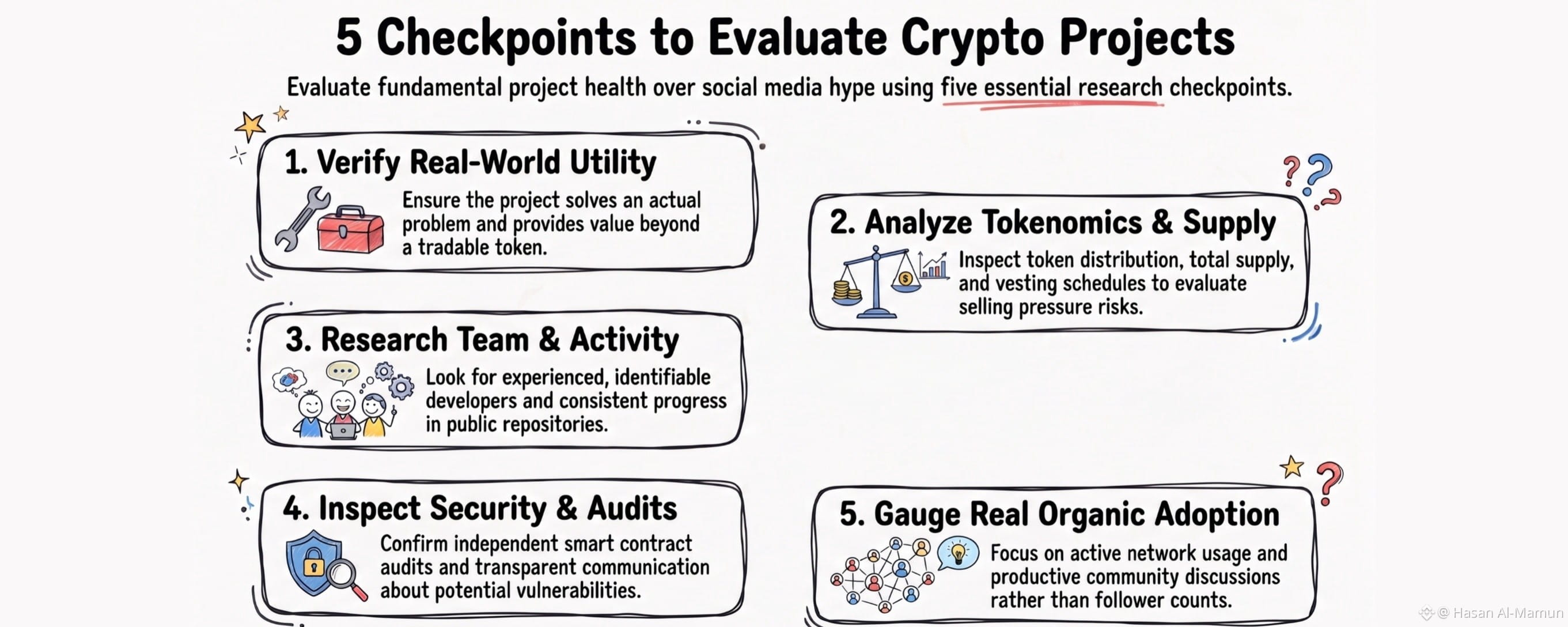
Here are 5 essential checkpoints I believe everyone should consider when researching a cryptocurrency.
1. Real-World Utility: Does It Solve an Actual Problem?
One of the first things to investigate is the project's real-world utility.
Ask yourself:
- What problem is this project trying to solve?
- Does its technology offer something useful?
- Are people actually using its products or services?
- Is there a genuine demand for its solution?
A cryptocurrency project should ideally provide value beyond simply having a tradable token.
For example, blockchain projects may focus on decentralized finance (DeFi), payments, smart contracts, data storage, or supply chain solutions.
My perspective: A project with a clear purpose is more interesting to research than one relying entirely on social media hype.
2. Tokenomics and Supply: Understand the Economics
Tokenomics plays an important role in understanding a cryptocurrency project.
Before considering a token, investigate:
- Total token supply
- Circulating supply
- Maximum supply
- Token distribution
- Vesting schedules and unlock periods
- Token utility and demand
For example, a project might have a relatively low circulating supply but a large number of tokens scheduled to enter the market later.
This could create selling pressure if demand doesn't grow accordingly.
Also, understand who holds the tokens. If a large percentage is concentrated among a few wallets, that may create additional risks.
My perspective: Never judge a token only by its price. Understand its market capitalization, supply structure, and distribution first.
3. Team and Development Activity: Who Is Building It?
Behind every serious technology project, there should be people continuously working to improve it.
Research the development team and their track record.
Consider these questions:
- Are the founders and developers identifiable?
- Do they have relevant experience?
- Is the project releasing regular updates?
- Is development activity consistent?
- Does the roadmap show measurable progress?
You can also explore public GitHub repositories, technical documentation, official announcements, and development updates.
However, remember that frequent updates alone do not guarantee a successful project.
My perspective: Consistent progress and technical transparency are more meaningful than big promises.
4. Security and Transparency: Can You Trust the Technology?
Security should never be an afterthought in cryptocurrency.
A project may have an impressive concept, but security weaknesses can put its users and funds at risk.
Important things to investigate include:
- Has the smart contract been independently audited?
- Are audit reports publicly available?
- Have previous security incidents occurred?
- How does the project communicate vulnerabilities?
- Are its security practices transparent?
Remember, an audit does not guarantee that a project is completely safe.
Even audited projects can experience vulnerabilities, exploits, or other unexpected problems.
My perspective: Transparency about risks and security is a major factor when evaluating a crypto project.
5. Community and Adoption: Are Real People Using It?
A large social media following doesn't automatically mean a project has a strong community.
Look beyond follower counts.
Check:
- Genuine community discussions
- Active users and ecosystem growth
- Developer and contributor participation
- Partnerships with verifiable activity
- Real adoption and network usage
Pay attention to whether community members discuss actual product development or simply speculate about token prices.
A healthy community should be able to discuss both opportunities and risks.
My perspective: Organic adoption is more interesting than artificial engagement or temporary hype.
Final Thoughts: Research Before You Follow the Hype
Evaluating a cryptocurrency project requires patience, critical thinking, and continuous research.
These five checkpoints provide a useful starting framework:
1. Real-World Utility — Does it solve a meaningful problem?
2. Tokenomics and Supply — Is its economic structure sustainable?
3. Team and Development — Is the team making consistent progress?
4. Security and Transparency — Are users and funds protected by credible practices?
5. Community and Adoption — Is there genuine interest and real usage?
No single checkpoint can predict a project's future success. Even projects with strong fundamentals can fail, and cryptocurrency investments carry significant risks.
The goal isn't to find a project that guarantees profits. The goal is to make better-informed decisions and avoid relying on hype alone.
Let's discuss! 👇
If you could choose only ONE of these five checkpoints when researching a new crypto project, which would you prioritize and why?
I'm especially interested in hearing different perspectives from the Binance Square community.
Do your own research (DYOR). This article is for educational purposes only, not financial advice.
#CryptoEducation #BinanceSquare #CryptoResearch #Blockchain #DYOR