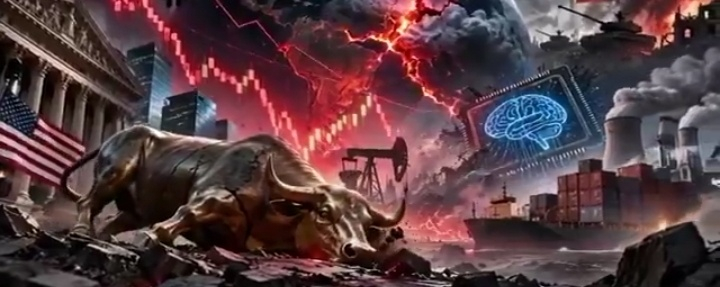

🚨 THE GLOBAL MARKET IS FACING A POTENTIAL STORM IN 2027–2028.
The world economy may be entering a dangerous period, with record debt, rising borrowing costs, geopolitical instability, and a massive AI investment boom that could eventually turn into a financial bubble.
Here’s what investors should be watching:
💣 1. GLOBAL DEBT IS BECOMING A MAJOR RISK
Global public debt is projected to approach 100% of GDP by 2029, according to the IMF, reaching that level a year earlier than previously expected.
Fitch estimates global government debt could rise by more than $7 trillion to approximately $115 trillion by the end of 2027.
Higher debt means governments become increasingly vulnerable to rising interest rates and refinancing costs.
💥 2. THE AI BOOM COULD TURN INTO A BUBBLE
AI investment is currently one of the biggest engines supporting global growth and financial markets.
But what happens if the expected returns fail to justify the enormous capital expenditure?
A major reassessment of AI valuations could trigger:
• Massive tech stock selloffs
• Reduced AI capital expenditure
• Falling semiconductor demand
• Data center investment slowdown
• Corporate earnings disappointments
• A broader market correction
The IMF specifically warns that disappointment over AI profitability could trigger equity market corrections and tighten financial conditions.
⚠️ 3. GLOBAL GROWTH IS ALREADY UNDER PRESSURE
IMF projections:
• Global GDP growth: 3.1% in 2026
• Global GDP growth: 3.4% in 2027
• Global inflation: 4.7% in 2026
• Global inflation: 4.1% in 2027
The OECD is more cautious, projecting global growth of 2.9% in 2026 and 3.0% in 2027.
The World Bank also warns that geopolitical conflicts, commodity disruptions, financial stress, and renewed inflation could push growth lower.
📉 4. BOND MARKETS COULD BECOME THE NEXT MAJOR PROBLEM
Rising government debt and massive bond issuance are putting pressure on long-term yields.
If yields spike:
• Governments face higher borrowing costs
• Corporations pay more to refinance debt
• Consumers face tighter credit
• Stock valuations become less attractive
• Liquidity deteriorates
A major bond market selloff could become the catalyst for a much broader financial crisis.
🌍 5. GEOPOLITICAL RISKS ARE STILL EXTREMELY HIGH
Wars, trade tensions, tariffs, energy disruptions, and supply-chain fragmentation could trigger another inflationary shock.
Higher energy prices could force central banks to maintain restrictive monetary policy for longer, even as economic growth weakens.
This creates a dangerous combination:
Slow growth + high inflation + high interest rates.
⚠️ 6. THE PERFECT STORM SCENARIO
Imagine these events happening simultaneously:
AI stocks collapse
↓
Corporate investment slows
↓
Unemployment rises
↓
Economic growth deteriorates
↓
Government deficits increase
↓
Bond yields rise
↓
Credit markets tighten
↓
Global liquidity contracts
↓
Stocks, crypto, and other risk assets sell off
This is the kind of domino effect that could turn an ordinary correction into a much more serious crisis.
2027–2028 could become a critical stress test for the global financial system.
A crash is NOT guaranteed, and current official forecasts still project economic growth.
But the risks are building, and the biggest danger is not one isolated problem, it’s multiple vulnerabilities colliding at the same time.
The question is no longer whether the global economy has risks.