

#Ad | Sponsored Content
Exploring Celo's payment infrastructure, stablecoin economy and the purpose behind its native token.
This is marketing material and not investment advice.
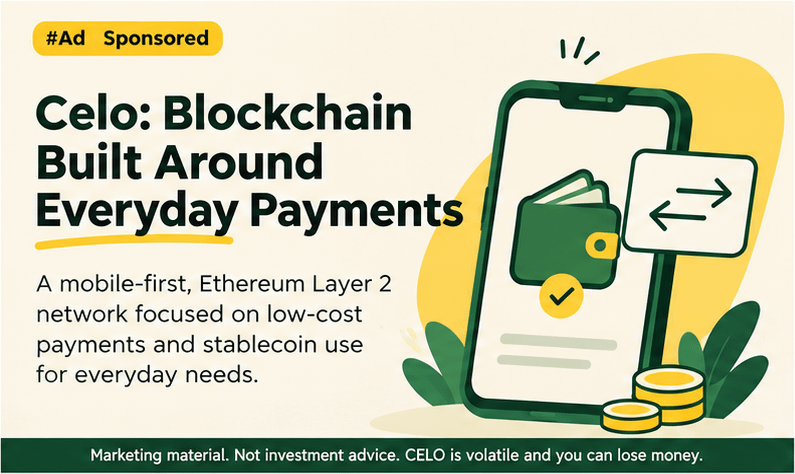
Imagine receiving five dollars in a digital wallet, but being unable to send those five dollars because you do not own another cryptocurrency required to pay the transaction fee.
For someone familiar with crypto, this might seem like a minor inconvenience. For someone experiencing blockchain technology for the first time, it could be a reason to stop using it altogether.
This is one of the problems Celo's architecture is designed to address.
While much of the blockchain industry discusses scalability through technical benchmarks, Celo approaches the subject from another direction: how much of the complexity can be removed from an ordinary financial transaction?
Understanding that distinction helps explain why Celo exists, what its infrastructure offers and where its limitations remain.
01. Understanding Celo: A blockchain with a different starting point
Celo originally launched in April 2020 as an independent Layer 1 blockchain, with an emphasis on mobile accessibility and affordable digital transactions.
In March 2025, Celo completed its transition to an Ethereum Layer 2 network built using the OP Stack.
The underlying architecture changed, but its focus on accessible financial applications remained.
Celo's current documentation describes a network featuring:
One-second block times.
Typical transaction fees below one US cent.
Transaction fees payable in supported stablecoins.
Compatibility with Ethereum smart contracts.
Infrastructure for mobile payments and decentralized applications.
These characteristics are intended to make blockchain-based financial services more accessible.
Associated risks: Actual fees and transaction speeds depend on network conditions. Ethereum compatibility does not eliminate smart contract vulnerabilities, operational failures or the possibility of financial losses.
02. What actually changed when Celo became an Ethereum Layer 2?
A blockchain does not need to perform every infrastructure function independently.
Celo's transition illustrates how different technical responsibilities can be distributed across multiple systems.
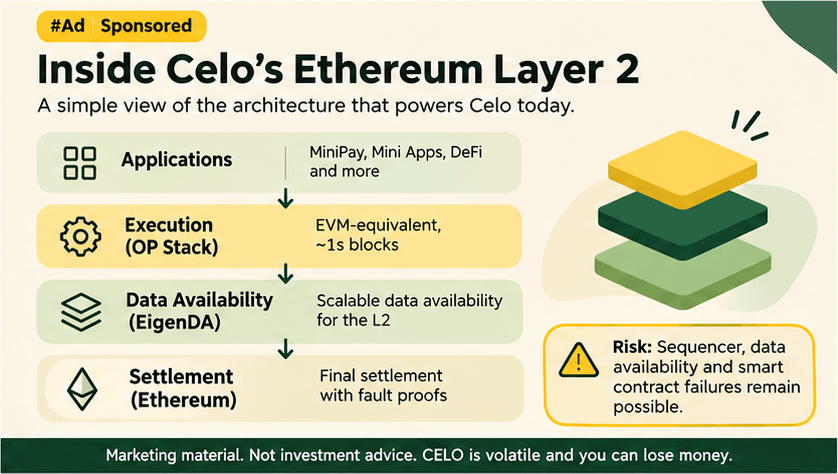
Its architecture consists of several important components.
OP Stack — Execution
Provides the underlying framework through which transactions and smart contracts are processed.
EigenDA — Data availability
Supports the accessibility of transaction data while helping manage infrastructure costs.
Ethereum — Settlement
Provides the underlying settlement environment for Celo's Layer 2 network.
Celo applications — User experience
Wallets, stablecoin payment services and decentralized applications connect users to this infrastructure.
The purpose of separating these responsibilities is to create a network that can accommodate financial applications without requiring every operation to occur directly on Ethereum.
However, distributing responsibilities also introduces additional technical dependencies.
Associated risks: Sequencer interruptions, data availability failures, bridge vulnerabilities, smart contract exploits and settlement delays can affect users. A one-second block time should not be confused with immediate final settlement on Ethereum.
03. The small transaction that explains Celo's bigger purpose
Consider a hypothetical freelancer who receives a stablecoin payment from an international client.
On some blockchain networks, transferring that payment requires acquiring a separate native cryptocurrency to cover gas fees.
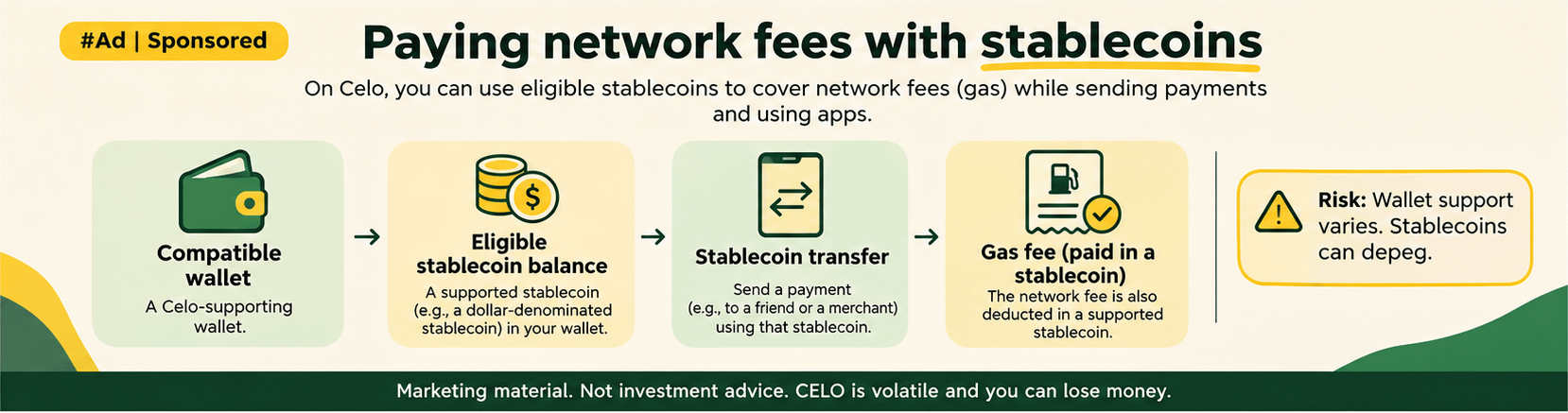
Celo supports an alternative through a feature known as fee abstraction.
With a compatible wallet, users can pay transaction fees using eligible assets such as USDC, USDT and USDm.
The person receiving a stablecoin payment may therefore be able to pay the associated network fee using the same type of asset.
It is a relatively small technical difference with a meaningful implication for accessibility.
The user can focus more on the payment itself and less on managing multiple cryptocurrencies.
Associated risks: Not every wallet or token supports fee abstraction. Stablecoins can lose their intended peg, and users remain exposed to issuer, smart contract, liquidity and regulatory risks.
04. Why does the CELO token exist if stablecoins can pay fees?
This is an important distinction that can easily be overlooked.
Celo is the blockchain network. CELO is its native digital asset. Stablecoins operating on Celo are separate assets with different purposes and risk profiles.
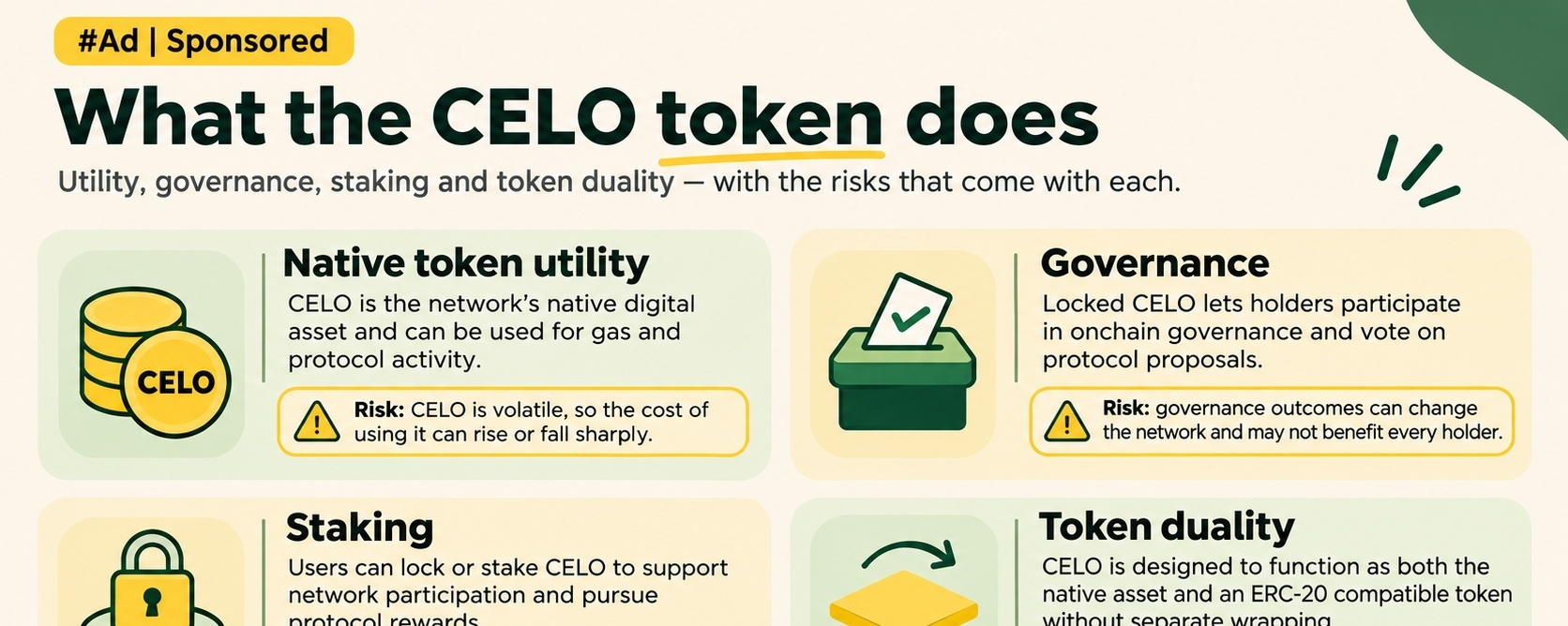
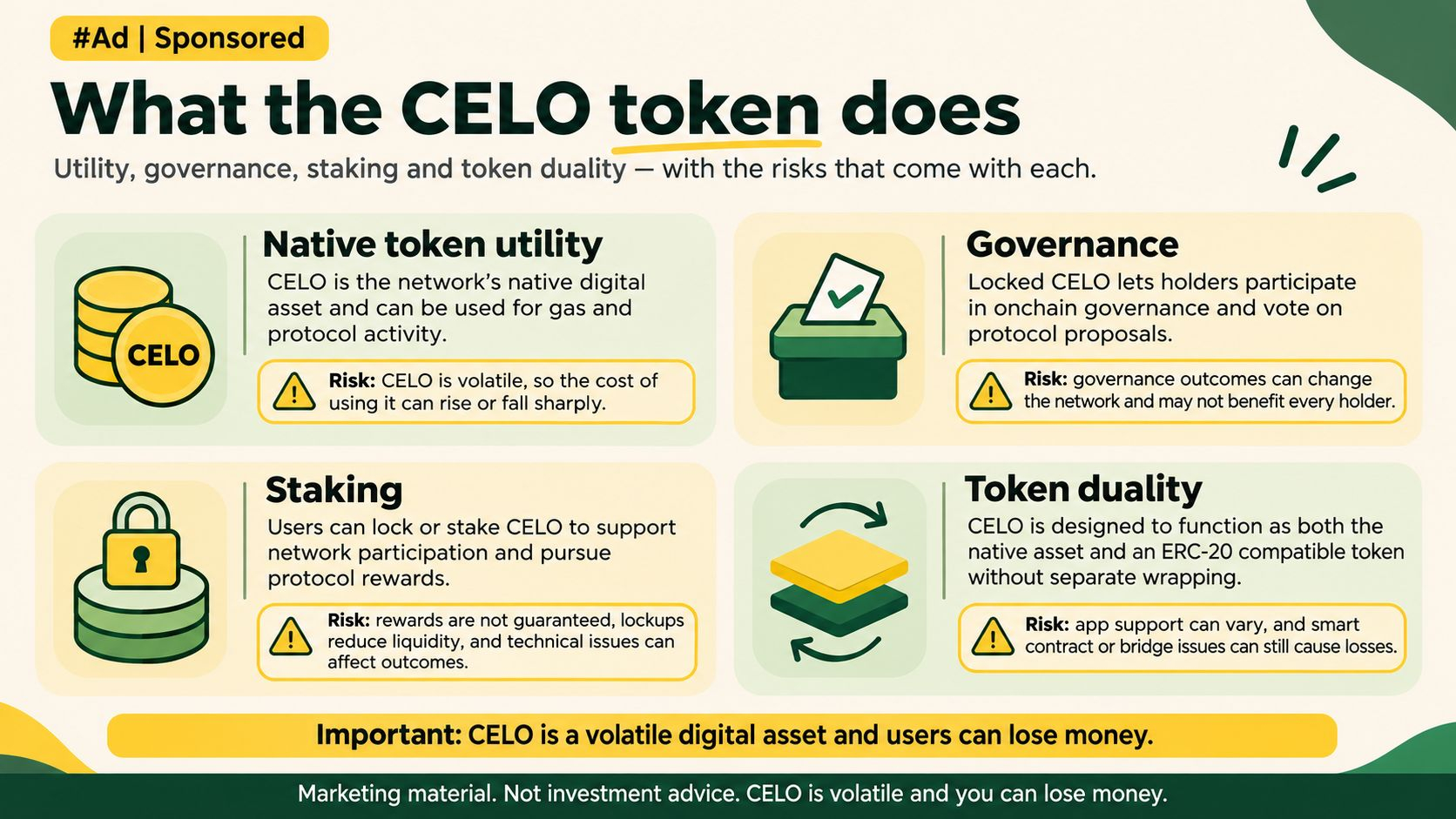
CELO serves several functions within the protocol.
Transaction fees
CELO can be used to cover the computational cost of transactions.
Risk: CELO's market value fluctuates, and transaction costs are not guaranteed to remain constant.
Protocol governance
Locked CELO provides voting rights on eligible governance proposals, allowing token holders to participate in decisions concerning the network.
Risk: Voting power can be concentrated among larger holders, and governance decisions may introduce unintended consequences.
Staking and community infrastructure
Locked CELO is used in elections involving community RPC providers, historically referred to as validators in the protocol's terminology.
Risk: Locking tokens restricts their immediate availability and does not protect their value from market volatility or technical failures.
Token duality
CELO functions as both the network's native currency and an ERC-20-compatible asset without requiring a separate wrapped version.
Risk: Applications and smart contracts may still contain vulnerabilities or handle tokens incorrectly.
These functions explain CELO's role within the protocol. They do not establish its future market value or guarantee financial returns.
05. Celo's connection with everyday financial activity
Blockchain adoption is often measured through wallet addresses, transaction counts and trading volume.
But another dimension deserves attention: what people actually accomplish with the technology.
Celo's mobile-oriented ecosystem includes applications such as MiniPay, which provides a stablecoin wallet experience, alongside decentralized finance applications and other payment infrastructure.
Potential use cases include everyday transfers, cross-border payments and access to digital currencies.
The underlying objective is to make financial applications usable by people who may have limited experience with blockchain technology.
However, availability is not the same as accessibility.
A functioning blockchain cannot independently solve unreliable internet access, limited local payment infrastructure, regulatory restrictions or the difficulty of converting digital assets into local currency.
Associated risks: Users may experience wallet security problems, loss of private keys, limited cash-out options, currency conversion costs and restrictions in their jurisdiction. DeFi applications also introduce protocol-specific financial risks.
06. CELO Trading Festival: Understanding the campaign
Separately from Celo's technological development, Binance has announced the CELO Trading Festival, an affiliate-focused promotional campaign scheduled from November 20, 2026, at 10:00 UTC to December 20, 2026, at 10:00 UTC.
The announced campaign consists of three promotional categories:
Spot trading promotion: up to 75 BNB.
New-user welcome promotion: 70 BNB.
Affiliate creator challenge: 25 BNB.
The combined announced allocation is up to 170 BNB in token vouchers, subject to eligibility, regional restrictions and the official campaign conditions.
Promotional rewards are conditional and are not guaranteed. Trading-related activities carry financial risks, including the potential loss of capital.
The festival is a marketing initiative and should be distinguished from Celo's underlying technological capabilities and the market performance of CELO.
Official campaign rules:
https://www.binance.com/en/activity/trading-competition/ExCELOTradingFestival2026
07. The bigger picture
The most meaningful question surrounding Celo is not simply how quickly its blockchain processes a transaction.
It is whether the infrastructure can make digital financial services practical enough to become part of someone's ordinary routine.
Low transaction costs address one part of that problem. Stablecoin fee payments address another. Mobile-focused applications attempt to address the experience of accessing the network itself.
None of these features guarantees adoption, eliminates financial risks or determines the value of CELO.
Celo represents an approach to blockchain infrastructure in which the payment experience matters alongside the technology that makes it possible.
Its long-term usefulness will depend on reliable infrastructure, application security, genuine user demand and the ability to operate within different financial and regulatory environments.
Ultimately, the distinction between a blockchain that can process payments and a blockchain that people can comfortably use for payments is worth understanding.
Official technical references
Celo documentation: https://docs.celo.org/
Layer 2 architecture: https://docs.celo.org/learn/network/architecture
CELO token duality: https://docs.celo.org/learn/protocol/celo-token
Staking: https://docs.celo.org/learn/protocol/staking
Gas fees: https://docs.celo.org/learn/gas-fees
Affiliate disclosure: The author may receive affiliate-related compensation from Binance.
CELO ownership disclosure: [State whether you currently hold CELO.]
Regulatory disclosure: Binance's ADGM entities are regulated by the Financial Services Regulatory Authority (FSRA). Nest Exchange Limited is recognised as an investment exchange, Nest Clearing and Custody Limited is recognised as a clearing house, and Nest Trading Limited is authorised to conduct specified regulated financial activities.
Risk warning: Virtual asset prices can be volatile. The value of your investment may go down or up and you may not get back the amount invested. You are solely responsible for your investment decisions and Binance is not liable for any trading losses you may incur.
CELO is a volatile digital asset. Its value can fall sharply, and users can lose money, including their entire investment.
This is marketing material and not investment advice.