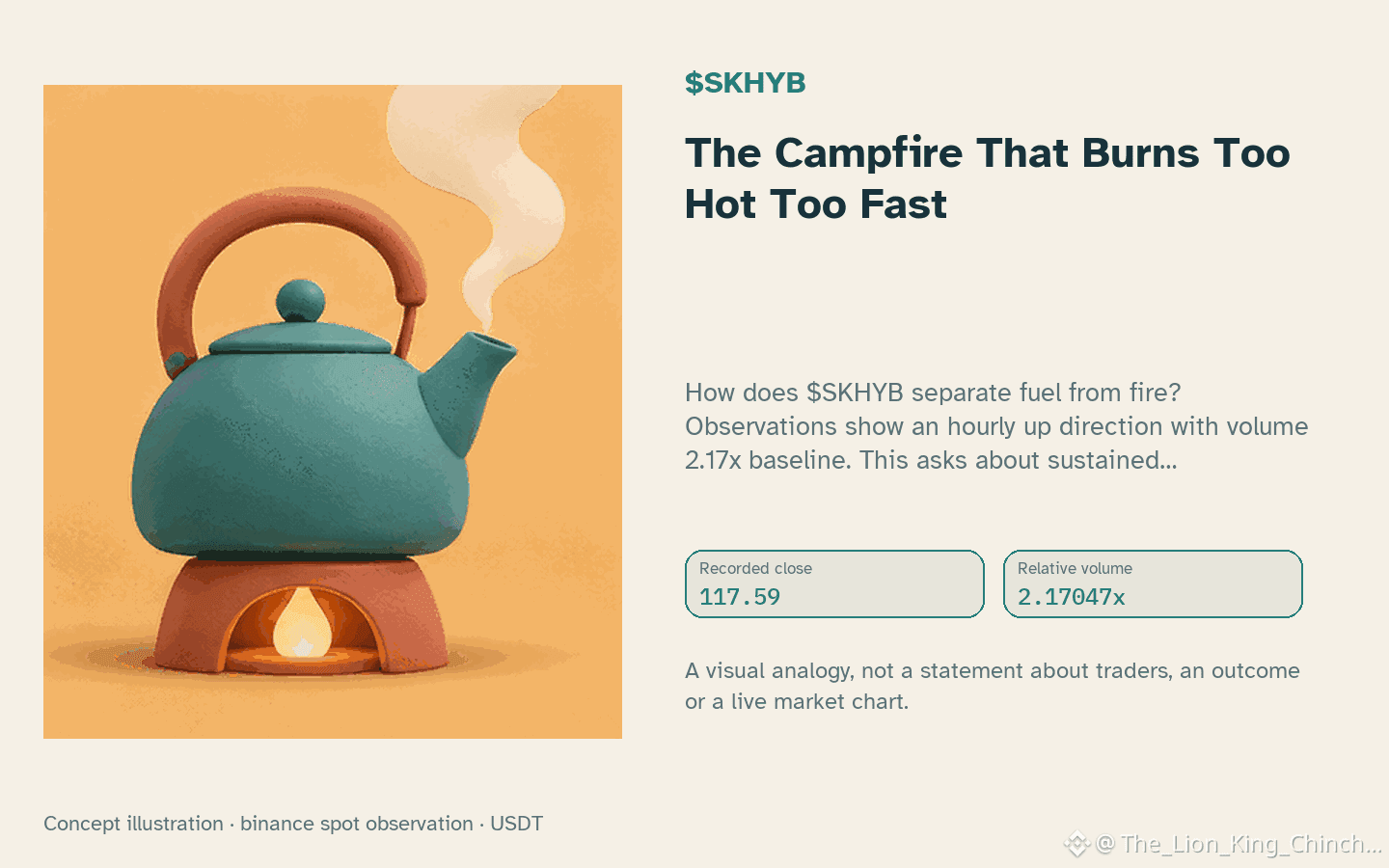
$SKHYB : The Campfire That Burns Too Hot Too Fast
How does $SKHYB separate fuel from fire? Observations show an hourly up direction with volume 2.17x baseline. This asks about sustained participation versus temporary spikes.
The Mechanism
Think of a campfire. Steady dry wood burns long. Damp leaves flare quickly but smother fast. In markets, relative volume measures the ratio of current activity to recent averages. It does not measure intent or order flow. A high ratio indicates more trades occurred. It does not prove who bought or why they bought. The analogy helps visualize momentum. Fuel represents consistent participation. Fire represents rapid expansion. Exhaustion volume acts like damp leaves. It creates heat but lacks the structure to sustain the climb.
The Trade-Off
High volume can support a move if it aligns with price structure. Here, price sits inside the recorded range. Support is 109.29 and resistance is 117.82. RSI is 75.8. These are static measurements. They describe the past, not the future. If volume spikes but price fails to close beyond resistance, the mechanism may lack follow-through. Conversely, steady volume near resistance might indicate testing. We cannot distinguish these from candles alone.
A Rule Worth Testing
Define a counterexample. Suppose volume rises to 2.17x baseline but price closes below the previous candle’s high. This weakens the momentum hypothesis. It suggests the spike did not capture the barrier. Now check the next closed candle. If it maintains a higher low, the interpretation strengthens. If it retraces below the starting price, the idea fails. This self-check turns a vague feeling into a testable rule. Always distinguish observation from inference. Volume is the fuel count. The close is the fire’s direction. Use both to assess whether the campfire is building a structure or just flashing out.
Probabilistic market research, not a recommendation or guaranteed return.
#SKHYB