


Galaxy Research now considers a daily bitcoin close below the June 30 low of $58,525 to be “the start of a move to a materially lower low.”
The firm has ditched its October call that the bear market ended in June.
The technical case behind the earlier call is “no longer valid”, head of firmwide research Alex Thorn wrote in a note to Galaxy Trading and Galaxy Asset Management clients on Nov. 24.
Seven historical breaks cut prices by a 52% median
Galaxy’s October 26 note was based on a single chart map. The bear-market floor is the 200-week moving average and the ceiling is the 50-week average.
In September, Bitcoin climbed back above the 50-week line, snapping 44 consecutive weekly closes below the line. In the past, such a sustained run only came about once the bear’s low was already in place.
The run above the 50-week line lasted seven weeks. Bitcoin closed the week ended Nov. 8 below the 50-week moving average and the week after that went below the 200-week average.
The October note had its own tripwire, a weekly close below the 50-week line that went unrepaired for a month. “We are not waiting for it,” Galaxy wrote.
On November 20, Bitcoin cracked below its July 1 intraday low. The next day it hit bottom at $55,100.
The June close low held. Bitcoin finished at $61,104 on Nov. 22, just 4.4% above $58,525.
Galaxy analyzed seven previous bear-market cases where bitcoin closed below a low that held for 60 days or more, following a rebound of 20% or better. All were down at least 17%, with a median drop of 52%.
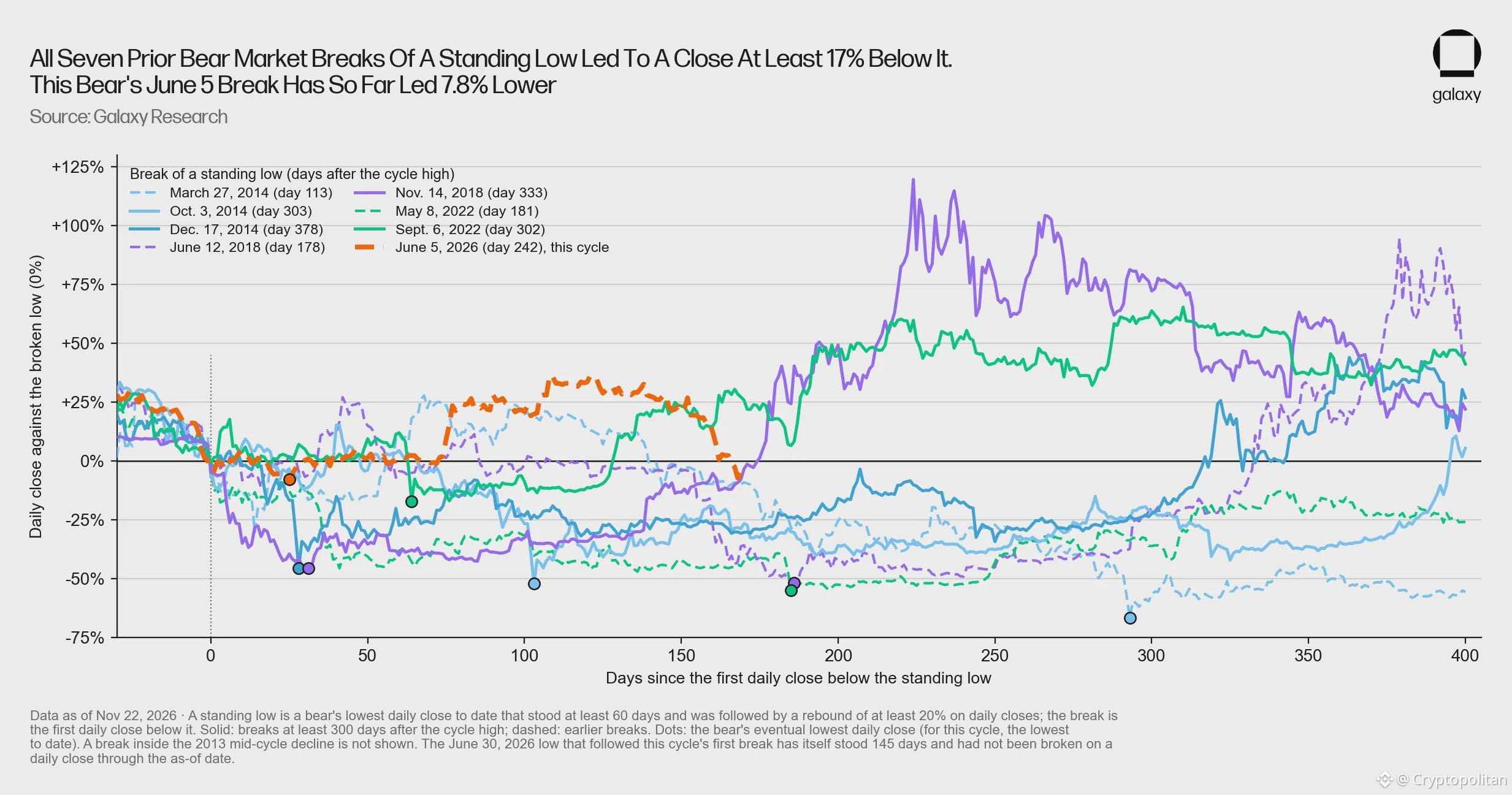 Bitcoin’s daily close after each break of a standing bear-market low since 2014, from Galaxy Research’s November 2026 report.
Applied to the June low, that puts the shallow end at about $48,500. The median is about $28,200.
Just 2 of 13 tracked bottom signals have been met
Galaxy’s own read is a 2-way split. The bear appears long overdue by the calendar, with November 22 marking day 412 since the October 6, 2025 record, compared to 163 to 406 days in the four previous bears.
The decline compares with 77% to 93% in those cycles. So far, it’s down 53%.
Bitcoin has not yet closed a single day below its realized price of $53,205. All previous bears spent a minimum of 140 days below that level.
Galaxy sees only two of its 13 tracked bottom signals hit. The macro environment has deteriorated since June.
The two-year Treasury yield stood 0.88 percentage point over the fed funds rate on Nov. 19. Galaxy interprets this as markets anticipating a higher policy rate down the road.
On Nov. 20, the S&P 500 was 11.6% below its record high, the Nasdaq 100 was down 19.8% from its high and the Philadelphia Semiconductor Index was 42.5% below its peak.
Galaxy left a narrow exit. Bitcoin has until about Dec. 8 to reclaim the 50-week average, a rise of almost 22% from the Nov. 22 close.
“We must acknowledge that the bear market is very likely not over and that the reclaim is unlikely to come in time,” Thorn wrote. Weekly closes above the 200-week average, now $68,159, and then the 50-week, now $74,401, would draw Galaxy back toward its October view.
“Whether Jensen Huang’s return to Nvidia on Nov. 23 can be the spark that pulls bitcoin back up to levels needed to end the bear market is unknown,” Thorn added.
US spot bitcoin ETPs have seen outflows of 71,339 BTC, or about $4.95 billion, since October 4, including outflows in 22 of 35 sessions, Galaxy said. Holdings are close to 1.24 million BTC.
Net outflows from US funds reached a record $4.71 billion, according to Cryptopolitan. Traders on Binance also cut bitcoin open interest by about 40% or $4.5 billion over the past year, which analyst Darkfost said was the biggest deleveraging in dollar terms.
At the time of writing, BTC was trading at $60,750, up 4.2% in the past 24 hours.
Don’t just read crypto news. Understand it. Subscribe to our newsletter. It's free.