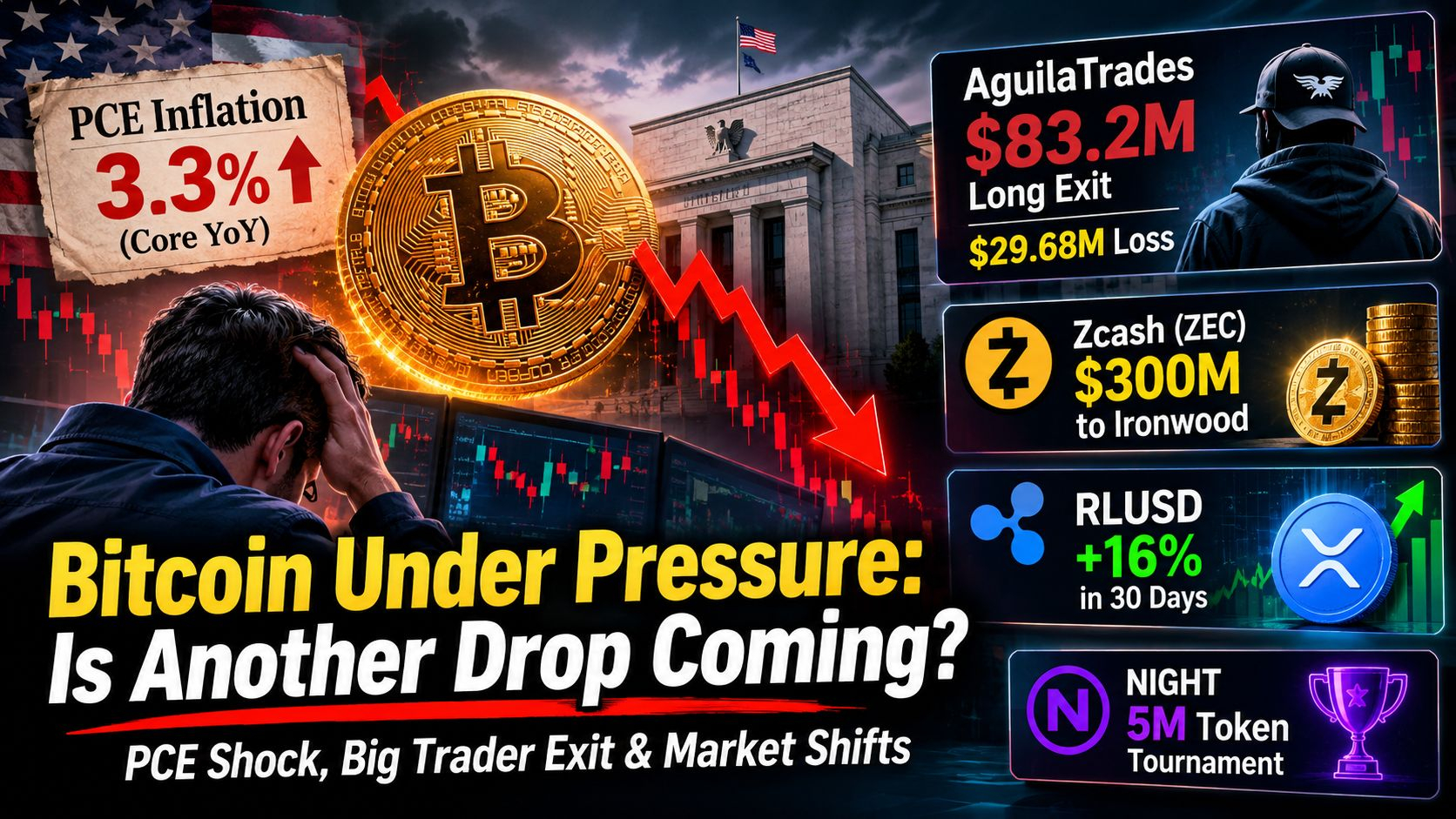

A $29.68 million trading loss, stubborn US inflation and growing liquidation risks are sending a warning to crypto investors. But while Bitcoin struggles with macroeconomic pressure, some parts of the crypto market are moving in the opposite direction.
On November 26, 2026, popular trader AguilaTrades closed a massive Bitcoin long position worth approximately $83.2 million, equivalent to 1,419.16 BTC. According to on-chain tracking reports, his cumulative futures account losses reached approximately $29.68 million.
At the same time, October's US PCE report showed that core inflation had climbed to 3.3% annually. These developments raise an important question: Is Bitcoin facing another wave of downside pressure, or is the market simply resetting excessive leverage?
The answer requires looking beyond price movements.
US PCE Inflation: Another Problem for the Federal Reserve
According to the US Bureau of Economic Analysis (BEA), October's headline PCE inflation increased 0.3% month over month, while the annual rate climbed from 3.7% to 3.8%.
Core PCE also rose 0.3% monthly, with its annual rate increasing from 3.1% to 3.3%, above the market expectation of 3.2%.
There is one positive detail: monthly inflation cooled from September's 0.5% increase. However, the annual core reading suggests that underlying price pressures remain persistent.
The Federal Reserve still has a 2% inflation target. With core PCE significantly above that level, policymakers have limited room to ease monetary policy aggressively.
For Bitcoin, this matters.
If interest rates remain elevated, US Treasury yields and the dollar could remain attractive relative to riskier assets. That could reduce the flow of fresh capital into cryptocurrencies, particularly highly leveraged positions.
However, one inflation report does not determine Bitcoin's direction. Treasury yields, Fed communication and spot ETF flows will also influence the market ahead of the December 9 FOMC meeting.
AguilaTrades' $83.2M Bitcoin Exit: A Warning About Leverage?
The most interesting development is the scale of AguilaTrades' position.
According to reports citing on-chain tracking data, he closed 1,419.16 BTC worth approximately $83.2 million between 00:34 and 00:52 UTC on November 26. His reported cumulative futures losses stood at around $29.68 million.
But there is an important distinction: closing a position is not necessarily the same as being forcibly liquidated.
There is no sufficient confirmation that the entire $83.2 million position was liquidated by an exchange. Treating the exit as a confirmed forced liquidation would therefore be misleading.
Another report subsequently indicated that AguilaTrades opened a new long position of approximately 1,549 BTC, valued at around $94.11 million.
That changes the interpretation.
His earlier exit should not automatically be viewed as a permanent bearish bet against Bitcoin. It may instead reflect a change in positioning, risk management or expectations about short-term market structure.
For investors, the more useful signals are:
Is Bitcoin's Open Interest declining or building again?
Are Funding Rates becoming excessively positive?
Are large BTC deposits moving toward exchanges?
Is fresh spot buying supporting the recovery?
These indicators can help distinguish genuine demand from temporary short covering.
Bitcoin Around $58K–$61K: Recovery or Another Liquidity Trap?
Bitcoin reacted quickly to the inflation report.
According to market data analysis, BTC initially traded around $58,858 before falling approximately 1.14% within an hour. Subsequent market reports showed a recovery from approximately $57,300 toward the $60,000–$61,000 region.
That recovery is encouraging, but it does not confirm a trend reversal.
A sharp rebound can come from short liquidations rather than genuine spot demand. This distinction matters because rallies driven mainly by derivatives positioning can lose momentum quickly.
I would watch three things:
Bullish scenario: BTC holds above $60,000, spot buying strengthens and Open Interest grows without excessive funding.
Bearish scenario: BTC loses the $57,000 region while Open Interest remains elevated, increasing the possibility of another long liquidation event.
Until the market confirms stronger spot demand, chasing a recovery carries unnecessary risk.
Zcash (ZEC): Why Developers Want $300M Moved to Ironwood
While Bitcoin faces macroeconomic pressure, Zcash has its own important development.
According to CoinDesk's November 26 report, Zcash developers urged users to move approximately 400,000 ZEC from the older Sapling shielded pool to the newer Ironwood pool. Based on prevailing prices, the assets were worth approximately $300 million.
The concern involves the cryptographic design used by Sapling. Developers have raised concerns that future advances in cryptographic research could weaken its security assumptions.
This does not mean Sapling has already been successfully compromised. The warning concerns potential future vulnerabilities.
The migration is important because privacy infrastructure is central to Zcash's value proposition.
If users migrate successfully, the network could strengthen its long-term security architecture. However, slow adoption could leave part of the ecosystem exposed to prolonged uncertainty.
For $ZEC investors, price action alone is not enough. Migration activity, shielded pool balances and actual network usage deserve attention.
$RLUSD : Growing While the Stablecoin Market Contracts
One of the more interesting developments is happening in the stablecoin market.
According to DefiLlama data cited in a November 23 report, Ripple's RLUSD market capitalization increased more than 16% over 30 days, reaching approximately $2.874 billion, even as the broader stablecoin market contracted.
By November 26, DefiLlama's reported figure stood near $2.799 billion.
Ethereum accounted for approximately $2.034 billion, while XRP Ledger held around $748.5 million.
This distribution is worth watching.
RLUSD's growth suggests increasing supply and potentially stronger demand for Ripple's dollar-backed payment infrastructure. But market capitalization alone cannot prove genuine adoption.
Investors should monitor new issuance, redemptions, transaction volumes and actual DeFi usage.
If these indicators grow together, RLUSD's expansion becomes more meaningful. If supply rises without corresponding activity, the growth story deserves more scrutiny.
NIGHT: Can Binance's Trading Tournament Create Lasting Demand?
Binance has also introduced a spot trading tournament featuring a prize pool of 5 million $NIGHT tokens.
According to Binance's announcement, the competition runs from November 25 to December 2, 2026. Eligible trading pairs include XRP/USDC and NIGHT/USDT, with a minimum qualifying trading volume of $500.
The first-place reward is 150,000 NIGHT, followed by 125,000 and 100,000 NIGHT for second and third place.
Such campaigns can increase short-term visibility and trading activity. However, higher volume during a promotional event does not necessarily translate into sustainable demand.
For NIGHT, the important question is what happens after the tournament ends.
Investors should watch whether daily spot volume remains elevated, whether order-book liquidity improves and whether buyers continue supporting the token without promotional incentives.
A temporary volume spike is not the same as long-term accumulation.
What Should Crypto Investors Watch Next?
Four developments are currently worth monitoring.
First, persistent US inflation could keep monetary policy restrictive. Second, AguilaTrades' position changes highlight the risks associated with large leveraged trades. Third, Zcash's migration introduces an important security-related development. Finally, RLUSD's expansion and Binance's NIGHT tournament show that opportunities are emerging in different parts of the market.
For Bitcoin, the most important confirmation will come from spot demand rather than liquidation-driven price movements.
Holding above $60,000 and reclaiming $61,000 with stronger spot buying would improve the short-term outlook. Losing the $57,000 region would increase downside risk.
I would avoid excessive leverage at this stage. Gradual spot accumulation, predefined stop-loss levels and partial profit-taking offer a more disciplined approach.
What do you think is the biggest risk for Bitcoin right now: persistent US inflation, large-trader liquidations or weakening spot demand? And do you see RLUSD and ZEC as stronger opportunities while BTC remains under pressure?



#USOctoberPCEPriceIndexAt0.3%MoM #Geopolitics #CryptoAnalysis #altcoins #Binance