
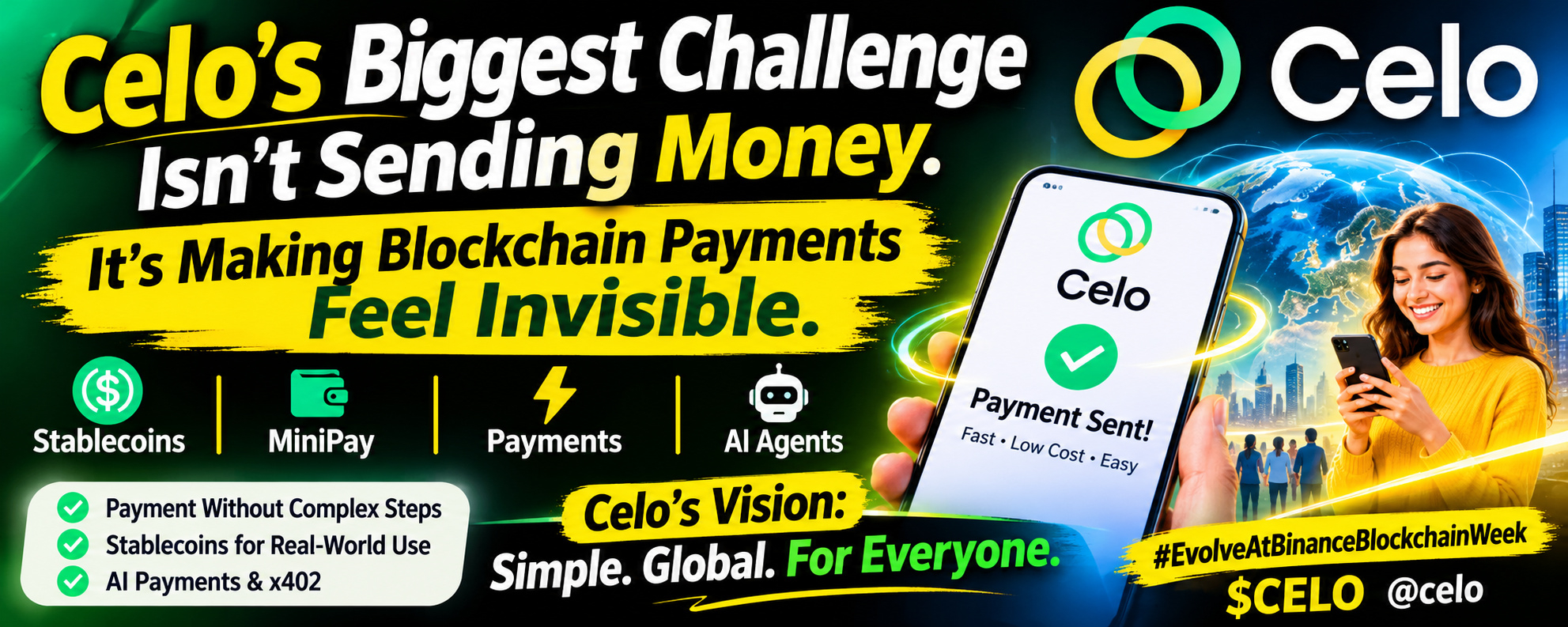


$CELO | Stablecoins | MiniPay | Payments | AI Agents
When I look at blockchain payment projects, I don't just ask how fast a network can process transactions.
I ask a more practical question: Can someone use it without having to understand blockchain in the first place?
That question is what makes Celo's direction interesting to me.
The real challenge in digital payments isn't simply moving money from one wallet to another.
It is removing the friction surrounding that movement. Users shouldn't have to worry about network selection, gas tokens, complicated wallet setup or whether the recipient can actually use the money they receive.
The technology should work in the background.
From Blockchain Infrastructure to a Payment Experience
Celo's transition to an Ethereum Layer 2 in March 2025 changed its infrastructure direction, but its broader objective remains focused on accessible financial services and mobile-first payments.
Its Ethereum-compatible environment, low transaction costs and fee abstraction approach are important because they address practical barriers rather than simply adding another blockchain feature.
Fee abstraction particularly deserves attention. When supported assets can be used to cover transaction fees, users don't necessarily need to acquire a separate gas token before completing a payment.
For someone unfamiliar with crypto, removing that extra step can make the experience considerably simpler.
MiniPay: Distribution May Matter More Than Technology
I believe MiniPay is one of the most interesting parts of Celo's ecosystem.
A technically impressive blockchain cannot achieve meaningful adoption if people struggle to access it.
MiniPay approaches this problem through a mobile-first wallet experience designed around stablecoin usability.
Its connection with Opera's broader ecosystem creates an opportunity to reach users beyond traditional crypto communities.
But wallet registrations alone aren't the finish line.
The more meaningful questions are whether users return, whether they regularly send and receive money, whether merchants or services accept their assets, and whether those transactions solve genuine problems.
Distribution gets people through the door. Utility gives them a reason to stay.
Stablecoins Are the Real Payment Layer
Celo's stablecoin-focused ecosystem is central to its payment strategy.
Stablecoins can make digital transfers easier to understand because their value is designed to track a reference currency.
Celo's ecosystem also explores stablecoins linked to different currencies, which could matter in regions where access to financial services and international transfers remain challenging.
However, stablecoin availability isn't the same as financial access.
Liquidity, redemption options, local regulations, trust and the ability to convert digital money into something people can actually use all matter.
That's where I believe the next phase of adoption will be decided.
Why AI Payments Could Open Another Door
The emergence of AI agents introduces another potential use case.
Agents may eventually need to purchase data, computing resources or digital services independently.
Payment infrastructure capable of supporting programmable transactions could help connect these automated systems with service providers.
Celo's exploration of x402 payment infrastructure is interesting in this context because it connects stablecoin settlement with internet-based services.
Still, infrastructure development should not be confused with proven widespread demand.
The real test will be whether developers build useful services and whether recurring payment activity develops around them.
The Question I Would Ask Celo
Celo's direction makes sense to me, but I would measure its progress using more than wallet counts or transaction volume.
I'd want to see:
- Retained users rather than just activated wallets.
- Repeat payment activity rather than isolated transactions.
- Sustainable liquidity across supported stablecoins.
- Growing merchant and service acceptance.
- Transparent network economics and a clearer relationship between ecosystem activity and CELO's economic value.
These indicators would help distinguish genuine financial adoption from activity that looks impressive on a dashboard.
My Conclusion
I don't think the strongest blockchain payment network will necessarily be the one with the most complicated technology.
It could be the one that makes sending, receiving and using digital money feel ordinary.
Celo's mobile-first approach, stablecoin infrastructure and experimentation with new payment models give it an interesting position in that conversation.
But the real achievement would be when people use the financial services built on Celo without needing to know what a Layer 2, sequencer or blockchain even means.
That is the adoption milestone I will be watching.
#EvolveAtBinanceBlockchainWeek $CELO @celo

@Binance Square Official