
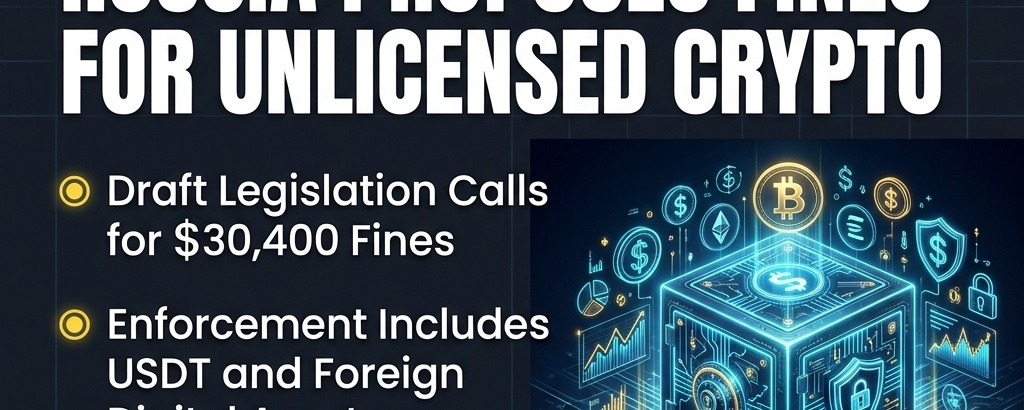

RUSSIA IS REPORTEDLY ADDING PRICE TAGS TO THE NEW CRYPTO RULEBOOK AND USDT TRADERS ARE THE TARGET
Russia has reportedly put forward new penalties for unlicensed crypto trading, with a headline fine of around 30,000 dollars and a scope that now reaches USDT and foreign digital assets. I could not find the draft itself, so I will not claim the exact amount, but the direction fits the framework Russia has been building all year.
The core of that framework is already law. A comprehensive crypto market statute passed in July and took effect in September, legalizing trading through licensed intermediaries, writing digital assets into the tax code and capping ordinary Russians at about 3,800 dollars a year of purchases. Domestic payments in crypto stay banned, while companies get explicit permission to use crypto in foreign trade, which analysts have linked to sanctions workarounds.
The enforcement side is what is now getting sharper. A separate bill would make unlicensed crypto services a crime, with fines in the hundreds of thousands to millions of rubles and prison of up to seven years for organized or aggravated cases, and thresholds that experts say could catch small exchangers quickly, since a modest USDT resale business can pass the large scale line fast. Peer to peer trading, where most Russian crypto activity has actually flowed for a decade, is being phased out.
The logic is control more than prohibition. Moscow wants trading to run through licensed venues like Moscow Exchange, where Bitcoin, Ether and USDT are about to launch, instead of informal networks it cannot see. For people already operating through the gray market, the penalties turn a tolerated activity into a risky one, while licensed platforms gain a captive audience.
For global markets the effect is limited. Russian retail volumes are small compared with the big markets, and the biggest flows are corporate and cross border, which stay legal under the new law. But the signal is clear, with another major economy shifting from tolerance to licensing backed by criminal penalties.
I'm watching the final text of the penalties and how quickly licensed venues absorb volume, since enforcement only works if the legal route is easy enough to use.
Do you think heavy penalties push Russian traders onto licensed exchanges or into harder to track workarounds, and does this matter for USDT demand?