

Honestly, sometimes I feel like crypto is just repeating itself.
Every day there's a new coin, another blockchain, another AI narrative, and another group of people on X telling everyone they've found the next big thing. Everyone is excited for a few days, influencers start posting, timelines get filled with predictions, and then something else comes along and takes all the attention.
We've seen this happen too many times.
I've been around long enough to know that a good announcement doesn't always mean a good project. Some projects look incredible during a bull market, but when things get quiet, you suddenly realize how little is actually happening.
That's why I don't get excited about every new upgrade anymore.
I'd rather look at what a project is trying to solve and whether people genuinely need it.
Recently, I've been thinking about Celo.
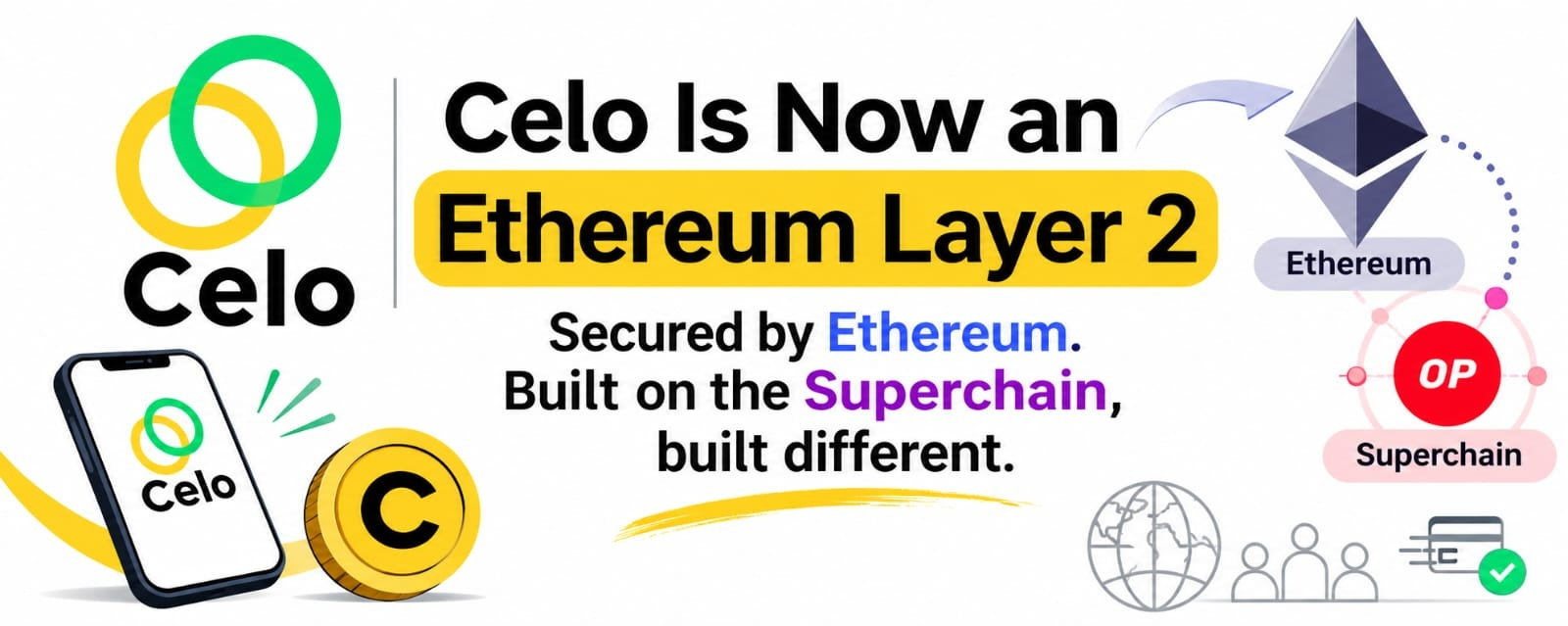
The project has made a pretty big change. It has moved from being an independent Layer 1 blockchain to becoming an Ethereum Layer 2.
Now, some people will look at that and immediately see it as a positive move. Others might wonder why a project that already had its own blockchain decided to change direction.
Personally, I think there's more to discuss here.
Celo has been around for a while. It isn't one of those projects that appeared yesterday with a nice website and a few influencers talking about it.
But being around for years doesn't automatically mean you've figured everything out.
The reality is that running an independent blockchain is difficult. You need developers, users, liquidity, applications, and enough activity to keep the ecosystem alive.
And we've watched many Layer 1 projects struggle with exactly that.
Launching a network is one thing. Getting people to actually use it when there are dozens of alternatives is something else.
Maybe Celo realized that competing independently wasn't the best way forward.
By moving to Ethereum as a Layer 2 in March 2025, it chose a different path. Instead of trying to build everything from scratch, it became part of the OP Stack and the wider Superchain ecosystem.
I can understand that decision.
Ethereum already has a huge developer community and an established ecosystem. There is infrastructure, liquidity, and years of work behind it.
Trying to compete with all of that independently can become exhausting.
But here's the thing: becoming an Ethereum L2 doesn't automatically bring users.
There are already plenty of Layer 2 networks. Some have funding, some have strong communities, and some are still trying to figure out what makes them different.
Celo needs more than a new technical identity.
It needs people to actually use it.
And this is where I find its focus on stablecoins and payments more interesting than the usual blockchain narrative.
Let's be real. Most ordinary people don't wake up thinking about which blockchain has better technology.
They want to send money. They want to receive payments without losing a ridiculous amount to fees. They want access to stable digital dollars without dealing with unnecessary complications.
These are real problems.
Especially in places where traditional financial services are expensive, slow, or difficult to access.
Stablecoins can help with some of these problems. That's one of the few crypto use cases I think has a clear practical purpose beyond speculation.
Celo seems to understand that.
Its focus on mobile payments and products like MiniPay gives it a direction that is easier to understand than another project simply promising faster transactions.
But I'm still cautious.
Because building a payment product and getting people to depend on it are two completely different things.
Someone might download a wallet, try it once, and never open it again.
That doesn't mean adoption.
Real adoption means people keep using it because it makes something in their daily lives easier.
And for that to happen, Celo needs more than cheap transactions. It needs reliable applications, useful payment options, local access, and enough trust for people to feel comfortable keeping their money there.
That's a much harder job than announcing a new partnership.
The technical side is also worth watching.
Celo now uses Ethereum for settlement, runs on the OP Stack, and uses EigenDA for data availability.
Being part of the Superchain could make it easier to connect with other networks and share infrastructure.
I like the idea of reducing fragmentation. Crypto already has too many separate ecosystems, and moving between them can be unnecessarily confusing.
But I wouldn't blindly assume that every Layer 2 has the same security guarantees just because it uses Ethereum.
Celo still has its own architecture and dependencies. Things like data availability, fault proofs, and upgrade controls matter.
These details aren't exciting, I know.
But they are exactly the things investors should pay attention to instead of just repeating whatever sounds good in a project announcement.
Another thing I can't ignore is the CELO token.
Whenever I look at a blockchain project, I try to separate the usefulness of the network from the usefulness of its token.
They're not always the same thing.
Celo can grow its payment ecosystem, attract users, and process more transactions. But what does that actually mean for CELO holders?
Where does the demand come from?
How much value does the token capture from the activity happening on the network?
These questions matter.
There are governance and revenue mechanisms in place, including the Community Fund receiving net sequencer revenue. That's worth paying attention to.
Still, I want to see how those mechanisms work over time.
A project announcing a revenue model is one thing. Building a sustainable business around real network usage is another.
I've seen too many tokens with impressive stories and very little economic substance behind them.
I don't want to confuse ecosystem growth with token value.
And then there's competition.
Celo isn't alone in the stablecoin payment space. Other blockchains are trying to make payments cheaper and easier too.
Even traditional financial companies are paying more attention to stablecoins.
So Celo has to answer a fairly simple question: why should people use its network instead of something else?
Being part of Ethereum is helpful. Being part of the Superchain is interesting.
But neither guarantees that developers will build there or that users will stay.
People usually don't care about the technical history behind a payment network. They care whether it works when they need it.
That's what Celo has to prove.
One thing I do appreciate is that payments aren't just another temporary crypto trend.
People will still need to send money when the market is down. They will still need affordable transfers when influencers have moved on to the next narrative.
That makes the problem worth solving.
But I also don't want to underestimate how difficult it is.
There are regulations, local payment systems, banking relationships, internet limitations, and trust issues to deal with.
You can't solve all of that by making transactions cheaper.
People need to feel comfortable using the product. They need to understand it without becoming blockchain experts.
And honestly, that's where crypto still has a lot of work to do.
Sometimes we make things complicated and then act surprised when ordinary people don't want to use them.
Celo has an opportunity to avoid some of that, but having an opportunity and actually delivering on it are two different things.
For me, the interesting part isn't simply that Celo is now an Ethereum Layer 2.
It's whether this move helps the project become more useful in the real world.
Can it bring more regular users into its payment ecosystem? Can MiniPay become something people genuinely use? Can the network attract developers without relying on short-term incentives? And can the CELO token maintain a meaningful role as the ecosystem grows?
I don't have clear answers to all of that.
And I don't think anyone should pretend they do.
I'm interested in the direction, but I'm not ready to call it a success just yet.
Crypto has taught me to be careful with that kind of excitement.
A lot of projects start with a good idea. The difficult part is surviving long enough to turn that idea into something people actually depend on.
Maybe Celo gets there. Maybe competition makes things harder than expected.
For now, I'd rather watch what happens than make big claims.
Show me real users. Show me consistent payment activity. Show me developers building things that people actually need.
That's more convincing to me than another announcement on X.
At this point, I'm less interested in what a project says it can become and more interested in what it manages to do.
And Celo still has something to prove.
