
US stock futures sank for a second day as traders dumped tech shares on worries about the AI boom. Investors rotated out of mega-cap AI and semiconductor names and into value, cyclical and domestic small-cap stocks. The Nasdaq 100 briefly dipped into a bear market, trading 20% below its early-October record close, before dip buyers stepped in.
Anthropic snapped a three-day losing streak but still sits just under its $83 IPO price, and so far it is doing little to steady the AI trade. The contrast with SpaceX is stark: its June debut closed 19% above its offer price.
The VIX, Wall Street's fear gauge, topped 30 in the session, a level that signals growing market stress. It closed near 28.
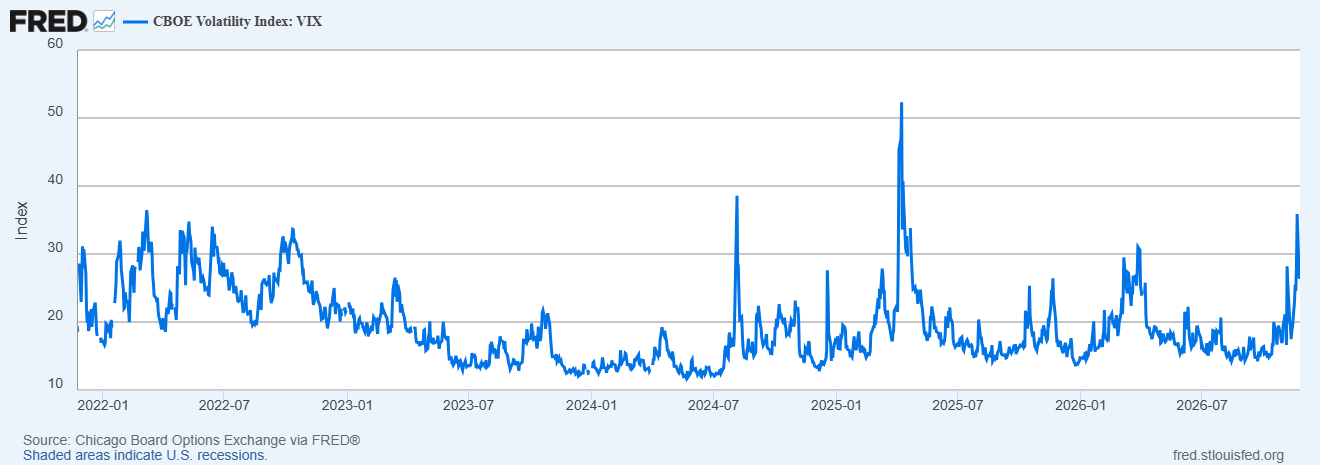
The Nasdaq Flirts With a Bear Market
The Nasdaq Composite finished just 0.62% lower after plunging as much as 4.6% earlier. The S&P 500 came nearly all the way back, closing down 0.25% at 7,182.78 after sinking as much as 3.2% at its low. The Nasdaq 100 ended 0.64% lower.
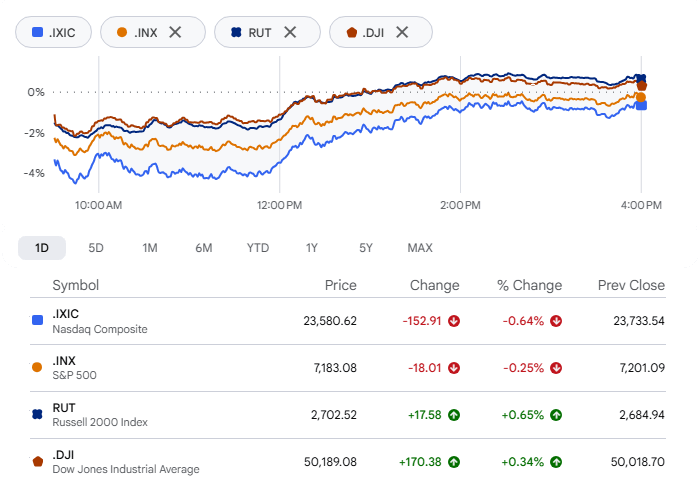
Rather than abandoning stocks altogether, dip buyers rotated out of crowded AI trades and into traditional sectors. The Dow gained 164.25 points, or 0.33%, to 50,182.95, after dropping more than 1,100 points, or 2.2%, at its low. The small-cap Russell 2000 rose about 0.7% to roughly 2,703, and about three in four S&P 500 stocks finished higher.
Chips Still Under Pressure
The State Street Technology Select Sector ETF (XLK) ended nearly 1% lower. The VanEck Semiconductor ETF (SMH) closed down about 1%, and CNBC noted it was on track for its worst 10-day stretch since April 2025. The fund fell 7.3% on Tuesday and was down more than 17% from its Nov. 11 close as of that session.
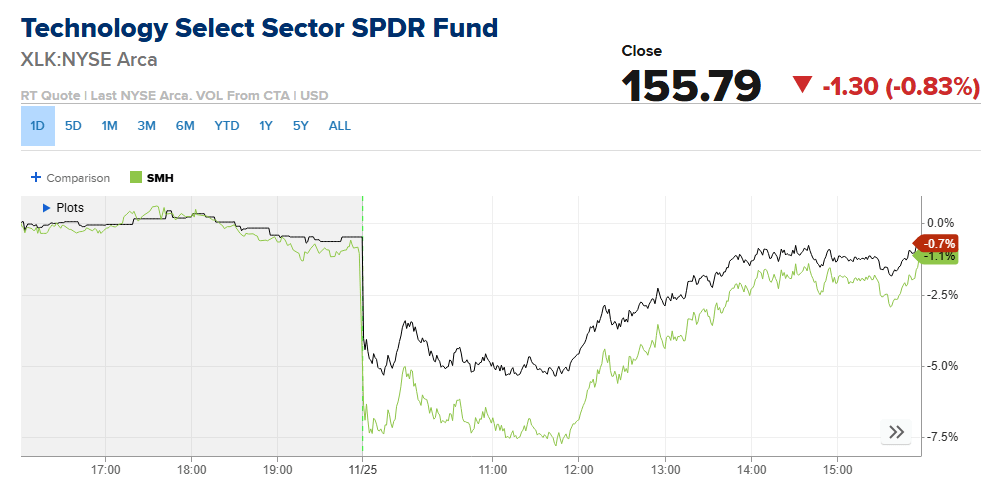
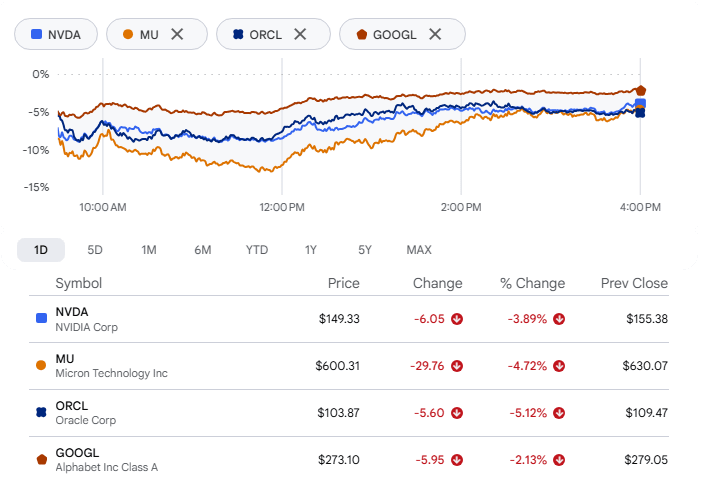
Nvidia led AI-related stocks lower, falling 3.91% to $149.30 after dipping as much as 8% earlier, and it is down about 27% in November. Micron dropped 4.5%, Oracle 5.1% and Alphabet 2.1%.
Ambarella Plunges, Anthropic Whipsaws
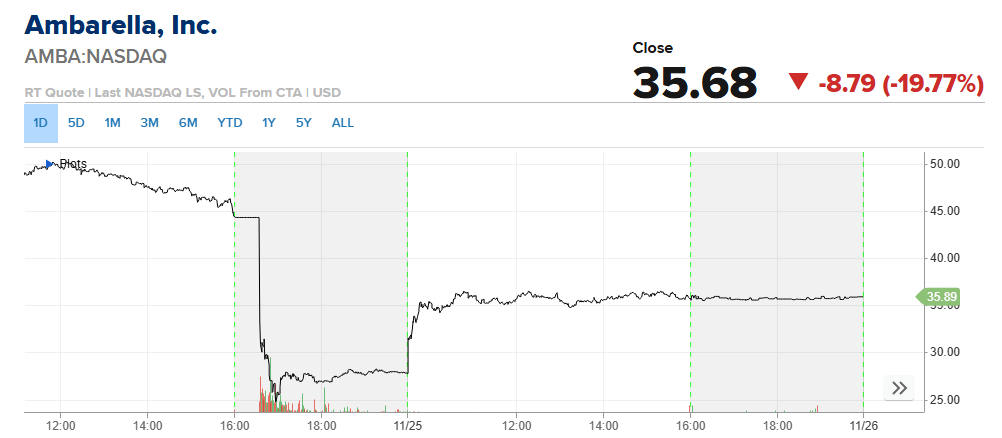
Chip company Ambarella plunged 19.8% after forecasting fourth-quarter revenue well below analyst estimates. Its third-quarter results also missed expectations.
Less than a week after its blockbuster IPO, Anthropic whipsawed. The stock fell nearly 10% at its low, to $73.85, then rallied to close up 1.08% at $82.79, a hair under the $83 offer price. It opened on IPO day at $111.50, briefly topped $115 and carried a value above $2 trillion on a fully diluted basis. At the close, its market value was about $1.09 trillion, with the stock roughly 28% below that intraday high.
Urban Outfitters Slides on Holiday Caution
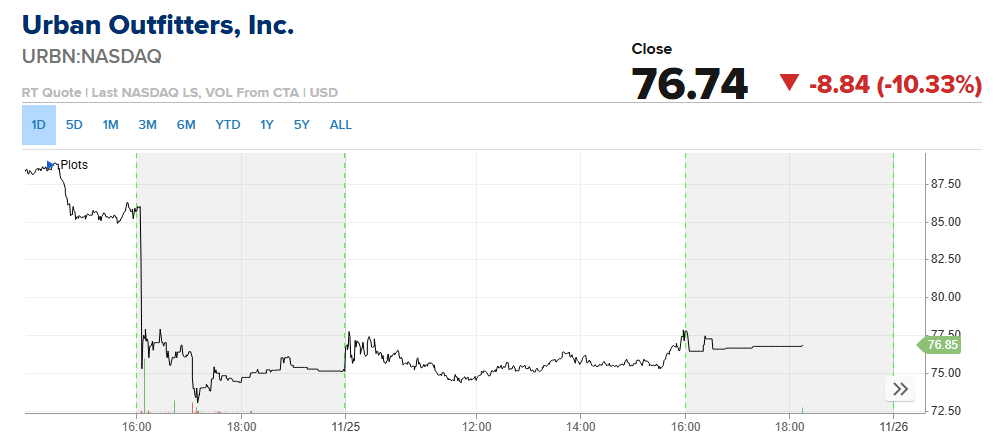
Urban Outfitters slid about 12% in early trading after third-quarter comparable retail sales grew 4.4%, short of the 5.3% analysts expected. Record revenue of about $1.67 billion roughly matched forecasts, and earnings of $1.54 a share edged past estimates. Free People Group comps rose 8.5%, the Urban Outfitters brand 5.8% and Nuuly revenue 28%, but Anthropologie managed just 1.7%. Inventory climbed 10.1% and freight costs rose, and management expects heavier fourth-quarter markdowns and flat comparable sales at Anthropologie.
How the Dow Staged Its Comeback
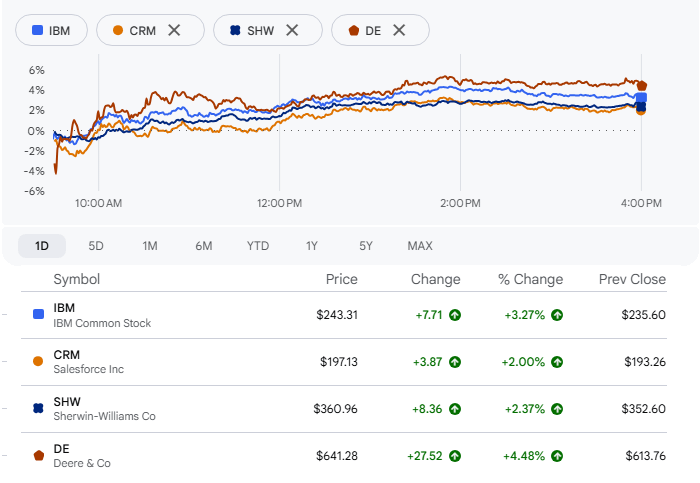
The Dow's turnaround ranked among the sharpest intraday reversals of the year, helped by non-chip names such as IBM, which rose about 3%, Salesforce and Sherwin-Williams. Deere, which isn't in the Dow, jumped 4.4% despite an earnings miss and a softer fiscal 2027 profit forecast.
Palo Alto Networks Slips on a Lawsuit
Palo Alto Networks slipped roughly 3% in after-hours trading on Wednesday after Bloomberg reported that a former regional vice president had sued the cybersecurity company. He alleges he was fired for raising concerns about accounting practices meant to inflate revenue. The suit, filed Friday in federal court in Manhattan, claims executives pushed resellers to issue purchase orders before customers had approved the deals. Palo Alto called the allegations meritless. The stock had closed the regular session up 0.89% at $356.14.
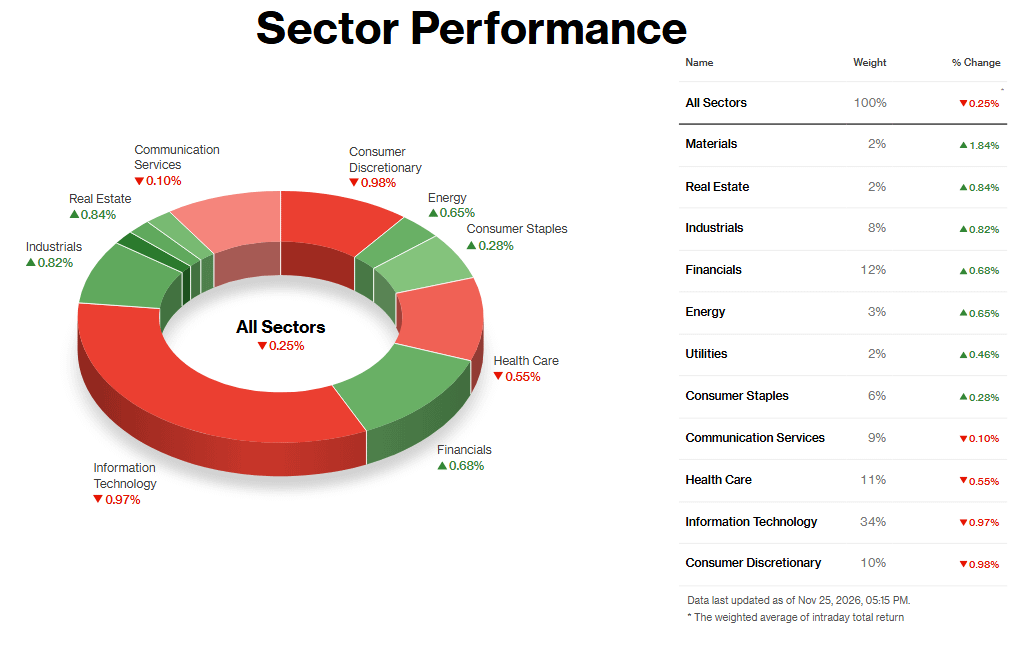
Sector Performance Summary
Best-Performing Sectors
Materials led the board, climbing 1.84% on a day when copper sank to its lowest level of the year, and gold slipped. That disconnect matters: coverage pointed to heavy volume and a rotation out of AI-linked names, with Linde, Southern Copper and Sherwin-Williams among the movers, but no single dominant driver. It reads as a funding trade, money leaving tech and landing wherever it fit, and those tend to fade once the selling stops.
Real Estate (+0.84%) and Industrials (+0.82%) caught the same current. Bonds drew a haven bid as the tech selloff deepened, which helps rate-sensitive property stocks, while Industrials had no company-specific story that stood out beyond a Dow that finished up 0.33%. Both gains look tactical, not the start of a trend.
Worst-Performing Sectors
Information Technology (−0.97%) and Consumer Discretionary (−0.98%) took the brunt of a renewed AI selloff that pushed the Nasdaq down more than 4% early. Nvidia fell 3.9% after S&P Global Ratings put its AA rating on negative watch, and credit default swap costs on Nvidia and CoreWeave hit records, while Lam Research lost nearly 6%. The worry has shifted from AI demand to AI financing, which makes this a sector-wide problem. Consumer Discretionary was largely an Amazon story: the stock fell 3.1% as a Bernstein note flagged soft cloud usage and fresh tariff proposals raised questions for its import-heavy retail arm.
Health Care (−0.55%) had no clear trigger; Eli Lilly slid 1.1%, and most large pharma names slipped, a modest give-back from a group that had benefited from the tech exodus.
Communication Services (−0.10%) was nearly flat because Meta's 3.4% gain and a firmer Verizon offset a 2.1% drop at Alphabet. Pressure was concentrated in tech and AI; the other two were stock-level noise.