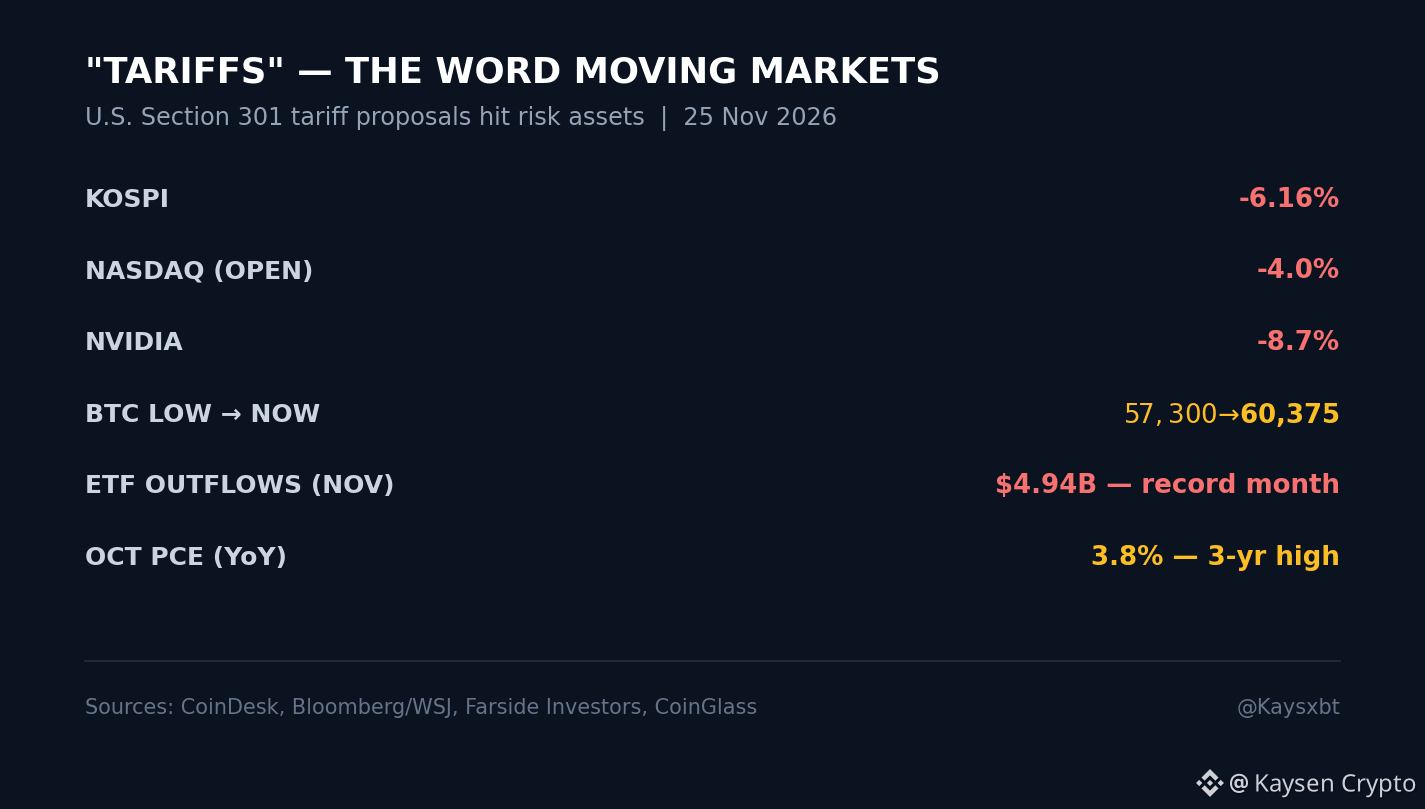
"Tariffs" is the word dominating X today — and the tape explains why.
Reports that the U.S. Trade Representative is preparing new Section 301 tariffs on 16 economies, including China and the EU, hit markets on Tuesday evening. Duties of up to 20% on some Chinese goods and up to 35% on Vietnamese goods were reported. The tariffs have not taken effect; public hearings are scheduled from 25 January.
The reaction was immediate and broad. South Korea's Kospi closed 6.16% lower, Taiwan fell as much as 8.6%, and Japan's Nikkei slid 3.7%. The Nasdaq dropped as much as 4% at the open, the S&P 500 lost 3%, and Nvidia fell 8.7%, reversing Monday's AI rally in a single session.
Bitcoin tracked the move. $BTC fell to an intraday low of $57,300 before recovering to $60,375, up 0.9% over 24 hours. Total crypto market capitalisation fell to $2.08 trillion, its lowest since September 2024, and roughly $515 million in positions were liquidated over 24 hours.
The tariff headlines landed on top of already fragile positioning. October PCE inflation printed 3.8% year-on-year, up from 3.6% and matching a three-year high. U.S. spot Bitcoin ETFs have now seen six straight days of outflows; November outflows total $4.94 billion, the worst month since the funds launched, with BlackRock's IBIT accounting for $4.17 billion. Glassnode reports investors are realising their heaviest losses since the FTX collapse in November 2022.
Galaxy has withdrawn its call that the bear market is over, warning a close below $58,525 points toward $48,500 on historical patterns.
What to watch: whether $58,525 holds into the weekly close, whether ETF outflows slow, and whether the tariff proposal hardens into policy or stays a negotiating headline.
With hearings still two months away, is the market pricing in a trade war that may not arrive — or is $58,525 the line that decides the next leg down?
Sources: CoinDesk, Bloomberg / WSJ via BitKan, Farside Investors, CoinGlass, The Block (25 Nov 2026)
#Bitcoin #Tariffs #Crypto