


#EvolveAtBinanceBlockchainWeek
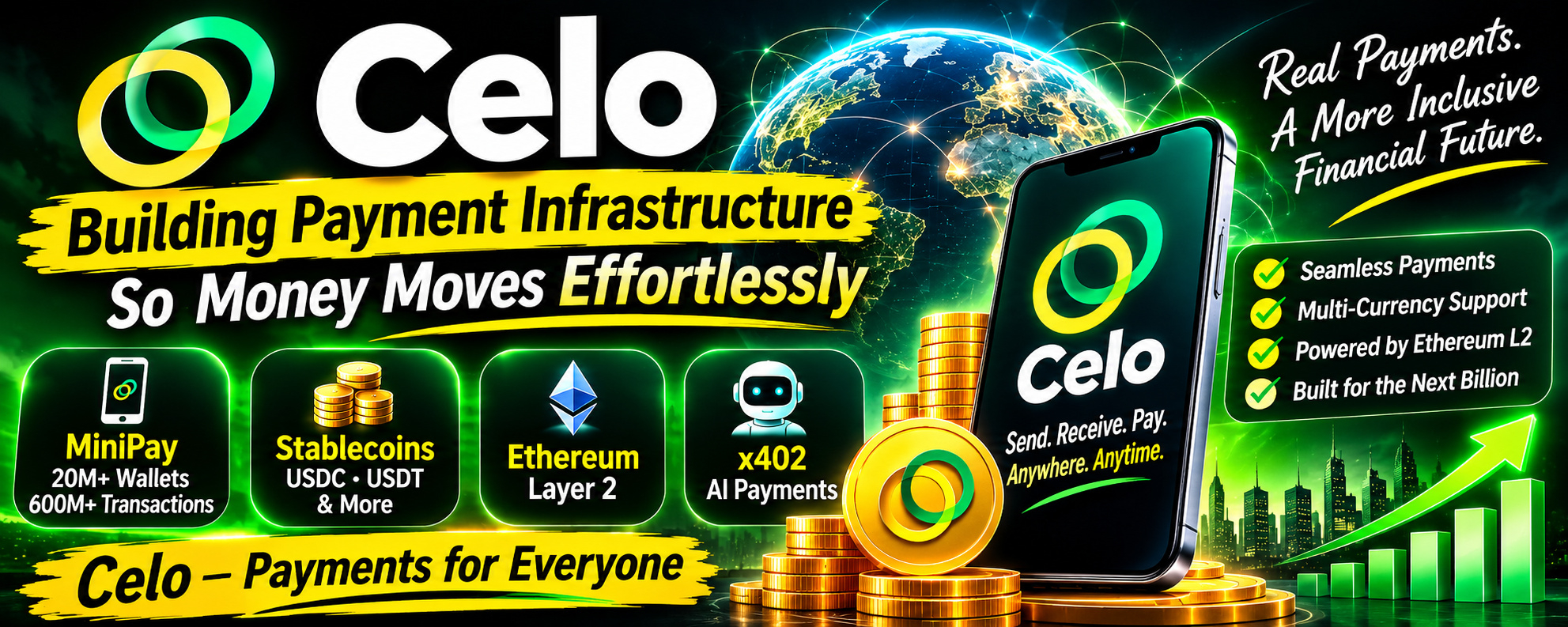
$CELO | Stablecoins | MiniPay | Ethereum L2 | x402
When I explore blockchain projects, I often ask myself one question: Would someone outside the crypto community actually use this?
That question is what made Celo interesting to me.
Celo is not simply trying to create another blockchain where people trade tokens.
Its broader direction is focused on mobile payments, stablecoins and making money easier to move between people, applications and services.
And I think that is a much more interesting problem to explore.
From a Standalone Blockchain to Ethereum Layer 2
Celo launched in 2020, initially operating as its own blockchain. In March 2025, it transitioned to an Ethereum Layer 2 built on the OP Stack.
This transition was important because it connected Celo more closely to Ethereum's settlement ecosystem while maintaining its focus on low-cost, mobile-friendly payments.
Its architecture incorporates the OP Stack, EigenDA for data availability and Ethereum settlement.
Celo also supports fee abstraction, allowing users to pay transaction fees using supported tokens instead of always needing a separate gas token.
To me, removing unnecessary steps from the payment experience matters more than making the technology sound complicated.
MiniPay Is a Major Part of the Adoption Story
MiniPay, developed by Opera, is one of the ecosystem's most interesting products.
It is designed around mobile users and stablecoin payments, aiming to simplify wallet access and transactions.
According to ecosystem-reported figures, MiniPay has surpassed 20 million wallet activations and 600 million transactions, with availability across more than 70 countries.
These numbers deserve attention, but wallet activations are not the same as active users.
I would want to see retention, recurring payment activity and how frequently people actually use the wallet.
MiniPay's integration with wallet infrastructure provider Privy is also an interesting development, particularly around simpler wallet access and authentication.
The bigger question for me is whether the experience becomes easy enough for people to use without needing to understand blockchain infrastructure.
Stablecoins Could Be the Practical Use Case
Stablecoins are where Celo's payment-focused strategy becomes easier to understand.
People and businesses often want to transact in currencies they already recognize. That could mean digital dollars, euros or local currencies.
Celo's ecosystem includes stablecoins such as USDC and USDT, alongside Mento's stablecoin infrastructure and other currency-based assets.
The potential applications are straightforward:
• International payments
• Freelance payments
• Digital savings
• Local currency transactions
• Payments between businesses
However, availability alone is not enough. Liquidity, redemption, regulatory compliance and real-world accessibility all matter.
I believe the strength of a payment ecosystem should be measured by how reliably people can use it, not simply by how many assets it supports.
AI Payments Are Another Direction Worth Watching
Celo's x402 infrastructure introduces an interesting possibility for AI agents.
An AI agent may need to pay for computing resources, APIs, information or digital services.
Traditional payment systems may not always fit these automated interactions.
The x402 approach uses a payment request through HTTP 402, allowing payment authorization and verification to become part of a software interaction.
Celo has also introduced infrastructure for facilitating these payments using stablecoins.
I find this concept interesting because digital payments could eventually involve not only humans but also software interacting with other software.
Still, the technology is early in its commercial adoption.
I want to see actual recurring transactions, businesses integrating it and meaningful demand before treating AI payments as a proven growth engine.
What Does This Mean for CELO?
This is the part I would examine carefully.
A growing ecosystem does not automatically mean the native token captures the same value.
CELO has roles in governance and the network's economic structure.
However, fee abstraction means users can pay transaction fees with supported tokens, so payment activity does not necessarily require every user to directly hold CELO.
That creates an important distinction between network adoption and token demand.
I would pay attention to governance decisions, network revenue, token-related economic mechanisms and transparent reporting rather than assuming ecosystem growth alone will drive token value.
Risks I Would Not Ignore
Celo has an interesting direction, but there are still challenges:
• Wallet activations must translate into recurring usage.
• Stablecoins require liquidity and reliable infrastructure.
• Other networks and traditional payment providers compete in this space.
• AI agent payments still need commercial adoption.
• Network growth does not guarantee token price appreciation.
My Honest Take
What makes Celo interesting to me is its focus on a practical problem.
MiniPay focuses on accessibility. Stablecoins provide familiar currencies.
Ethereum Layer 2 infrastructure supports scalable transactions. And x402 opens another possibility for automated payments.
I don't think every development automatically translates into success.
But I do think payment infrastructure is a space worth following closely.
The indicators I would watch are recurring MiniPay activity, stablecoin transaction growth, real integrations, network revenue and how the economic model connects ecosystem activity with CELO.
For me, the most interesting blockchain projects will not necessarily be the ones with the loudest narratives.
They will be the ones people actually use without having to think about the technology behind them.
That is the direction I find worth watching with Celo.
This is my personal research and opinion, not financial advice.
