

25 Nov 2026, 08:35:10
Bitcoin extends losses, trading below $58,700 on Wednesday and putting its yearly low of $55,130 back in focus.
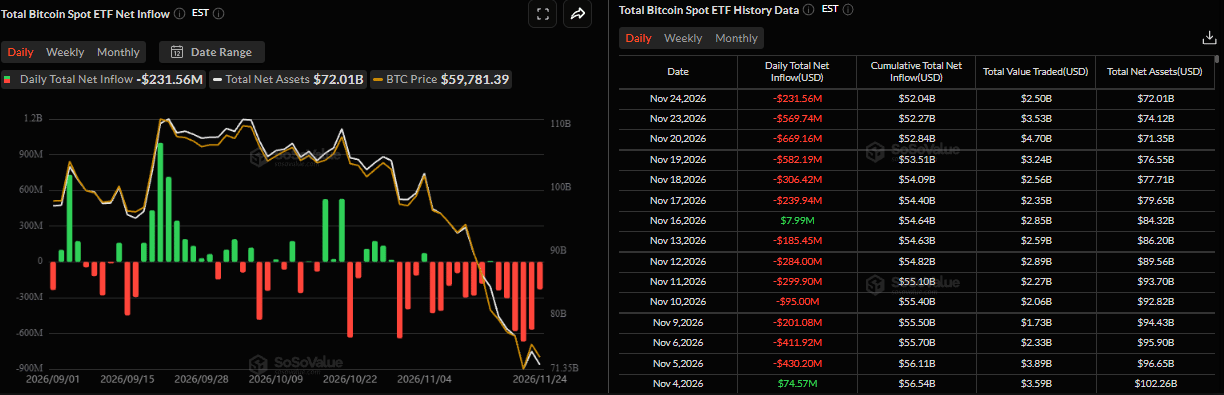
US-listed BTC Spot ETFs recorded an outflow of $231.56 million on Tuesday, extending their withdrawal streak to six consecutive days.
Market participants await US PCE inflation data for fresh clues on the Fed’s policy path and fresh impetus for risk assets.
Bitcoin (BTC) extends correction, trading below $58,700 on Wednesday and putting its yearly low of $55,130 back in focus. The bearish outlook strengthens as BTC spot Exchange Traded Funds (ETFs) record persistent outflows and broader market uncertainty weighs on sentiment. Investors now turn to US Personal Consumption Expenditures (PCE) data for fresh clues on the Federal Reserve’s (Fed) policy outlook, which could bring fresh volatility for the Crypto King.
Selling pressure remains robust
Institutional demand for Bitcoin has weakened so far this week. SoSoValue data shows BTC spot ETFs recorded net outflows of $231.56 million on Tuesday, marking the sixth straight day of withdrawals.
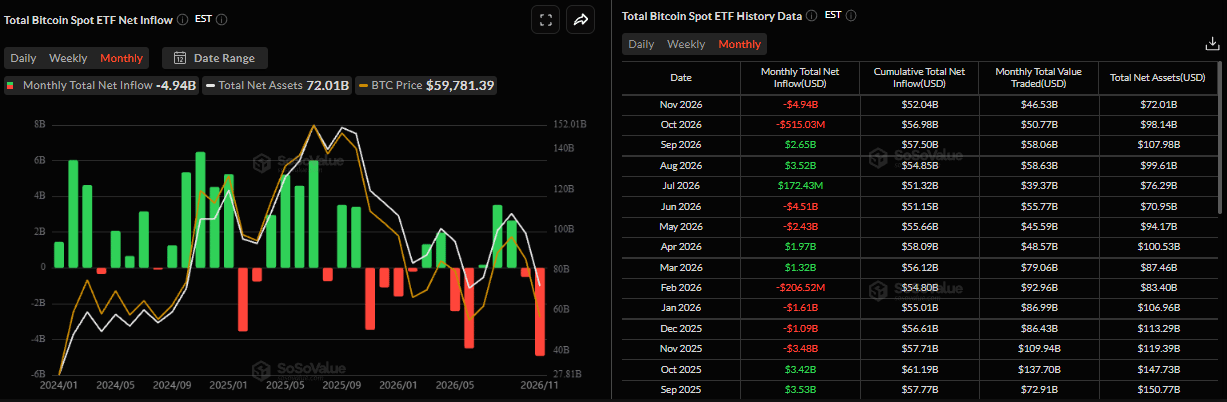
Moreover, BTC spot ETFs have recorded net outflows of $4.94 billion so far in November, the highest monthly outflows since their launch in January 2024. If this trend persists or accelerates through the week, sustained selling pressure could weigh further on Bitcoin, increasing the risk of a retest of its yearly low at $55,130.
All eyes on US PCE data
The US Personal Consumption Expenditures (PCE) Price Index, the Fed’s preferred inflation gauge, is due later in the North American session, alongside the second estimate of US Q3 Gross Domestic Product (GDP). The data could shape expectations for the Fed’s monetary policy outlook, influencing US Dollar (USD) demand and risk appetite.
Meanwhile, escalating geopolitical tensions could provide additional support for the USD and limit BTC’s recovery attempts. Shipping attacks near the Strait of Hormuz and stalled diplomatic efforts to end the US-Iran conflict have kept geopolitical risks elevated.
Iran’s Islamic Revolutionary Guard Corps (IRGC) said that it has targeted a non-compliant container ship illegally transiting the strategic waterway. Moreover, Iran-backed Houthis threatened to target Saudi Arabia’s ports on the Red Sea coast in retaliation for a Saudi-led coalition attack on Yemen’s Hodeidah port, which keeps the geopolitical risk premium in play and favors USD bulls.
This, in turn, suggests any recovery in BTC is more likely to be sold into and remain capped. Earlier optimism around Nvidia’s reinstatement of Jensen Huang as CEO, and a wave of short liquidations, failed to signal a sustained shift in market sentiment, suggesting a cautious outlook for BTC.
Bitcoin technical outlook: Risks fresh yearly low
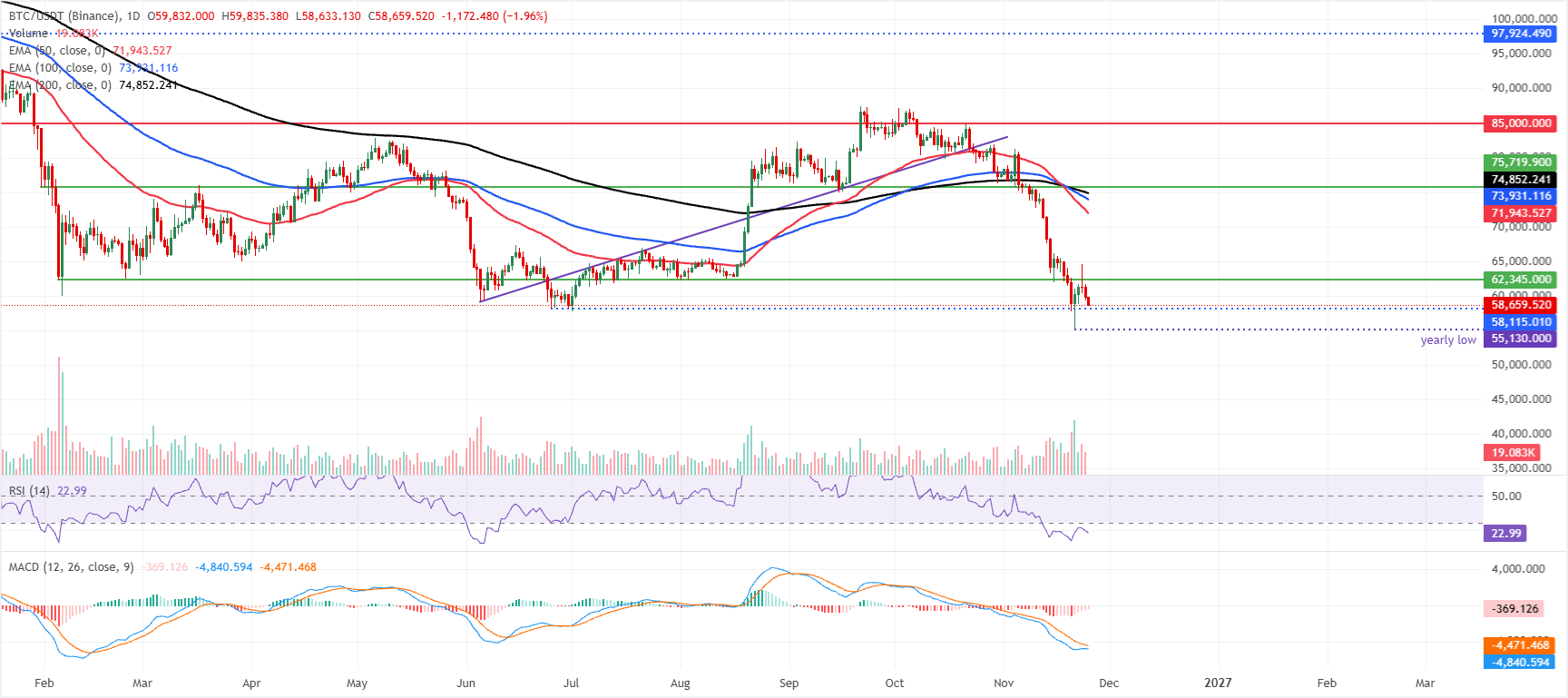
Bitcoin price trades below $58,700 at the time of writing on Wednesday, extending a bearish phase after failing to close above the key resistance level at $62,345 earlier this week. Moreover, BTC trades well below the 50-day, 100-day, and 200-day Exponential Moving Averages (EMAs), clustered between roughly $71,943 and $74,852.
The Relative Strength Index (RSI) at 22 sits in oversold territory on the daily chart. At the same time, the Moving Average Convergence Divergence (MACD) histogram remains negative, which together hint at persistent downside pressure even as the sell-off risks becoming stretched.
On the topside, initial resistance emerges at the horizontal level at $62,345, followed by the 50-day EMA near $71,943, the 100-day EMA at $73,931 and the 200-day EMA at $74,852, forming a dense overhead supply zone that would need to be reclaimed to ease the bearish bias. A more significant barrier is seen at the horizontal level around $85,000, where a sustained break would be required to signal a more durable recovery. Until then, BTC remains vulnerable, putting its yearly low of $55,130 back in focus.
(The technical analysis of this story was written with the help of an AI tool. Know more.)
Bitcoin, altcoins, stablecoins FAQs
What is Bitcoin?
Bitcoin is the largest cryptocurrency by market capitalization, a virtual currency designed to serve as money. This form of payment cannot be controlled by any one person, group, or entity, which eliminates the need for third-party participation during financial transactions.
What are altcoins?
Altcoins are any cryptocurrency apart from Bitcoin, but some also regard Ethereum as a non-altcoin because it is from these two cryptocurrencies that forking happens. If this is true, then Litecoin is the first altcoin, forked from the Bitcoin protocol and, therefore, an “improved” version of it.
What are stablecoins?
Stablecoins are cryptocurrencies designed to have a stable price, with their value backed by a reserve of the asset it represents. To achieve this, the value of any one stablecoin is pegged to a commodity or financial instrument, such as the US Dollar (USD), with its supply regulated by an algorithm or demand. The main goal of stablecoins is to provide an on/off-ramp for investors willing to trade and invest in cryptocurrencies. Stablecoins also allow investors to store value since cryptocurrencies, in general, are subject to volatility.
What is Bitcoin Dominance?
Bitcoin dominance is the ratio of Bitcoin's market capitalization to the total market capitalization of all cryptocurrencies combined. It provides a clear picture of Bitcoin’s interest among investors. A high BTC dominance typically happens before and during a bull run, in which investors resort to investing in relatively stable and high market capitalization cryptocurrency like Bitcoin. A drop in BTC dominance usually means that investors are moving their capital and/or profits to altcoins in a quest for higher returns, which usually triggers an explosion of altcoin rallies.
Source:Fxstreet
#bitcoin #Binance #BitcoinDunyamiz $BTC
