

道AFI469
每天下午2点直播 ‖web3财富专区 ‖一级日调研‖优质标的发掘
1.3K+ подписок(и/а)
13.8K+ подписчиков(а)
11.0K+ понравилось
Посты
Все
Цитирования
Активно
PINNED
PINNED

В эфире:
@可可529
[В ЭФИРЕ] 🎙️ 追涨杀跌为什么总亏钱,一起交流底层逻辑
Слушатели: 7.5k

大丹7878
·
--
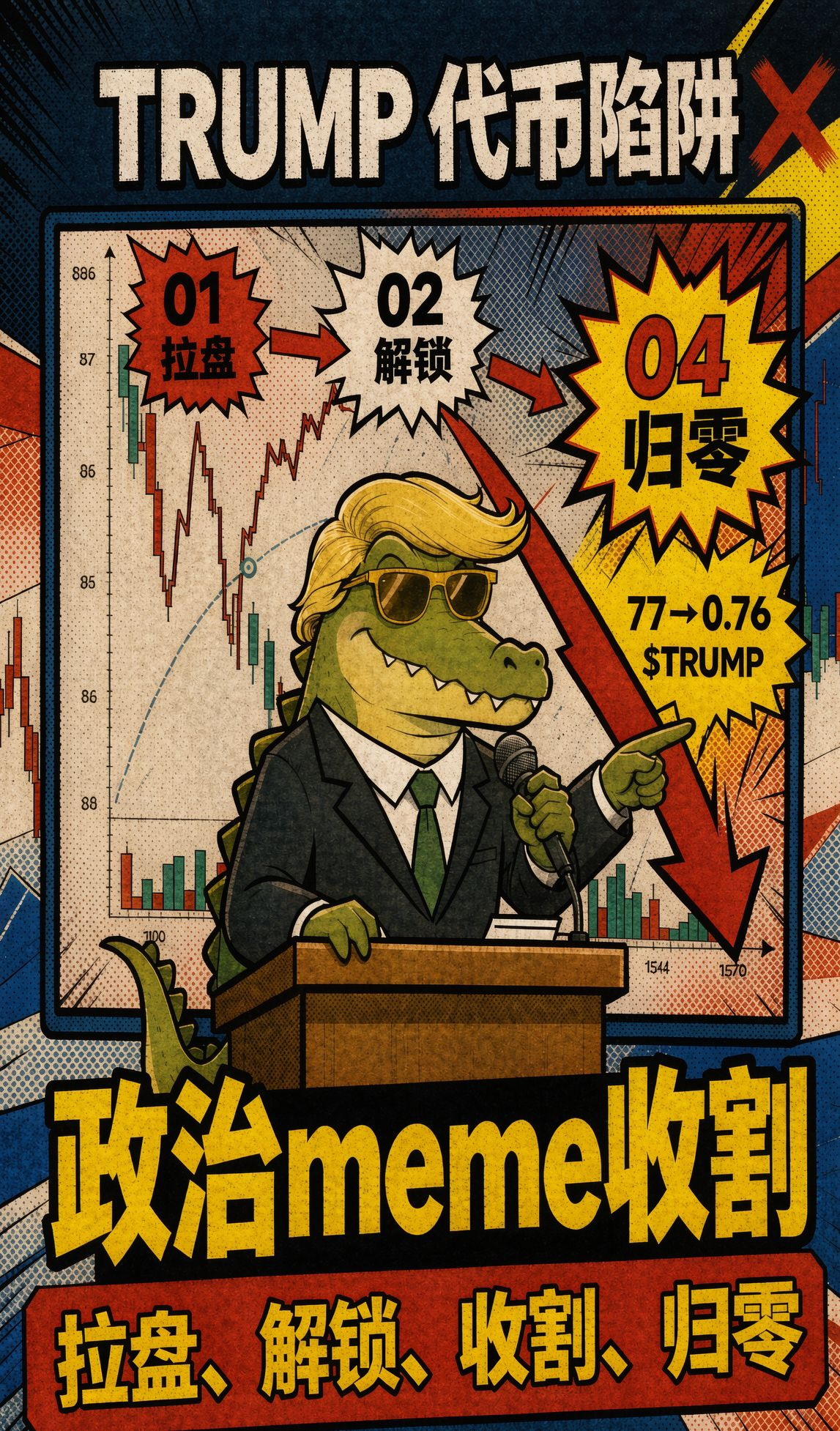
Падение谁动蛋糕搞谁?懂王家族自己把蛋糕掀了🍰💥
WLFI 三小时腰斩,储备钱包砸 ETH 实亏1900万
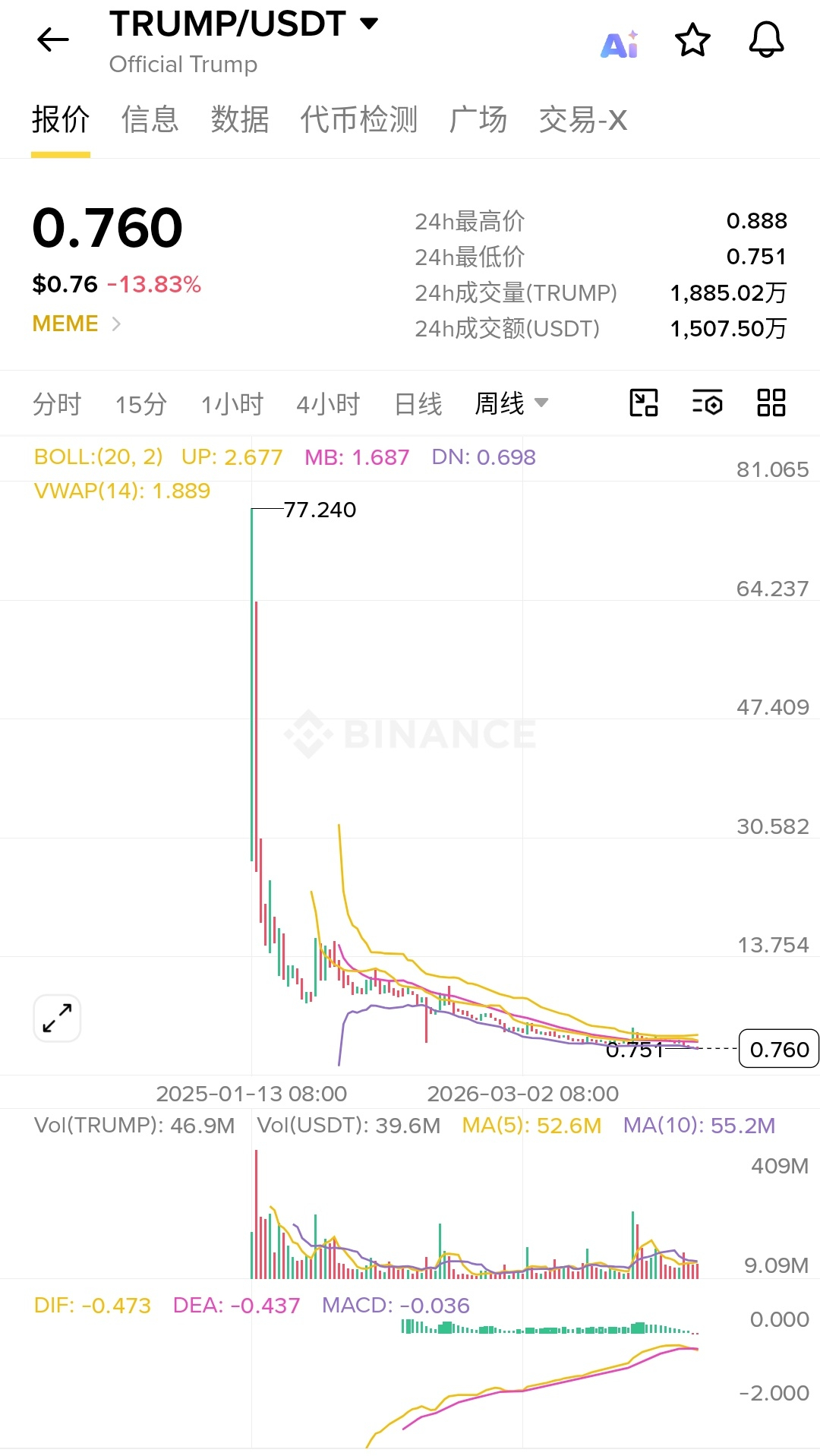
TRUMP 从77干到0.76,拉盘→解锁→收割→归零
狗庄看了都递烟:哥你比我专业
还在车里的报个数👇
$TRUMP $WLFI #狗庄
#BinanceSquareTalks
WLFI 三小时腰斩,储备钱包砸 ETH 实亏1900万
TRUMP 从77干到0.76,拉盘→解锁→收割→归零
狗庄看了都递烟:哥你比我专业
还在车里的报个数👇
$TRUMP $WLFI #狗庄
#BinanceSquareTalks

Fabi_4043
·
--
Ótima sexta-feira 🥰🥰
Siga,curta e compartilhe 🧧🧧
$LUNC
#CanMarketsReboundAfterThanksgiving?
Siga,curta e compartilhe 🧧🧧
$LUNC
#CanMarketsReboundAfterThanksgiving?


磊哥1688
·
--
倘若你真的笃定自己有点东西和本事,你就更应该凭着这口气,成就你自己,人生一定要看一次最强版本的自己!
If you truly believe you have talent and capability, you ought to hold onto this drive and build yourself up. You owe it to yourself to meet the strongest version of who you can be.
If you truly believe you have talent and capability, you ought to hold onto this drive and build yourself up. You owe it to yourself to meet the strongest version of who you can be.


Ahli Hidaya
·
--
Рост🔥 $19,000 to $376,900 (+1,984%) on a Single Nvidia Options Play?
After Nvidia shares tumbled 39% in November, a retail trader stepped in with a $19,000 bet on Nvidia call options right before the weekend.
When the board reinstated Jensen Huang as CEO on Monday, NVDA surged roughly 31% to around $165.05—turning that position into a $376,900 profit (+1,984%) at the open, per Bloomberg.
Key Market Takeaways:
Massive Leverage: Options amplified a sharp rebound move far beyond what spot shares alone could deliver.
Whale Action Too: Bloomberg also reported a large trader locking in $23.8 million in profit by selling half of a January $160 call position into the spike.
Volatility Cuts Both Ways: Even after the pop, hedging picked up quickly and NVDA pulled back on Tuesday—a reminder that headline catalysts bring extreme swings and liquidation/expiry risk.
Whether you trade stocks, options, or crypto perps—catching the catalyst is one thing, managing risk in violent volatility is another.
What’s your take on this move: pure timing or crazy risk? 👇
#NVDA #Nvidia #OptionsTrading #Trading #MarketNews #CryptoMarket #BinanceSquare$NVDAB $BTC #dyor



Bilverse
·
--
🚨 BNB RED PACKET GIVEAWAY! 🧧💛
💰 The #BilverseArmy deserves a WIN 🔥
I'm giving away a portion of $BNB to EVERYONE who participates. Yes, you read that right — EVERYONE. 👀💸
Here's how to join:
👇 COMMENT “BNB” 👇
That's it, drop “BNB” in the comments and get ready to receive your share of the red packet. 🧧
No one gets left behind. Let's spread the BNB love. ❤️
🔥 More comments, more hype, more reasons to celebrate.
Let's make this HUGE!
YOUR FRIENDLY CRYPTO GUY, #Bilverse 🚀
#BNB #CryptoGiveaway #CryptoCommunity


Bilawal Ashiq
·
--
🧧🧧Clam Repost Like SOL 🎁 🎁 Gift
$SOL
$SOL

Цитируемый контент удален
Цитируемый контент удален

NAJAF_999
·
--
‼️$DOGE 🧧 Reward is here ‼️
I’m sharing $DOGE 🧧 rewards with the community as a Bigger thank-you.
✨ Just claim your reward and enjoy! ✨
Claim it. Get rewarded
@DOGE_ $DOGE #DOGE
I’m sharing $DOGE 🧧 rewards with the community as a Bigger thank-you.
✨ Just claim your reward and enjoy! ✨
Claim it. Get rewarded
@DOGE_ $DOGE #DOGE


HF火烽
·
--
Рост🧧🧧🎁🎁 祝愿各位天天有盈利$BTC

Цитируемый контент удален

技委书记
·
--
🧧🌹🎁《看好PEPE,每人送100枚PEPE》🧧🌹🎁
🐸 为什么在众多 Meme 币中,我依然看好 PEPE?
在 Meme 币市场,短期炒作或许能带来流量,但真正能够长期留在市场视野中的,往往离不开强大的社区共识和文化传播力。
而 PEPE,正是我一直持续关注的 Meme 项目之一。
我看好 PEPE,主要有三个原因:
🔥 第一:强大的社区共识
PEPE 已经积累了庞大的社区基础和较高的市场辨识度。对于 Meme 币来说,社区活跃度和用户共识,是维持长期关注度的重要因素。
🔥 第二:独特的 Meme 文化影响力
Meme 币本质上也是注意力经济。谁拥有更强的传播能力,谁就更容易获得市场关注。PEPE 的文化符号已经形成了一定影响力,这是它的重要优势。
🔥 第三:新一轮行情的潜在机会
如果未来加密市场流动性改善,风险偏好回升,Meme 板块有望重新成为资金关注的热点。作为市场中具有较高知名度的老牌 Meme 币,PEPE 仍然值得持续观察。
当然,看好不代表盲目追高。真正的机会,需要耐心、研究和对市场节奏的判断。
我始终相信:机会属于提前做好研究、并且能够保持耐心的人。
🎁 今天给币安广场的朋友们送一波福利!
🐸 每人领取 100 PEPE!
感谢一直以来支持我的朋友们,也欢迎更多喜欢 Meme 文化的小伙伴一起交流、一起成长!
👇 评论区告诉我:你觉得 PEPE 下一轮行情还有机会吗?
点赞、评论走起来!🐸
风险提示:Meme 币价格波动较大,存在较高投资风险。本文仅代表个人观点,不构成任何投资建议。
$PEPE #币安区块链周进化由你


Wendy小幸运
·
--
[Повтор] 🎙️ 一起建设币安广场
02 ч 06 мин 44 сек · Слушатели: 960


Nayeem 承认我
·
--
To survive in this world, everyone needs money; in this world, everyone bows down to money—the world is a slave to money.💸💸💸



MrSattarking
·
--
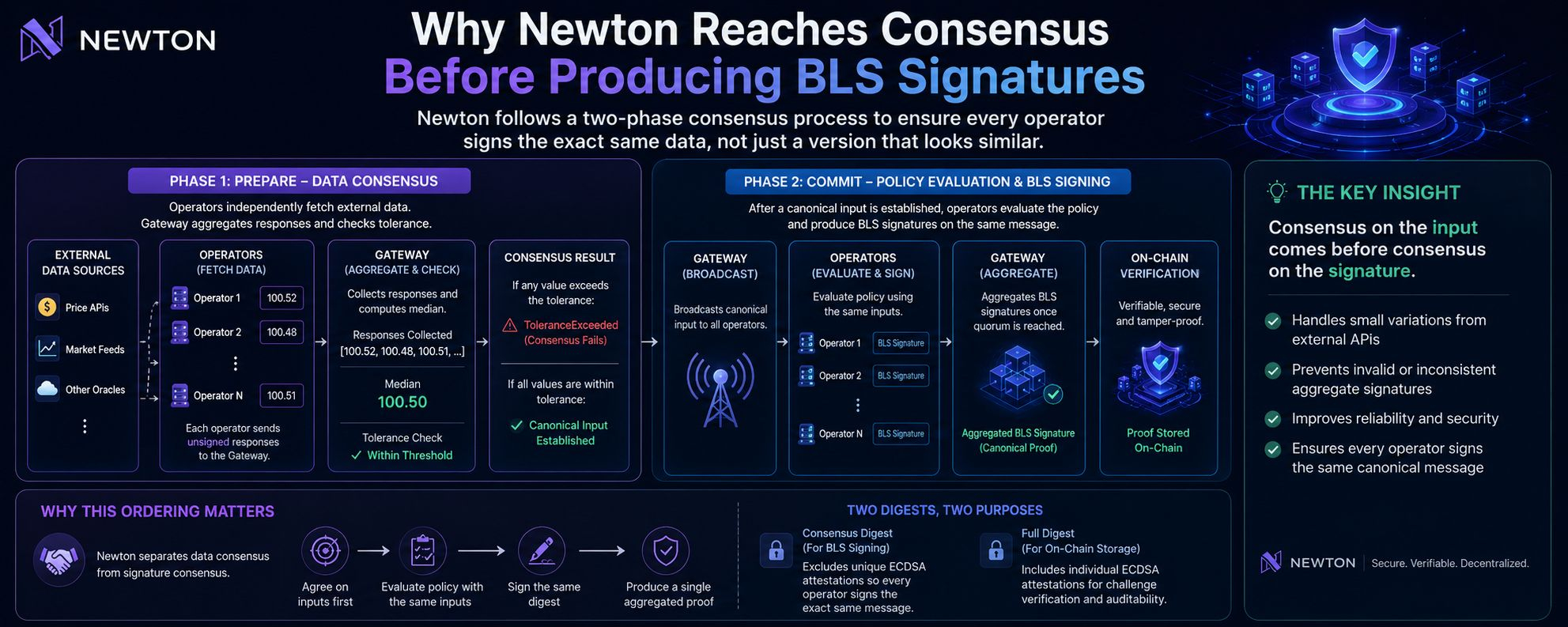
An Engineering Observation: Why Newton Reaches Consensus Before Producing BLS Signatures
While reading Newton Protocol's Consensus & Security documentation, one implementation detail stood out. Many distributed systems focus on how signatures are verified, but Newton places equal importance on ensuring every operator signs the same data in the first place.
The documentation describes a two-phase consensus process consisting of a Prepare phase followed by a Commit phase.
During the Prepare phase, operators do not immediately evaluate policies or produce BLS signatures. Instead, each operator independently fetches external policy data, such as numeric values returned by PolicyData oracles, and sends unsigned responses back to the Gateway.
At this stage, no consensus proof exists.
Instead of allowing each operator to continue with slightly different inputs, the Gateway computes the median value for each numeric field and verifies that every operator's response remains within the configured tolerance. If any value exceeds the allowed tolerance, consensus fails with a ToleranceExceeded error rather than silently excluding the outlier.
Only after a canonical set of input values has been established does the protocol enter the Commit phase.
The Gateway broadcasts the consensus data back to operators. Because every operator now evaluates the policy using the same normalized inputs, they produce BLS signatures over an identical message. The Gateway then aggregates those signatures once quorum has been reached.
The documentation also explains why this sequence matters.
Newton uses two different digest types. Operators generate individual ECDSA attestations that naturally differ between participants, but BLS aggregation requires every signer to sign exactly the same message. To satisfy that requirement, operators BLS-sign a consensus digest that excludes the unique attestations, while a separate full digest containing those attestations is stored on-chain for challenge verification.
From an engineering perspective, this ordering reduces disagreement before cryptographic consensus even begins.
Rather than asking operators to sign first and reconcile differences later, Newton first standardizes the evaluation inputs, then performs policy evaluation, and only afterward produces aggregate BLS signatures.
This approach separates data consensus from signature consensus, making the final proof depend on a shared view of external data instead of independent interpretations of it.
The result is a workflow where consensus is built in stages. Operators first agree on the inputs, then evaluate the policy, then sign the same digest, and finally produce a single aggregated proof for on-chain verification.
That sequencing is one of the more interesting engineering decisions documented in Newton Protocol's Consensus & Security design.
Question for builders: When external data comes from multiple independent sources, is it better to standardize the inputs before policy evaluation, or should each operator evaluate independently and let consensus emerge only at the signature layer?@NewtonProtocol #Newt $NEWT
Войдите, чтобы посмотреть больше материала