$AT : Why a Pause Before the Next Feed Matters
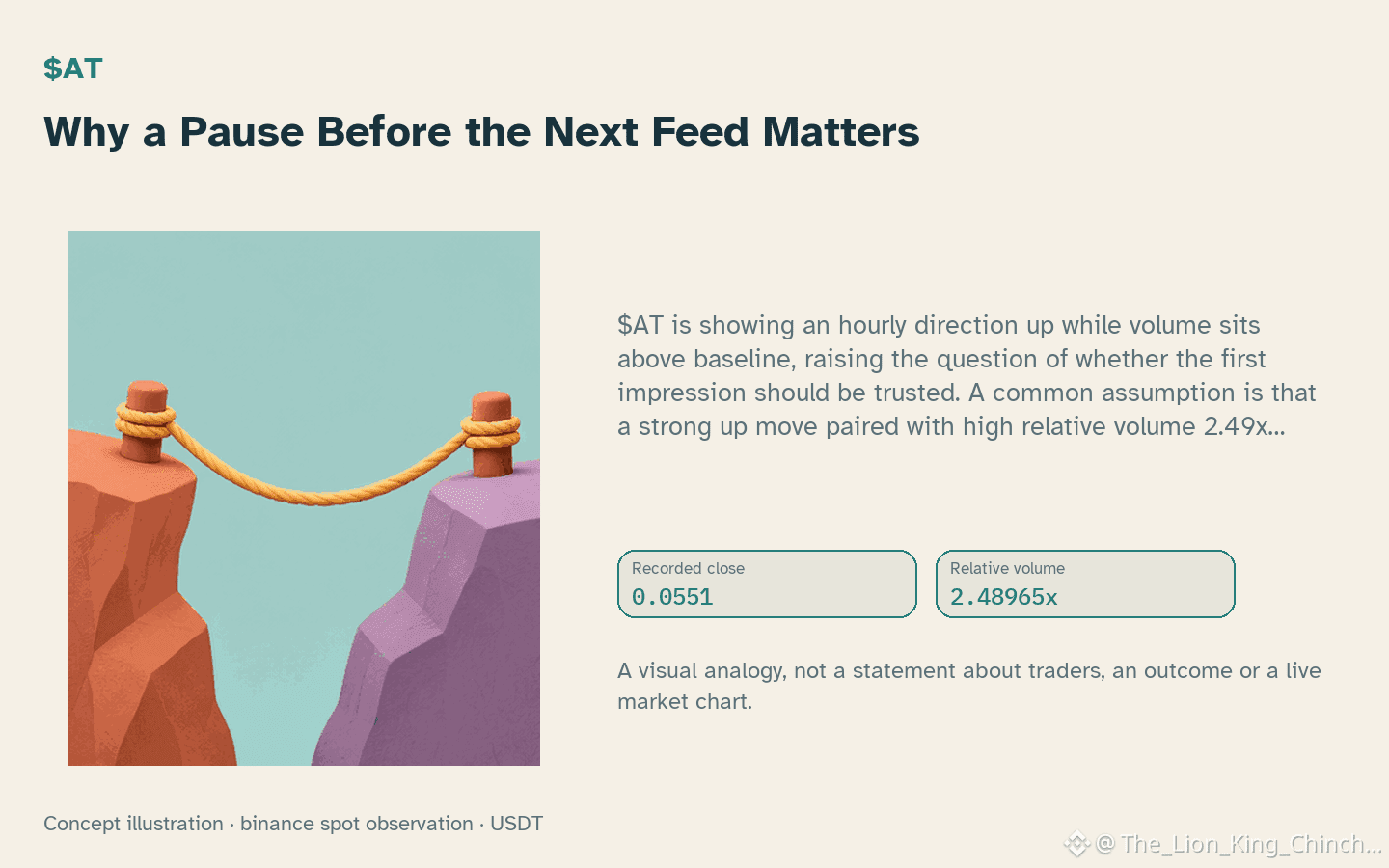
$AT is showing an hourly direction up while volume sits above baseline, raising the question of whether the first impression should be trusted. A common assumption is that a strong up move paired with high relative volume 2.49x signals a clear entry opportunity. The counterexample to consider is a thought experiment: imagine two traders, one who jumps in as soon as the candle closes and another who waits for a second, quieter feed interval to confirm the signal. The first trader enjoys a tight entry but risks chasing a move that could reverse on the next news burst; the second trader sacrifices immediacy for a clearer picture, potentially entering at a slightly worse price but with a more meaningful invalidation level.
If the price continues above the recorded resistance, the waiting trader can set a stop just beyond the next local support, using the ATR 0.00088976 as a distance guide. Conversely, the immediate entrant may set a tighter stop, increasing the chance of being stopped out by a short‑term pullback. A future closed‑candle observation that shows the price retreating below the resistance would weaken the initial bullish reading and validate the cautious approach. The reassessment condition, therefore, is simple: if the next hourly candle closes below the resistance level, reconsider the entry and favor the trade‑off that prioritises entry quality over speed.
Probabilistic market research, not a recommendation or guaranteed return.
Recheck the evidence or keep the first interpretation?
#AT #RiskManagement #CryptoLearning