


World is trying to solve a problem that's getting harder every year.
How do you know whether the person behind an online account is actually human?
AI can already generate convincing messages, images, voices, and entire conversations. For websites dealing with fake accounts, automated signups, and ticket-buying bots, verifying real people is becoming increasingly important.
That's the problem World ID is designed to address.
And the network has grown considerably.
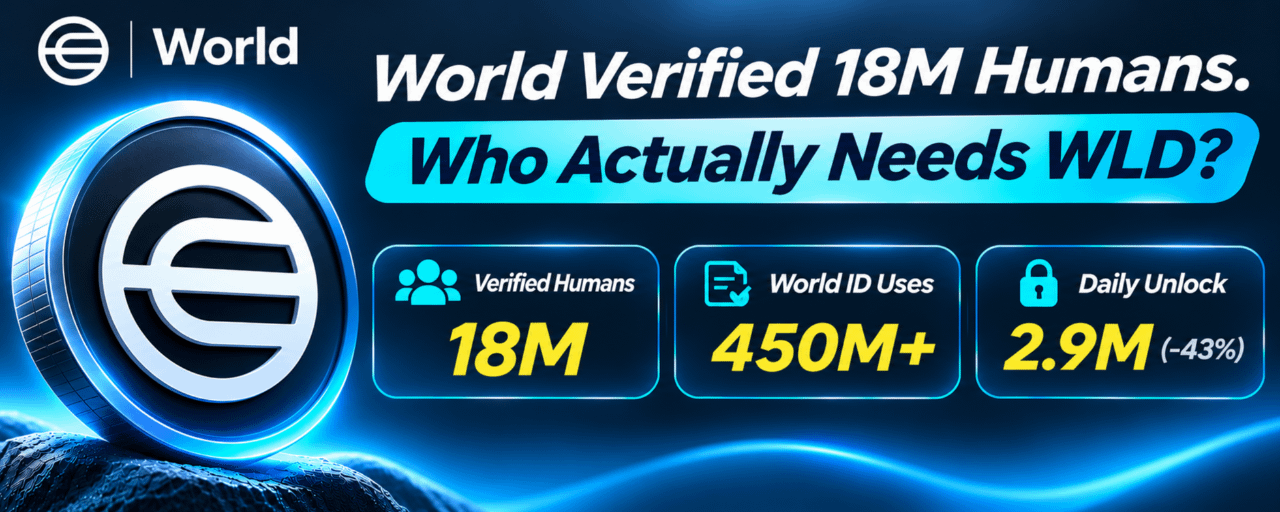
In June 2026, World Foundation reported more than 18 million verified humans and over 450 million uses of World ID.
Those are substantial figures for a project built around biometric identity verification.
But I think there's a question WLD investors need to examine separately.
If millions of people use World ID, does that mean millions of people need to buy WLD?
Not necessarily.
World ID allows individuals to prove they're unique humans without revealing their personal identities to every application they use.
The system relies on cryptographic credentials, with Orb verification providing one way to establish uniqueness.
A ticketing platform could use World ID to limit purchases to verified people. An online service could use it to reduce fake accounts.
Neither use case automatically requires the person being verified to purchase WLD.
That distinction becomes particularly interesting when we look at World's newer plans.
In April, World Foundation published a proposal for World ID fees.
The idea is to charge applications for using verification credentials while keeping the experience free for individual users.
Those fees could be settled in WLD, creating demand from businesses integrating World ID.
A portion of protocol fees could also eventually be burned.
I find that model more interesting than simply rewarding people for signing up.
It gives World a potential way to connect actual verification demand with its native token.
But there's an important catch.
The fee design and its potential economics shouldn't be confused with a proven stream of revenue flowing into WLD today.
We still need evidence showing how much applications are paying, whether those payments create net buying demand, and what happens to the tokens after collection.
There's another development worth watching.
On November 12, World and Cloudflare introduced Trusted Agent Delegation.
The initiative explores ways for websites to recognize AI agents acting on behalf of real people, while allowing site operators to control what those agents can do.
Imagine asking an AI assistant to book travel or manage an online purchase.
The website needs some assurance that the agent has legitimate permission to act for you.
World's identity infrastructure could become useful in that kind of interaction.
But this is still an emerging approach. A new industry initiative doesn't guarantee mass adoption or direct WLD revenue.
Meanwhile, token supply continues changing.
WLD has an initial supply of 10 billion tokens, with allocations for the community, development team, and investors.
On July 24, 2026, the scheduled daily unlock rate fell by 43%, from approximately 5.1 million to 2.9 million WLD.
That's a meaningful reduction.
But 2.9 million newly unlocked tokens per day still adds up to a substantial amount over a year.
And unlocking isn't identical to selling. Tokens may remain held by recipients or controlled entities after they become transferable.
For investors, the important issue is how much supply actually reaches the market.
There's also a challenge that can't be ignored.
World's biometric verification model has faced regulatory scrutiny in several countries over privacy, consent, and the handling of sensitive personal information.
Those concerns can affect where the project operates and how quickly it expands.
World describes its technology as privacy-preserving, but technical safeguards don't remove every legal or public-trust concern.
For me, WLD comes down to two things.
Can World turn human verification into a service businesses repeatedly pay for?
And can that demand become economically meaningful for WLD while millions of tokens continue unlocking?
I'd rather see verified application revenue, actual WLD-denominated fees, and measurable usage by paying businesses than another headline about total registered users.
World may be building something useful for an internet increasingly filled with AI.
Whether that becomes a strong investment case for WLD is a separate question.
