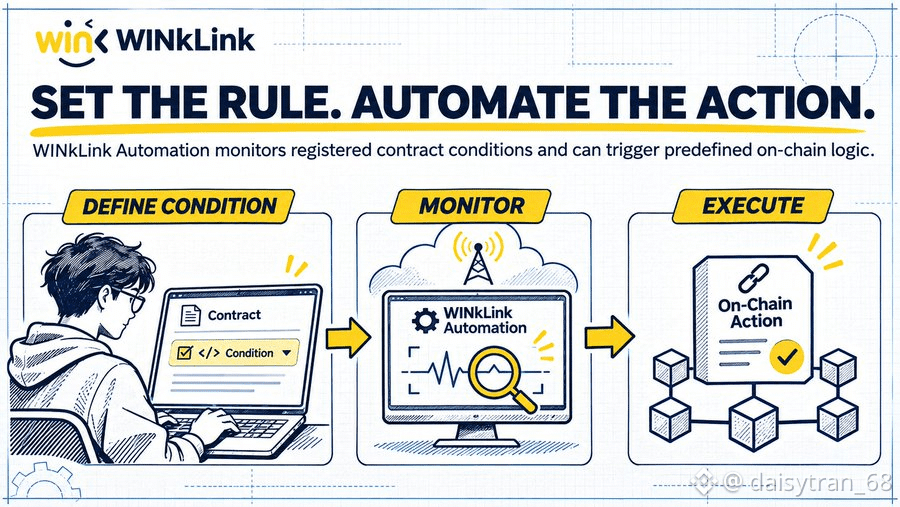
SET THE RULE. AUTOMATE THE ACTION.
Imagine running a DeFi application where certain contract conditions need to be checked continuously.
Maybe a predefined condition has been met, a specific threshold has been reached, or an on-chain event requires another action.
Without automation, someone may need to monitor these conditions manually and trigger the next transaction at the right moment.
This is where WINkLink Automation becomes useful.
Instead of relying on constant manual monitoring, developers can define the conditions that matter and let the automation system handle the monitoring process.
Here's how it works:
1️⃣
Define the conditions
Developers specify the conditions that need to be monitored by the automation system, based on their smart contract logic.
2️⃣
Monitor registered contracts
WINkLink Automation monitors the registered contract conditions to check whether the predefined requirements have been met.
3️⃣
Trigger the predefined action
When the required conditions are satisfied, the system can trigger the corresponding on-chain logic that developers have already defined.
4️⃣
Reduce manual intervention
This allows applications to automate certain contract operations without requiring someone to constantly watch the blockchain and manually initiate every action.
Personally, I think automation is an important step toward making DeFi applications more efficient.
Smart contracts can execute predefined rules, but applications still need reliable ways to detect when those rules should be activated.
By connecting condition monitoring with automated on-chain execution, WINkLink Automation helps bridge that gap.
Of course, developers still need to define the conditions, execution logic, and security requirements carefully. Automation follows the rules; it doesn't replace good contract design.
@Justin Sun孙宇晨 #TRONEcoStar @WINkLink_Official