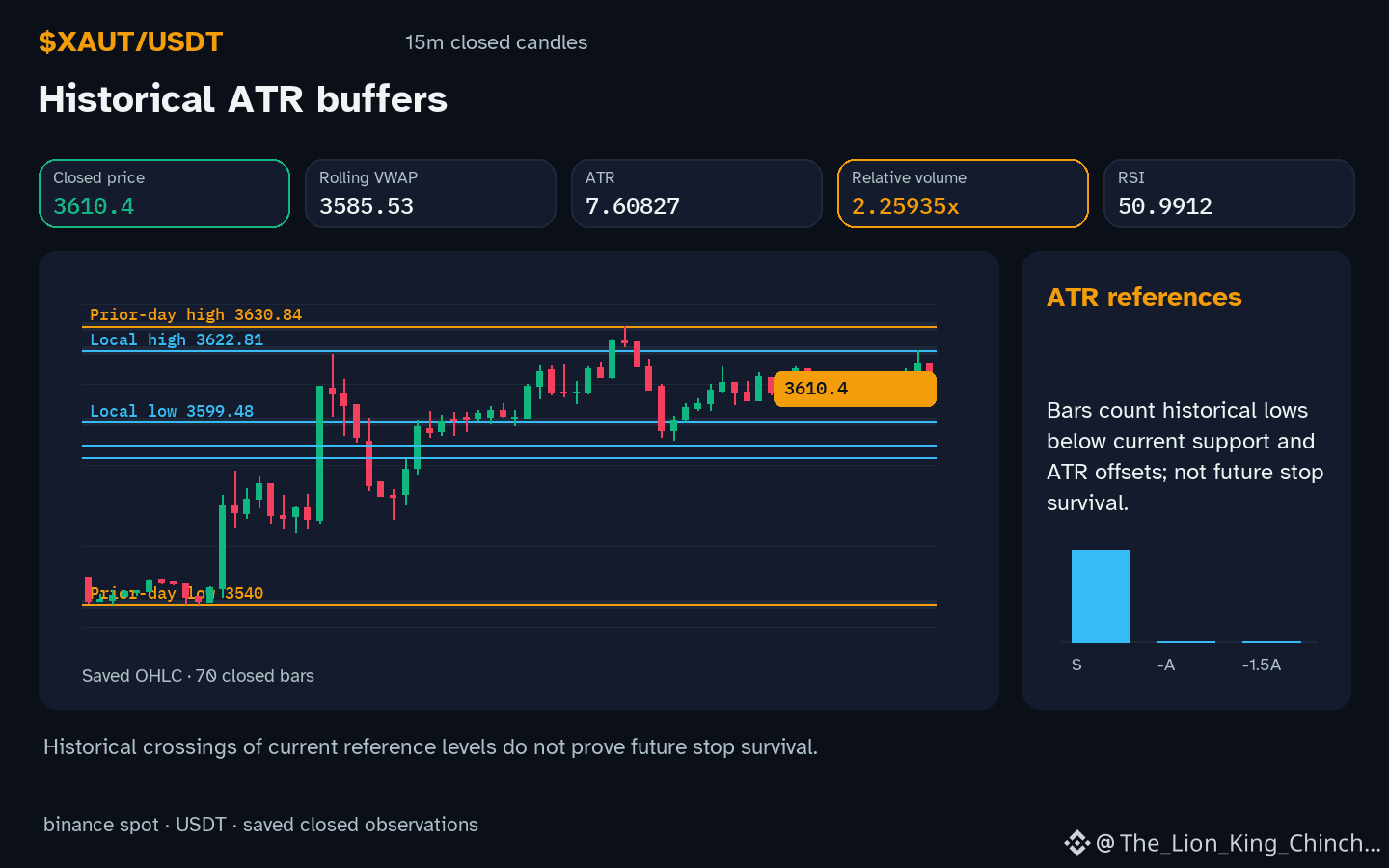
$XAUT: Execution Friction vs. Entry Precision
Can $XAUT help you trade where you planned? The asset is inside its recorded range with an upward hourly direction and volume at 2.26x baseline. This combination creates a tension: wait for a cleaner entry or act now to avoid missing the move. Execution feasibility is often the first practical constraint, not a backdrop. Imagine a hypothetical scenario where you plan to enter near specific levels. If the spread widens or liquidity thins, your executed price may differ from your limit order. This slippage can shift your stop distance. A tighter invalidation point might require better fills, but chasing can worsen entry quality. Use the ATR 7.60827 to gauge normal volatility. If your planned stop is too close relative to this measure, noise alone might trigger an exit. A meaningful invalidation respects the asset's current behavior. The RSI 51.0 offers context, not proof. If it shows momentum, it does not guarantee continuation. Look at the change in the hourly window, 0.00637089%, to see immediate direction. A self-check involves asking: can I verify my order type and expected fill rate before submitting? If the answer is unclear, waiting may be safer than forcing a position. What future closed-candle evidence could weaken this view? A daily close outside the local support or resistance levels described in the data would challenge the current range-bound expectation. This reassessment condition helps you stay flexible without relying on unverified forecasts.
Probabilistic market research, not a recommendation or guaranteed return.
#XAUT #RiskManagement #CryptoLearning