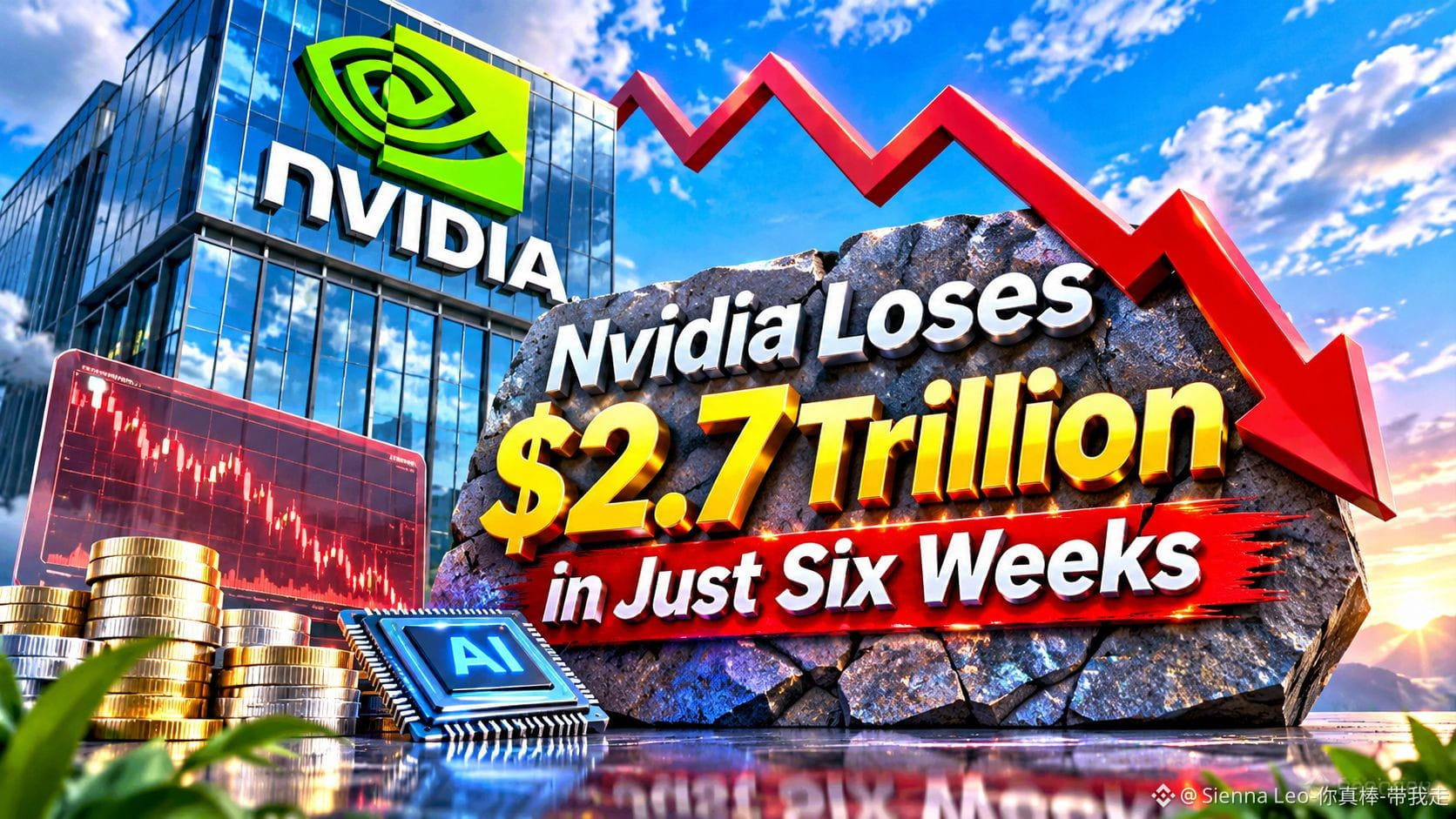

#NvidiaLoses$2.7TrillionInMonthAndAHalf
🚨📉 Nvidia Loses $2.7 Trillion in Just Six Weeks: What Went Wrong? 📉🚨
Imagine watching the world's most powerful AI company lose nearly half its market value while its technology remains central to the AI revolution. That is the uncomfortable reality investors are facing with Nvidia.
Since its October 6 record high, Nvidia has lost approximately $2.7 trillion in market capitalization. Its shares plunged sharply on November 20, extending an extraordinary losing streak.
What triggered the collapse? Several pressures collided: CEO Jensen Huang's departure, growing uncertainty surrounding AI valuations, a broader technology sell-off, and reports that the SEC is examining potential accounting issues.
Importantly, an investigation is not proof of wrongdoing. The precise scope of the reported SEC inquiry remains unclear.
Here is the bigger picture: Nvidia's business and its stock valuation are two different things. Strong AI demand does not automatically justify every market price.
Even after reporting $115.84 billion in quarterly revenue, Nvidia struggled to reassure investors. This highlights a critical shift: markets increasingly want evidence that enormous AI investments can generate sustainable returns.
My takeaway? Nvidia's decline is a reminder that even exceptional companies are not immune to valuation risk, leadership uncertainty, or changing investor confidence.
Great technology does not guarantee an unstoppable stock.
Is this a temporary correction in the AI trade, or the beginning of a deeper reassessment of AI valuations?
Disclaimer: This article is for educational purposes only, not financial advice.
#NVIDIA #AI #GrowWithSAC $NVDA $EDU $XTZ