
#SolanaSets2027RoadmapToDoubleComputeCapacity Solana Wants Twice the Engine Room and Five Times the Fuel Efficiency by 2027
If you have followed crypto for more than five minutes, you know the usual routine when a blockchain announces a roadmap. You get a wall of buzzwords, a bunch of vague promises about "revolutionizing finance," and a timeline that stretches into the next decade.
So when Anza, the core engineering team behind Solana, took the stage at Breakpoint in London this week to lay out their 2027 game plan, it was refreshing to hear something that actually sounded like a mechanic talking about tuning an engine.
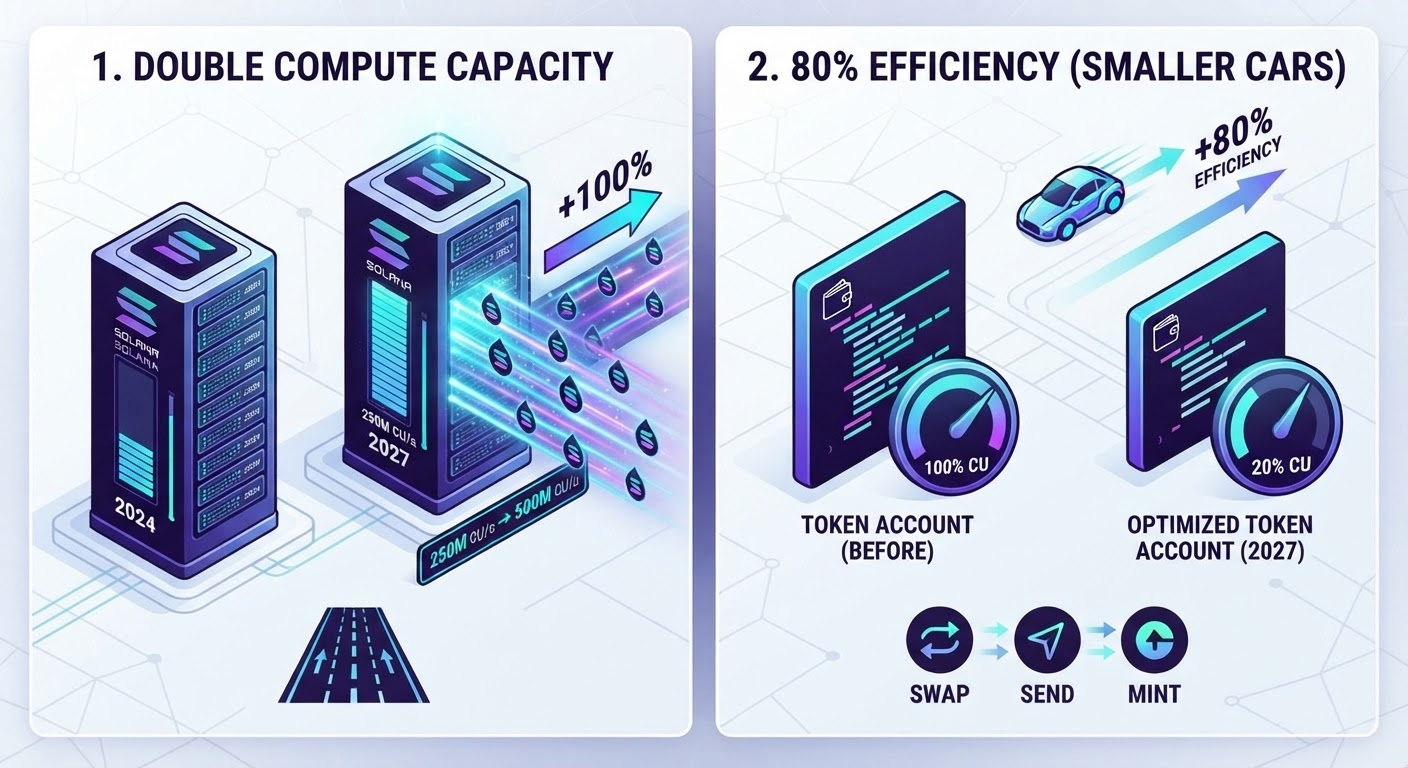
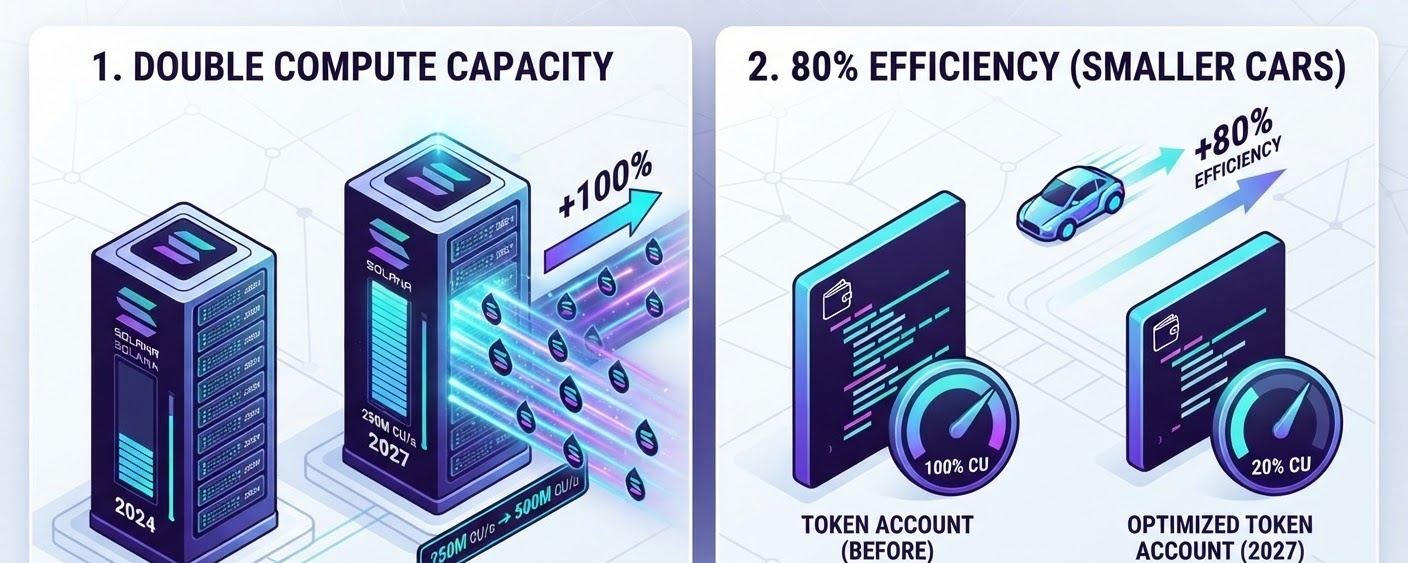
The headline is straightforward: Solana wants to double its compute capacity by the end of 2027 while making everyday transactions use 80% less computing power.
Let's strip away the technical jargon and talk about what that actually means if you use or build on the network.
Bigger highway, smaller cars
Right now, Solana can process roughly 250 million compute units per second. Think of compute units as the fuel required to run an action on the network. Sending a token, swapping on a decentralized exchange, or minting an NFT all burn a certain amount of this fuel. By the end of 2027, Anza wants to push that ceiling to 500 million compute units per second.
Doubling the capacity is great, because it means the highway is twice as wide.
The smarter part of the plan, though, is making the cars smaller. Anza is targeting an 80% reduction in the compute units required for token account operations. Because basic token transfers and account updates make up the vast majority of activity on Solana, slashing their footprint clears out a massive amount of room without forcing the people running the network to go out and buy ridiculously expensive server hardware. You get way more traffic through the same pipes simply because the code isn't wasting energy.
Why this matters beyond speed
A faster, cheaper chain is nice, but developers care about what they can build when the ceiling gets raised. Anza bundled a few other upgrades into this roadmap that quietly open the door for much heavier apps:
More complex transactions: Currently, a single Solana transaction can only interact with 64 accounts at once. The 2027 plan bumps that limit to 96. If you are a developer building a complex trading app or a game that needs to update a lot of data in one go, you no longer have to chop your code into awkward, multi-step workarounds.
AI math right on the chain: They are adding something called on-chain vector processing to the virtual machine. Without getting lost in computer science theory, vector math is the backbone of artificial intelligence models. Building support for it directly into Solana means developers can run actual AI models on-chain instead of relying on outside servers.
Cheaper storage deposits: Through a separate proposal called SIMD-0437, the network is steadily cutting the amount of SOL users have to lock up just to keep a token account open. Over the next few steps, that deposit is dropping from about 0.001488 SOL down to 0.000204 SOL. For apps onboarding hundreds of thousands of users, that saves serious money.
Cleaner plumbing under the hood: They are also planning to replace Turbine (how blocks get passed around the network) with a faster system called Rotor, and introduce clearer transaction ordering rules under a system called Constellation.
Should we actually believe the timeline?
Crypto roadmaps have a reputation for slipping, and it is completely fair to look at a 2027 target with a healthy dose of skepticism.
That said, Solana has some recent momentum working in its favor. Just last month, in October 2026, the network rolled out its Alpenglow consensus upgrade. That update dropped transaction finality from around 12.8 seconds down to roughly 150 milliseconds. By the time you blink, your transaction isn't just pending, it is locked in permanently. Shipping a core consensus overhaul on schedule gives their 2027 engineering targets a lot more weight than a typical whitepaper wish list.
The takeaway
Solana isn't trying to reinvent itself with this roadmap. It is doubling down on what it already tries to be: a high-speed, low-cost execution layer that feels instant to the end user. If Anza hits these numbers over the next year, the network won't just handle more volume without choking; it will give developers enough breathing room to build apps that simply wouldn't fit on a blockchain a couple of years ago.