if NVIDIA is growing. The market is getting less convinced. That's the part I can't ignore.
Honestly, this is what makes the recent NVIDIA sell-off interesting to me.
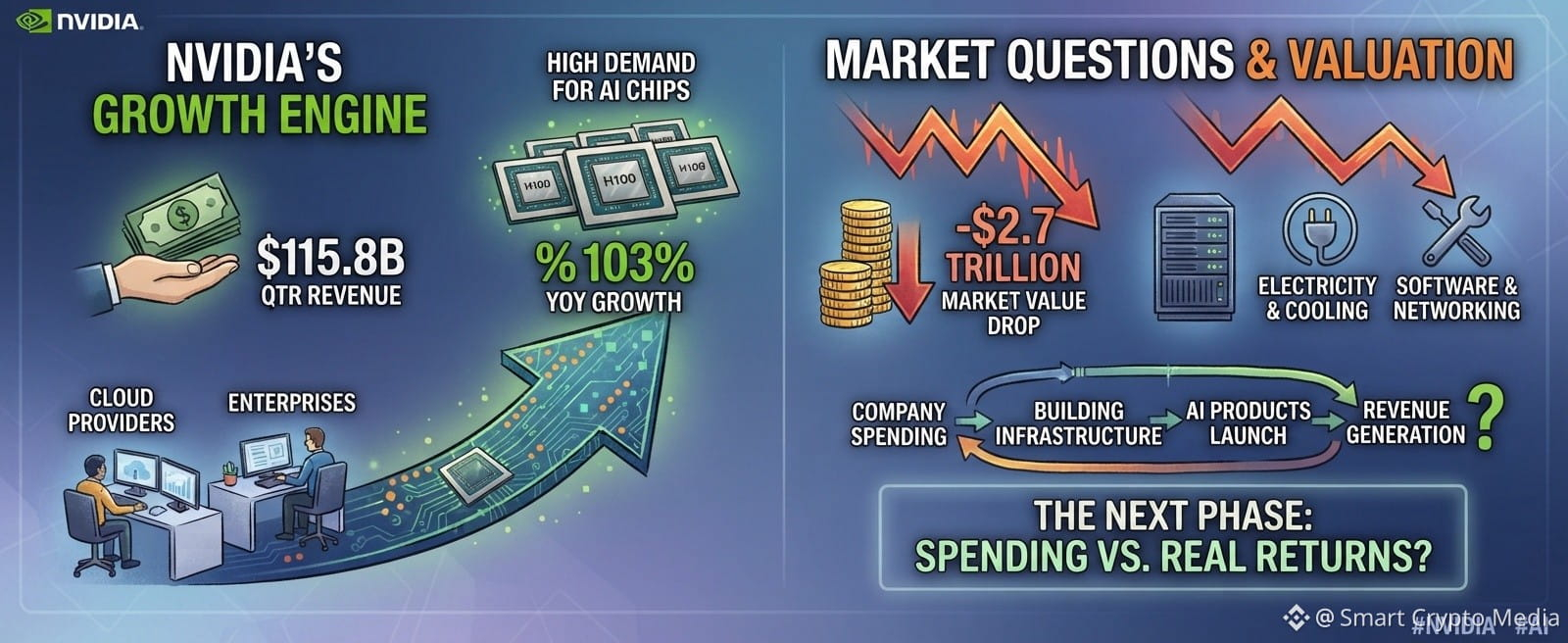
We're talking about a company reporting $115.8 billion in quarterly revenue, with 103% year-over-year growth, while the market is questioning its valuation and wiping roughly $2.7 trillion off its market value from the recent peak.
Those two things can happen at the same time.
And I think that's where the AI conversation is starting to change.
For a while, the story was simple: AI demand is growing, companies need more computing power, and NVIDIA is right in the middle of it.
But building AI infrastructure is expensive.
Chips are only one part of the bill. Companies also need data centers, electricity, networking, cooling, and software. Then comes the harder part: turning all that spending into revenue and eventually into real returns.
That's the loop investors are watching.
Companies spend on AI → build infrastructure → launch AI products → try to generate revenue → justify even more spending.
If that loop works, the investment cycle can keep expanding.
But if spending grows faster than the returns, eventually the market may start asking uncomfortable questions. Not because AI is useless, but because even a promising technology has to make economic sense.
That's why I don't think a falling NVIDIA share price automatically means the AI story is finished.
At the same time, record revenue doesn't automatically mean every valuation is justified.
The technology and the stock market are not the same thing. One can keep advancing while the other reassesses expectations.
Maybe this is the next phase of the AI narrative: less focus on how much companies can spend, and more focus on what that spending actually produces.
So what's the bigger test now: continued AI demand, or proof that the billions being invested can generate real returns?
#NVIDIA #AI #SmartCryptoMedia
Honestly, this is what makes the recent NVIDIA sell-off interesting to me.
We're talking about a company reporting $115.8 billion in quarterly revenue, with 103% year-over-year growth, while the market is questioning its valuation and wiping roughly $2.7 trillion off its market value from the recent peak.
Those two things can happen at the same time.
And I think that's where the AI conversation is starting to change.
For a while, the story was simple: AI demand is growing, companies need more computing power, and NVIDIA is right in the middle of it.
But building AI infrastructure is expensive.
Chips are only one part of the bill. Companies also need data centers, electricity, networking, cooling, and software. Then comes the harder part: turning all that spending into revenue and eventually into real returns.
That's the loop investors are watching.
Companies spend on AI → build infrastructure → launch AI products → try to generate revenue → justify even more spending.
If that loop works, the investment cycle can keep expanding.
But if spending grows faster than the returns, eventually the market may start asking uncomfortable questions. Not because AI is useless, but because even a promising technology has to make economic sense.
That's why I don't think a falling NVIDIA share price automatically means the AI story is finished.
At the same time, record revenue doesn't automatically mean every valuation is justified.
The technology and the stock market are not the same thing. One can keep advancing while the other reassesses expectations.
Maybe this is the next phase of the AI narrative: less focus on how much companies can spend, and more focus on what that spending actually produces.
So what's the bigger test now: continued AI demand, or proof that the billions being invested can generate real returns?
#NVIDIA #AI #SmartCryptoMedia