

While Nvidia NVFP4 and AMD OCP MXFP4 both utilize 4-bit floating-point representation ($E2M1$: 1 sign bit, 2 exponent bits, 1 mantissa bit) to achieve up to double the compute throughput of FP8 during AI LLM inference, they differ fundamentally in microscaling block size, scaling precision, hardware lock-in, and accuracy retention.
Architectural & Specification Comparison
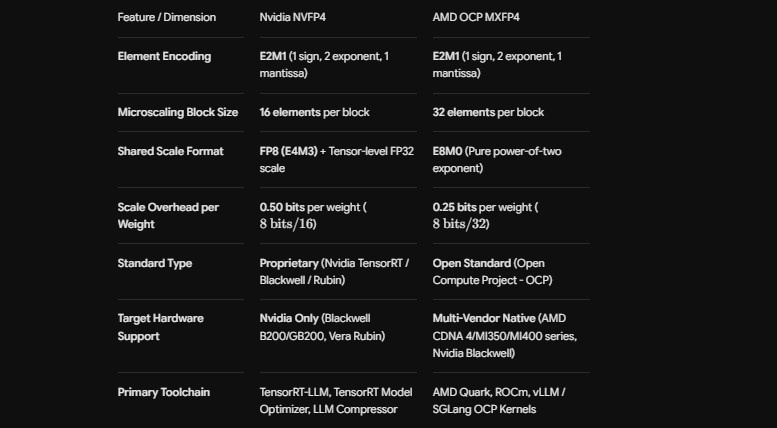
Technical Differences & Performance Trade-offs
1. Microblock Size & Outlier Sensitivity
Nvidia NVFP4 (16-Element Block): By grouping weights and activations into smaller 16-element blocks, NVFP4 isolates large activation outliers in LLMs (such as in attention projections). An outlier only impacts 15 neighboring weights within its block.
AMD OCP MXFP4 (32-Element Block): Microscaling FP4 doubles the block size to 32 elements. While this halves the memory storage footprint of scale factors (saving 0.25 bits/weight), a single outlier in a transformer matrix dilutes the scaling resolution across 31 neighboring values, leading to heavier quantization rounding errors.
2. Scale Factor Precision (E4M3 vs. E8M0)
NVFP4's Dual-Layer Scaling: NVFP4 uses an FP8 (E4M3) scale factor per 16-element block combined with a global FP32 matrix-level scale factor. E4M3 provides mantissa precision in the scale factor itself, preserving fine-grained sub-distributions in large model weight weights without sacrificing accuracy.
MXFP4's Exponent-Only Scaling: MXFP4 employs an E8M0 scale, meaning the scale factor can only shift the decimal point by powers of two ($2^n$). While E8M0 offers massive dynamic range, it lacks mantissa precision within the scale itself. To offset this gap, AMD relies on calibration methods like MR-GPTQ (applying block-wise Hadamard rotations to flatten outliers prior to quantization).
3. Cross-Platform Portability vs. Hardware Lock-In
NVFP4 (Nvidia Single-Vendor Optimization): Built exclusively for Nvidia's 5th and 6th Generation Tensor Cores. Models quantized to NVFP4 are optimized for TensorRT engines running on Blackwell and Vera Rubin platforms, but cannot run natively on AMD GPUs or open accelerators.
OCP MXFP4 (The Portable Ecosystem): MXFP4 is an industry open standard supported across multi-vendor AI hardware ecosystems. AMD's Instinct MI350/MI400 series GPUs execute MXFP4 natively in hardware via Matrix Fused Multiply-Add (MFMA) instructions. Crucially, Nvidia Blackwell GPUs also support MXFP4 execution, making OCP MXFP4 the standard choice for multi-cloud, cross-vendor AI serving fleets seeking to avoid lock-in.
Key Takeaway for Deployment
Choose NVFP4 if you operate an all-Nvidia fleet (Blackwell / Rubin) and require the highest task accuracy retention without complex rotation re-calibration tricks during W4A4/W4A8 inference.
Choose OCP MXFP4 if you require cross-hardware model portability across AMD Instinct and Nvidia accelerators, or want to reduce scale-storage overhead in multi-tenant cloud serving setups.