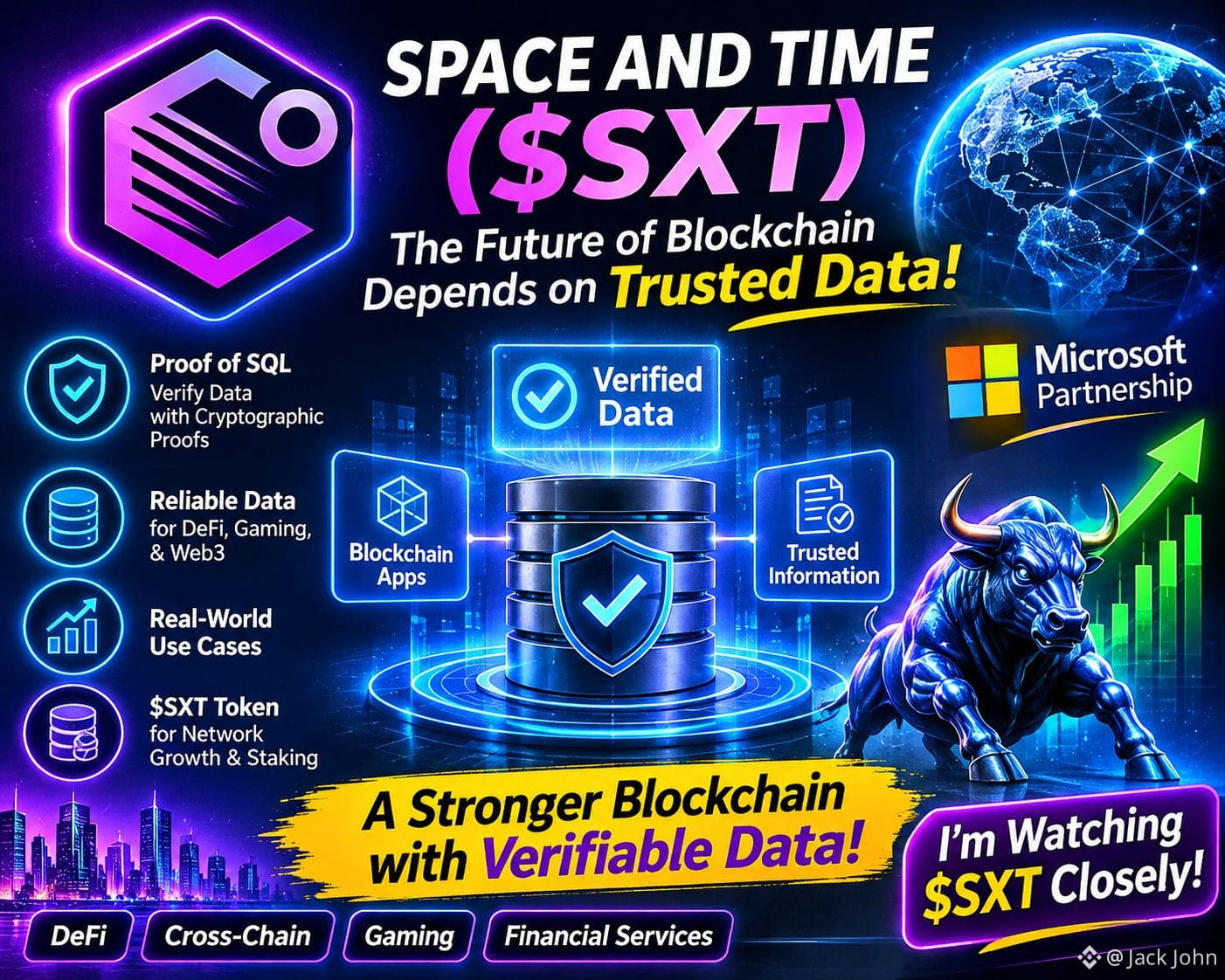
Space and Time ($SXT): The Problem Nobody in Crypto Can Afford to Ignore
I've been thinking about something that gets overlooked in crypto. Everyone wants faster blockchains, cheaper transactions, and bigger ecosystems. But what happens when the data behind those transactions cannot be trusted?
That's a problem worth taking seriously.
A blockchain can be secure, and its smart contracts can work exactly as programmed, but that doesn't mean every piece of information entering the system is reliable. Applications still depend on external databases, APIs, and data providers. One bad input can create a very real problem.
This is where Space and Time gets interesting.
Instead of asking users to simply trust the information they receive, Space and Time is working on a way to verify how that information is processed. Its Proof of SQL technology allows supported database queries to produce cryptographic proofs of correctness.
I like this approach because it focuses on something practical. Developers don't need another complicated crypto narrative. They need infrastructure that solves actual problems.
Think about DeFi applications, cross-chain platforms, gaming, and financial services. All of them need information. Sometimes they need millions of records processed before making a single decision. Space and Time aims to make those operations more useful for blockchain applications without forcing every calculation to happen directly onchain.
And then there's SXT.
The token is designed to support the network's economic activity, including query-related services and staking participation. Its long-term relevance will depend on whether people actually use the infrastructure. That's the part I care about most.
I'm not interested in judging a project only by announcements or market excitement. I want to see developers building, real applications integrating, network activity growing, and actual demand for its services.
#sxt $SXT @SpaceandTime