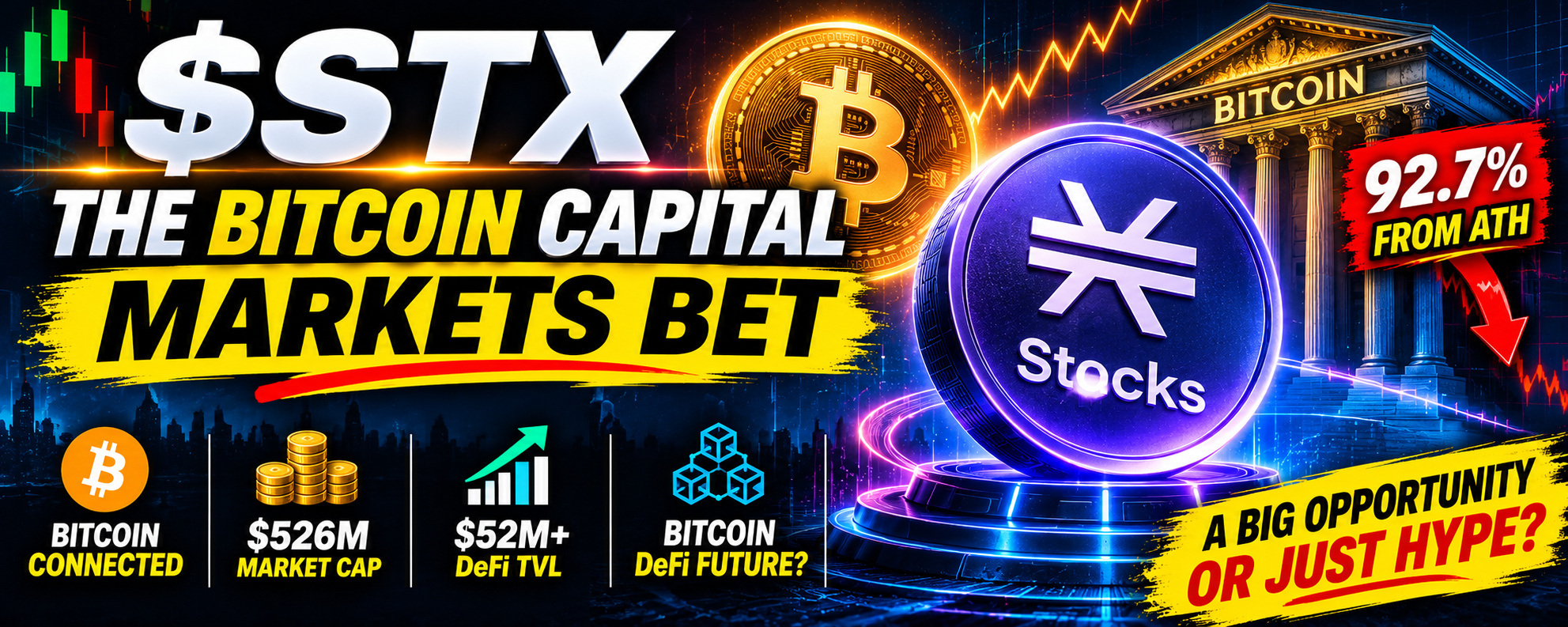

 A roughly $526 MILLION cryptocurrency.
⠀
More than $52 MILLION in tracked DeFi TVL.
⠀
A network designed to bring smart contracts and financial applications to Bitcoin.
⠀
And a token trading approximately 92.7% below its all-time high.
⠀
But here's the contradiction.
⠀
Bitcoin has a large capital base.
⠀
That does not automatically mean its holders want to move into DeFi.
⠀
And Bitcoin-denominated rewards do not automatically make STX an attractive investment.
⠀
Is $STX an overlooked bet on Bitcoin becoming productive capital?
⠀
Or does the opportunity still depend on demand that has yet to reach meaningful scale?
⠀
Let's examine the numbers.
⠀
01 | WHAT IS STACKS?
⠀
Stacks is a Bitcoin-connected smart contract network.
⠀
Its applications support activities such as trading, borrowing, and lending.
⠀
STX is the network's native token.
⠀
It pays transaction and smart contract execution fees.
⠀
It also participates in the network's consensus economics through Stacking.
⠀
The investment thesis is straightforward:
⠀
Bitcoin holders may want financial services without selling their BTC exposure.
⠀
Stacks aims to provide infrastructure for those services.
⠀
But investors need to distinguish three assets:
⠀
BTC is Bitcoin.
⠀
sBTC represents Bitcoin within the Stacks application environment.
⠀
STX powers the network and its economic mechanisms.
⠀
Owning STX is not the same as owning BTC.
⠀
02 | THE NUMBERS THAT MATTER
⠀
November 19, 2026 snapshot:
⠀
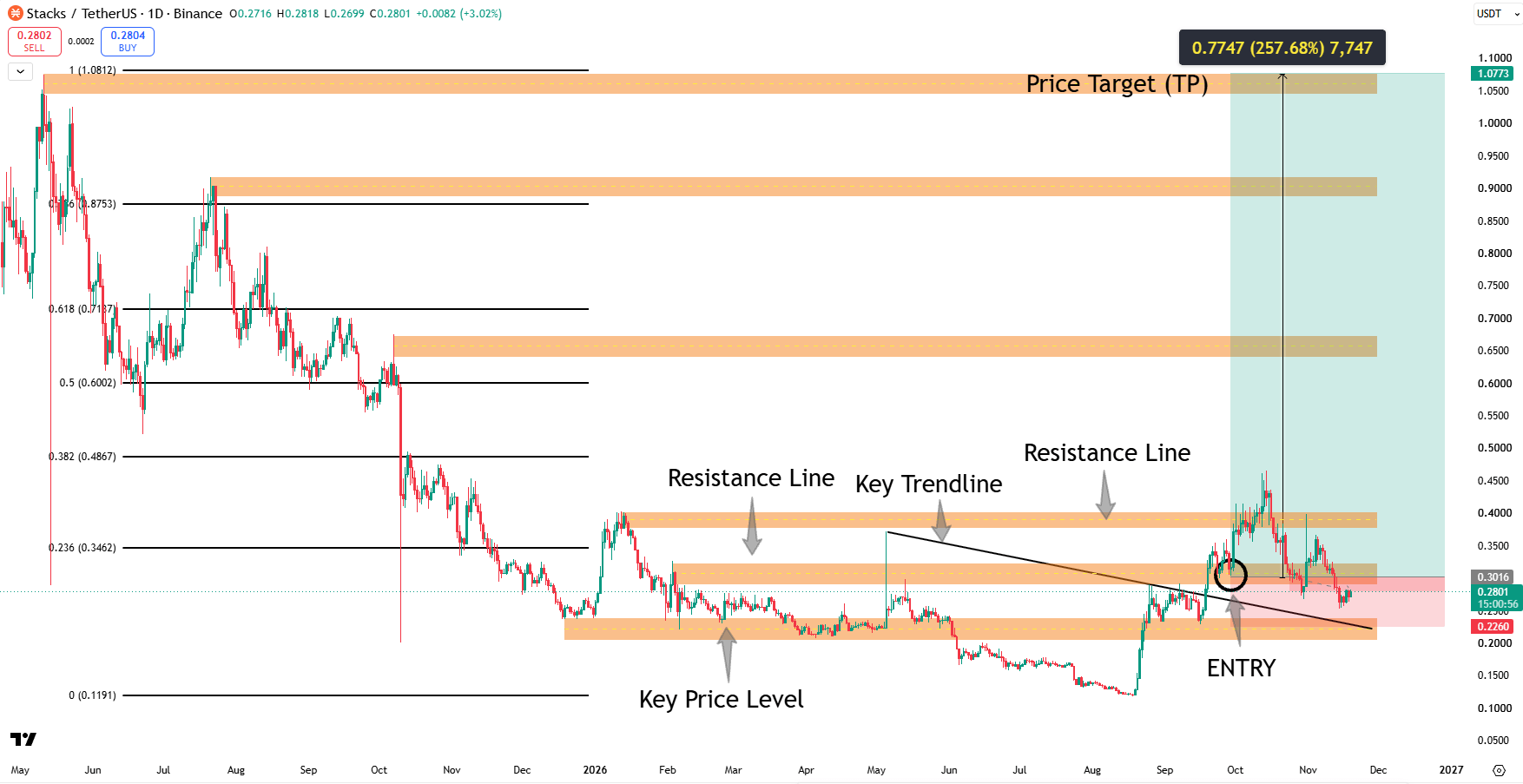
STX Price: ~$0.2790
Market Cap: ~$525.71M
Reported FDV: ~$525.71M
Circulating Supply: ~1.884B STX
Reported Total Supply: ~1.884B STX
Maximum Supply: No fixed cap
Circulating / Reported Total Supply: ~100%
24H STX Trading Volume: ~$11.67M
All-Time High: ~$3.84
Decline From ATH: ~92.7%
⠀
NETWORK FUNDAMENTALS:
⠀
Retrieved DefiLlama snapshot:
⠀
DeFi TVL: ~$52.23M
Stablecoin Market Cap: ~$11.92M
24H DEX Volume: ~$1.23M
7D DEX Volume: ~$6.23M
24H Chain Fees: ~$781
24H Chain Revenue: $0 under tracker methodology
⠀
A zero chain-revenue figure does not mean miners receive no fees or Stackers receive no BTC.
⠀
These are different economic categories.
⠀
Likewise, DeFi TVL is not the same as total BTC backing sBTC or the value of all stacked STX.
⠀
03 | THE sBTC OPPORTUNITY
⠀
sBTC is designed to represent BTC at a 1:1 ratio on Stacks.
⠀
It allows Bitcoin exposure to interact with smart contracts.
⠀
That opens potential uses in lending, trading, and collateral management.
⠀
The official Q3 report recorded 2,487 BTC in sBTC supply at quarter end.
⠀
That is a historical checkpoint, not a verified live November balance.
⠀
The important question is what happens after BTC arrives.
⠀
Does it remain deposited?
⠀
Does it support recurring borrowing and trading?
⠀
Or does it leave when incentives weaken?
⠀
Deposits establish access to capital.
⠀
Repeated economic activity establishes demand for the platform.
⠀
04 | BITCOIN FINALITY IS NOT THE WHOLE RISK MODEL
⠀
Stacks connects its transaction history to Bitcoin.
⠀
But investors should not interpret that as every application inheriting all the properties of simply holding BTC.
⠀
sBTC also relies on a signer system safeguarding its backing.
⠀
Official security materials distinguish network signers from sBTC signers.
⠀
These roles should not be collapsed into one mechanism.
⠀
Bitcoin settlement, peg operation, and application safety are separate questions.
⠀
A lending contract can fail without Bitcoin failing.
⠀
A withdrawal mechanism can face operational problems without a Bitcoin reorganization.
⠀
The useful analysis examines each layer of the system.
⠀
“Built on Bitcoin” is a starting description.
⠀
It is not a complete security assessment.
⠀
05 | WHERE THE BTC YIELD COMES FROM
⠀
Under Proof of Transfer, miners commit BTC while competing to produce Stacks blocks.
⠀
Participating Stackers receive BTC through that mechanism.
⠀
Miners receive STX rewards and transaction fees.
⠀
This creates a concrete source for Bitcoin-denominated payouts.
⠀
But the economic loop still matters.
⠀
Miners need an incentive to commit BTC.
⠀
Their expected returns depend partly on STX rewards and their market value.
⠀
Therefore, receiving BTC does not make the system independent of STX economics.
⠀
BTC rewards are not automatically equivalent to customer-funded application profit.
⠀
Investors should examine miner commitments, issuance, transaction demand, and participation together.
⠀
06 | THE NEW BITCOIN STAKING MODEL
⠀
Stacks' Q3 report described the PoX-5 upgrade and the launch of Bitcoin Staking.
⠀
Its protocol bonds pair BTC timelocked on Bitcoin with STX locked as staking capacity.
⠀
That introduces a more explicit connection between a Bitcoin product and demand for STX capacity.
⠀
The first two bonding periods brought approximately 735 BTC into the product.
⠀
The report also recorded 493 million STX staked with Bonding Period 2.
⠀
These figures describe the report's measurement period.
⠀
They should not be presented as current balances.
⠀
The investment test is whether subsequent bonds attract repeat participation while maintaining workable economics.
⠀
Initial capacity filling is encouraging.
⠀
Renewals provide stronger evidence of durable demand.
⠀
07 | PAYOUTS ARE EVIDENCE, NOT A COMPLETE THESIS
⠀
A November 13 update reported that Bond 2 paid 1.21 BTC during its first 30 days.
⠀
That is more concrete than a projected yield headline.
⠀
However, the payout alone does not establish investor profitability or long-term sustainability.
⠀
A useful evaluation needs:
⠀
Capital committed.
⠀
Time committed.
⠀
Fees and operating costs.
⠀
The source of rewards.
⠀
And changes in the value of any required STX exposure.
⠀
A BTC payout can coexist with an overall loss if the associated token position falls sufficiently.
⠀
The correct comparison measures the complete position.
⠀
Reward denomination cannot replace total-return analysis.
⠀
08 | THE SUPPLY CORRECTION
⠀
STX has no fixed maximum supply.
⠀
The Stacks Foundation explicitly states that the commonly repeated 1.81 billion figure was an early supply projection for 2050.
⠀
It was not a permanent cap.
⠀
Ongoing issuance means similar market cap and reported FDV figures do not eliminate future dilution.
⠀
SIP-031 also matters.
⠀
The Foundation identifies it as an approved 2025 change increasing emissions over five years to fund a community endowment.
⠀
Therefore, investors should not rely only on an old mining-reward chart.
⠀
The full supply analysis must include approved governance changes and their implementation.
⠀
Current circulation describes today's denominator.
⠀
It does not establish tomorrow's.
⠀
09 | INCENTIVES VERSUS ORGANIC ACTIVITY
⠀
Stacks has also used targeted programs to encourage Bitcoin DeFi activity.
⠀
The Stack Sats program announced a total of 3 BTC in rewards across September 10 to December 10, 2026.
⠀
Incentives can help users discover applications and establish liquidity.
⠀
They can also attract capital primarily interested in collecting rewards.
⠀
The distinction becomes clearer after the program ends.
⠀
Watch whether deposits remain.
⠀
Whether borrowing continues.
⠀
Whether trading volume persists.
⠀
And whether applications retain users without equivalent subsidies.
⠀
A temporary increase can be useful.
⠀
It should not automatically be annualized into permanent demand.
⠀
10 | THE VALUATION QUESTION
⠀
Using approximately 1.884 billion current tokens:
⠀
$0.50 STX implies ~$942M current-supply valuation.
$1.00 implies ~$1.884B.
$2.00 implies ~$3.768B.
$3.84 implies ~$7.235B.
⠀
These are valuation illustrations, not price targets.
⠀
Future issuance can increase the denominator.
⠀
The current market capitalization is also roughly 10 times the retrieved DeFi TVL.
⠀
That ratio is not an earnings multiple.
⠀
TVL is user capital, not protocol-owned cash.
⠀
The valuation thesis needs expectations about adoption, token demand, and economic durability.
⠀
It cannot be established by comparing STX with Bitcoin's total market value.
⠀
A large addressable market does not guarantee a large captured market.
⠀
11 | THE BULL AND BEAR CASE
⠀
THE BULL CASE:
⠀
More Bitcoin holders use Stacks financial products.
⠀
sBTC becomes durable collateral.
⠀
Lending and trading produce recurring activity.
⠀
Bitcoin Staking creates sustained demand for STX capacity.
⠀
And economic growth exceeds the effect of continuing issuance.
⠀
THE BEAR CASE:
⠀
BTC holders prefer direct custody or competing services.
⠀
Deposits depend too heavily on incentives.
⠀
Application demand remains modest.
⠀
Peg operations or contracts undermine confidence.
⠀
And Bitcoin-denominated rewards attract attention without producing sufficient net demand for STX.
⠀
A growing Bitcoin ecosystem can support multiple platforms.
⠀
It does not guarantee that each platform's token captures attractive returns.
⠀
12 | THE FINAL VERDICT
⠀
Stacks has identifiable strengths.
⠀
Bitcoin-connected smart contracts.
⠀
A live BTC-backed asset.
⠀
An established BTC reward mechanism.
⠀
And products that connect locked STX with Bitcoin staking capacity.
⠀
But the investment case remains conditional.
⠀
A roughly $526 million market capitalization.
⠀
Approximately $52 million in tracked DeFi TVL.
⠀
Continuing token issuance.
⠀
And a need to demonstrate retained demand beyond product launches and incentives.
⠀
My assessment:
⠀
STX is a bet on Bitcoin capital markets becoming large enough to create sustained demand for the infrastructure token.
⠀
More BTC deposited creates available capital.
⠀
More useful applications create reasons to deploy it.
⠀
Repeat activity creates economic demand.
⠀
The token model determines how much of that demand benefits STX holders.
⠀
A 92.7% drawdown does not settle that question.
⠀
Neither does a BTC yield headline.
⠀
Bookmark this analysis before the next Bitcoin DeFi rotation.
⠀
Would you rather hold $BTC directly or take additional STX exposure for its Bitcoin capital markets thesis?
⠀
And what would convince you that the demand is sustainable?
⠀
Drop your view below.