
What if the next major crypto opportunity is not driven by another Bitcoin rally, but by the growing connection between AI, Wall Street and blockchain-based financial markets?
Nvidia's latest earnings outlook, the rapid expansion of tokenized equities and Strategy's latest financing moves are revealing an important shift in global capital markets. Money is increasingly flowing between traditional technology companies, institutional financial products and crypto infrastructure.
For investors, these developments deserve attention because they are connected to a much bigger story: the geopolitical competition for technological and financial leadership.
1. Nvidia: AI Is Becoming a Strategic Economic Asset
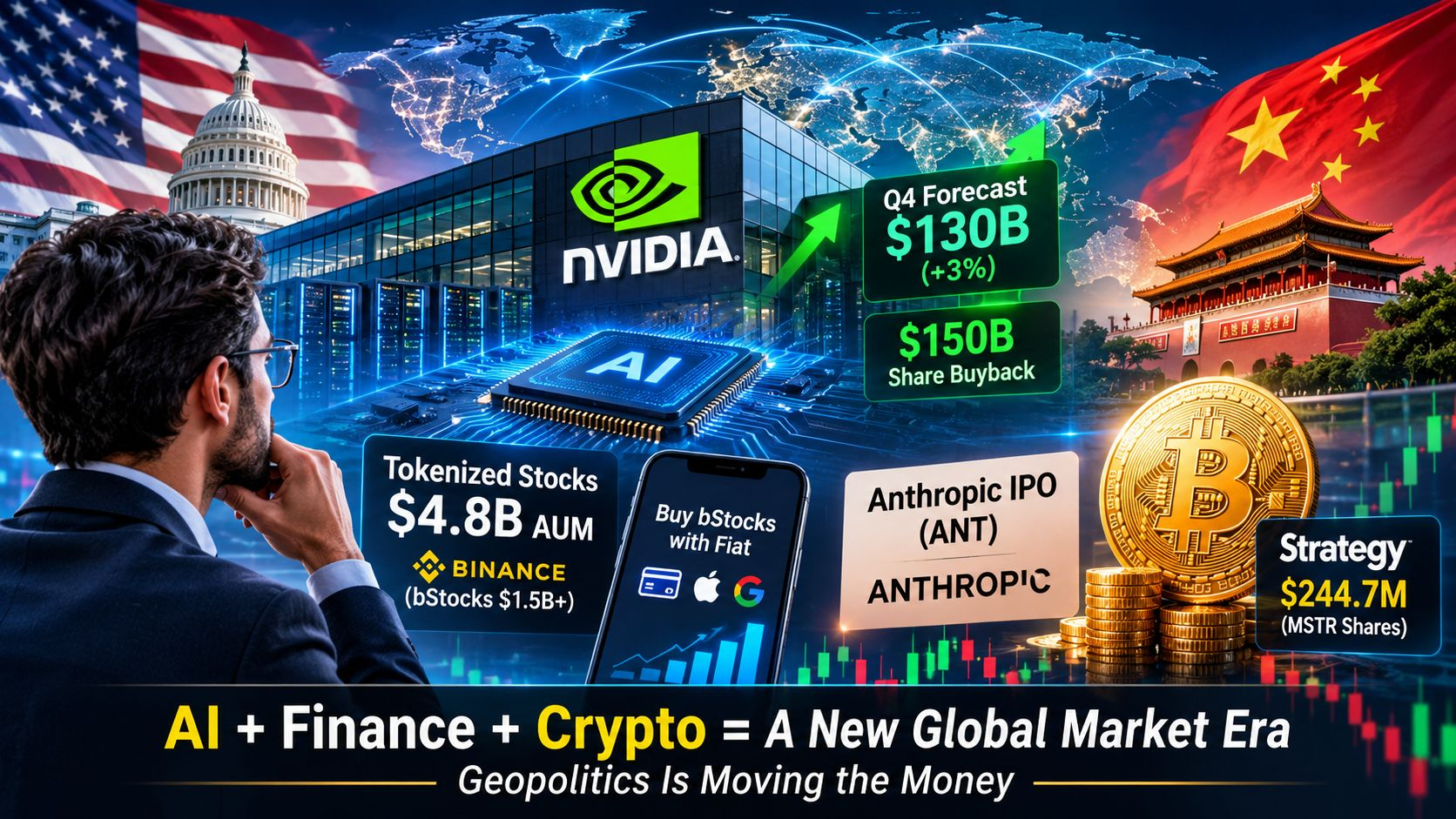
Nvidia remains at the centre of the global AI investment cycle. Its latest results showed quarterly revenue of approximately $115.8 billion, while its Q4 revenue forecast reached around $130 billion, above the market expectation of $125.2 billion.
The company also authorized an additional $150 billion share-repurchase program, reinforcing its confidence in its financial position.
But the real story goes beyond earnings.
AI computing power is now closely linked to national security, industrial competitiveness and economic influence. The United States wants to maintain its advantage in advanced semiconductors, while China is investing heavily in domestic alternatives.
Export restrictions have become an important part of this competition.
For Nvidia, this creates both opportunities and risks. Strong global AI demand supports revenue growth, but restrictions on advanced chip exports could limit access to certain markets and accelerate competition.
Investor takeaway: $NVDA remains a major AI investment opportunity, but valuation, margins, export restrictions and future demand matter more than one strong earnings report. Investors should avoid chasing short-term price spikes.
2. Nebius and CoreWeave: The Next Layer of the AI Trade
Nvidia is not the only company benefiting from the expansion of AI.
Companies such as Nebius and CoreWeave provide the cloud infrastructure that allows businesses and AI developers to access expensive computing capacity.
The investment chain is straightforward: Nvidia supplies GPUs, cloud providers build computing infrastructure, and AI companies rent that capacity to develop and operate their products.
This creates opportunities beyond semiconductor manufacturers.
However, there is a risk. Building data centres requires enormous capital, electricity and financing. Strong demand does not automatically translate into sustainable profits.
Investors should watch revenue growth, debt levels, capital expenditure and operating cash flow before deciding whether these companies offer attractive valuations.
3. Tokenized Equities: Wall Street Is Moving Closer to Blockchain
Another development attracting attention is the expansion of tokenized stocks.
The tokenized equity market reportedly reached a record $4.8 billion in AUM, with Binance's bStocks surpassing $1.5 billion.
The introduction of direct fiat and card purchases has also made these products more accessible to eligible investors without requiring them to purchase cryptocurrency first.
This matters because traditional financial markets have historically depended on banking networks, brokerage accounts and cross-border payment infrastructure.
Tokenization offers another way to distribute financial products.
For crypto investors, the opportunity extends beyond individual stocks. Blockchain networks, stablecoin infrastructure, custody providers and trading platforms could all benefit if adoption continues.
However, tokenized equities should not be confused with direct ownership of conventional shares. Their legal structure, investor rights and availability depend on the product and jurisdiction.
The important question is whether tokenization can develop into a sustainable financial business rather than simply attracting temporary trading activity.
4. $ANTHROPIC IPO: Can AI Valuations Justify Institutional Expectations?
Anthropic's potential public listing is another development worth watching.
Investor interest in advanced AI companies remains strong, but high valuations bring difficult questions about profitability, computing costs and competition.
The bullish argument is clear: enterprise AI adoption could create substantial long-term revenue opportunities.
The bearish argument is equally important. Developing advanced AI models requires expensive computing infrastructure, while competition could pressure margins.
Geopolitics adds another layer. Governments increasingly view AI leadership as a strategic priority, making regulation, data security and export restrictions important factors in corporate valuations.
For investors, the opportunity is not simply about buying into the AI narrative. It is about determining whether the company's future earnings can justify its IPO valuation.
5. Strategy's $244.7 Million Share Sale: What It Means for Bitcoin
Strategy's reported sale of approximately 2.09 million $MSTR shares raised around $244.7 million.
This is particularly important for Bitcoin investors because Strategy's business model connects traditional equity financing with corporate Bitcoin exposure.
The company has used capital-market transactions to manage its preferred securities, maintain financial flexibility and purchase additional Bitcoin.
This creates several implications.
First, issuing common shares can dilute existing shareholders. Second, repurchasing preferred shares can reduce future financing obligations. Third, Strategy's ability to raise capital depends partly on investor confidence in its business model and Bitcoin exposure.
But investors should understand one distinction: raising money through equity issuance does not automatically mean the same amount is flowing into Bitcoin.
The company's capital allocation decisions deserve closer attention than the headline transaction itself.
6. The Geopolitical Connection: Follow the Capital
These developments are connected through three major forces.
US-China competition: Semiconductor restrictions and technology policy influence where AI infrastructure is built and which companies attract investment.
Institutional AI spending: Large technology companies are committing substantial capital to computing infrastructure, supporting semiconductor demand but increasing financial exposure.
Financial market modernization: Tokenized equities and blockchain settlement are creating new ways to access traditional financial assets.
The transmission to investor portfolios is worth understanding:
Geopolitical decisions → Technology and trade restrictions → Corporate investment and capital allocation → Market liquidity and valuations → Equity and crypto prices.
This process is not always straightforward. Higher bond yields can pressure technology valuations and crypto assets, while geopolitical uncertainty can trigger defensive positioning and capital outflows.
That is why monitoring central-bank policy, the US dollar, Treasury yields and institutional capital flows remains essential.
7. What Investors Should Watch Next
Three scenarios deserve attention.
Bullish: AI spending remains strong, tokenized equity adoption accelerates and institutional interest in blockchain infrastructure grows. This could support selected technology stocks and crypto infrastructure projects.
Neutral: Earnings remain healthy, but expensive valuations and financing costs encourage investors to become more selective.
Bearish: Geopolitical escalation, tighter export controls or weaker AI investment returns trigger a broader reduction in risk exposure. Technology stocks and cryptocurrencies could face selling pressure.
My investment approach would be to focus on companies with real revenue, sustainable cash flow and manageable debt. In crypto, actual adoption, network activity and token value capture should matter more than marketing narratives.
The next major opportunity may emerge where AI, traditional finance and blockchain intersect. But identifying that opportunity requires following the money, not chasing the headlines.
What do you think will attract the strongest institutional capital over the next 12 months: AI infrastructure, tokenized equities or Bitcoin-related financial products? Share your analysis in the comments.



#NvidiaBeatsEstimatesWith$130BQ4Outlook #AnthropicIPOPriceCouldExceed$80 #Geopolitics #CryptoAnalysis #stock