

#DBSAndCirclePartnerToExpandAsianInstitutionsUSDCAccess
1. What Happened (Market Update) 📰
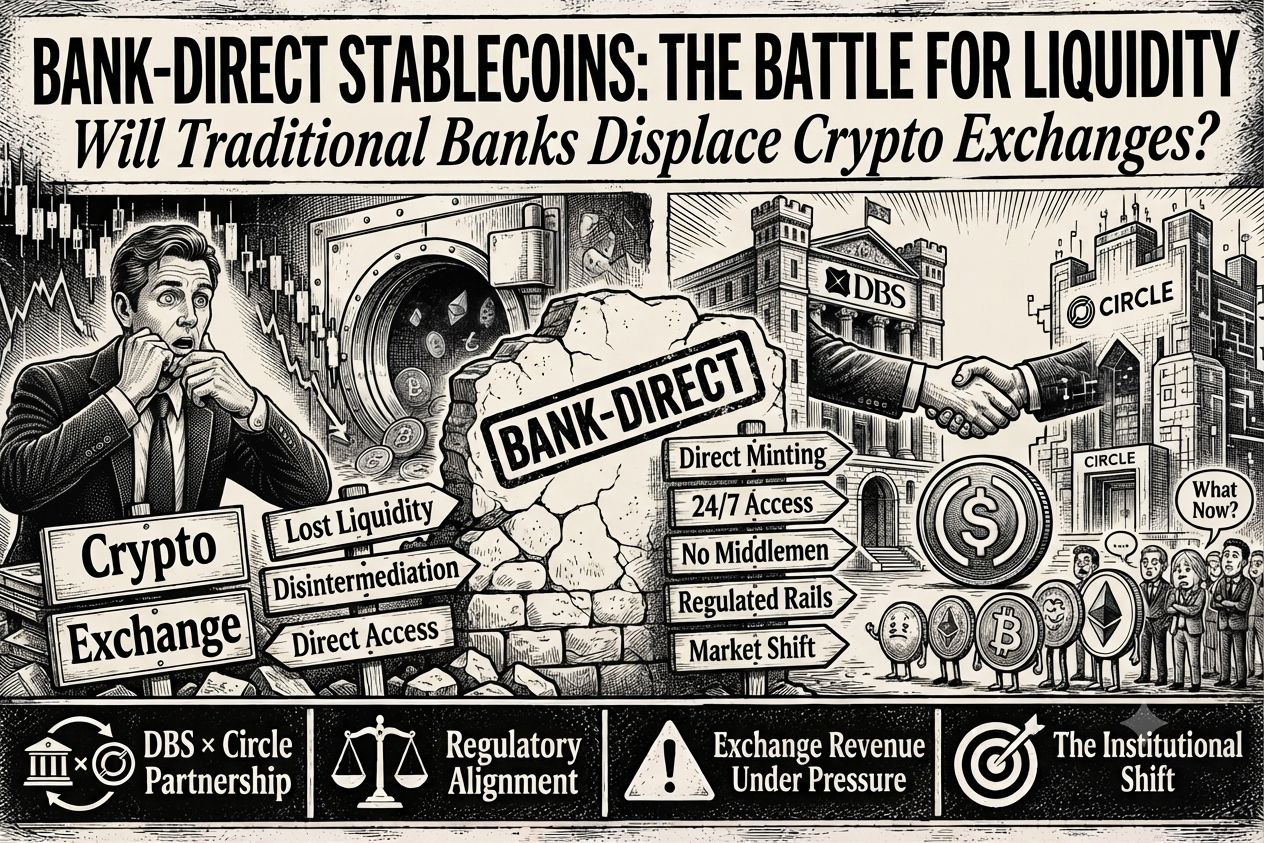
On November 18, 2026, Singapore's largest bank, DBS, announced a partnership with Circle. Eligible institutional clients can now mint and redeem USDC directly through DBS, meaning there is no need to go to an exchange or OTC desk. Settlement is 24/7 and near-instant, with no banking hour limits. This is part of Project Bloom, a tokenized money initiative under the Monetary Authority of Singapore (MAS). 🏦🤝🌐
2. Impact on USDC Price — Absolutely None 💵🛡️
USDC is designed to be 1:1 with the USD. Data from November 13, 2026: price $0.99958, market cap $69.43B, 24h volume $12.95B, ranking #5. DBS's direct mint/redemption further strengthens this anchor; it does not move the price. What could be affected is the secondary market premium/discount — large institutions no longer need to pay extra on exchanges to buy USDC in an emergency, so the exchange's "scarcity premium" may decrease. 📉✅
3. Impact on Crypto Exchange Market — Structural Pressure, Not an Immediate Shock⚠️🏗️
This decision is not a direct "blow" to exchanges, but it is certainly a slow structural shift. Previously, when large institutions needed USDC, they had to go to venues like Binance, Coinbase, or OKX, and exchanges earned spreads and fees. Now DBS is offering a direct wholesale channel, allowing large clients to bypass exchanges. For exchanges, this means: a major "liquidity customer" could be lost. 🚶♂️💸
However, the immediate impact is limited: (a) it is only for eligible institutional clients, not retail; (b) DBS is Asia-focused, and global flow remains on exchanges; (c) exchanges have other revenue streams such as trading, derivatives, and yield products. Recent exchange flow data is also mixed — over the past 7 days, Binance saw +$935M inflow, while MEXC saw -$738M outflow. The market is still exchange-centric, but the bank-direct channel is creating a new alternative. ⚖️📊
4. Why DBS and Circle Needed to Do This 🤔💡
On DBS's side: demand from institutional clients. Corporations are adopting tokenized money, and they needed a bank-level USDC channel without exchange counterparty risk. The practical implementation of Project Bloom was also necessary. 🏢📈
On Circle's side: expanding distribution channels. Circle's CPN (Circle Payments Network) is currently scaling — annualized transaction volume reached $8.3B by March 2026. By adding a Tier-1 bank channel like DBS, Circle aims to reduce dependency on exchange partners and capture the institutional market. Circle's CCO clearly states: institutions need a "trusted way" to access stablecoins. 🚀🔗
5. Trend Confirmation: Not Just USDC, the Entire Bank-Direct Model is Gaining Traction🌊🏦
RLUSD (Ripple) launched Ripple Mint in July 2026, offering API-based institutional mint/redeem. In October, Cross River Bank integrated RLUSD, with BNY and Standard Chartered providing custody. PYUSD (PayPal/Paxos) is issued through an OCC-regulated trust charter, representing bank-level infrastructure. USDtb/USAT is issued directly by Anchorage Digital Bank. This means: DBS-Circle is not alone; the entire "bank as stablecoin on-ramp" model is becoming an industry-wide trend. 🔄🏛️
6. Bottom Line for Exchanges🎯🔮
The USDC price will not move, but the exchange's status as a "liquidity intermediary" is being gradually challenged. For large institutions, the bank-direct channel is becoming a credible alternative. Exchanges will need to rethink their value proposition — focusing not just on USDC distribution, but on multi-chain flexibility, trading infrastructure, and DeFi integration. For exchanges that were merely a "place to buy stablecoins," the signal is clear: the bank is coming, and it is offering wholesale rates. 🏁🔔


#Binance #BTC #NvidiaBeatsEstimatesWith$130BQ4Outlook #DBSAndCirclePartnerToExpandAsianInstitutionsUSDCAccess