Most people still frame Space and Time as another indexing play or a Microsoft-adjacent data tool. That misses the quieter shift happening underneath.
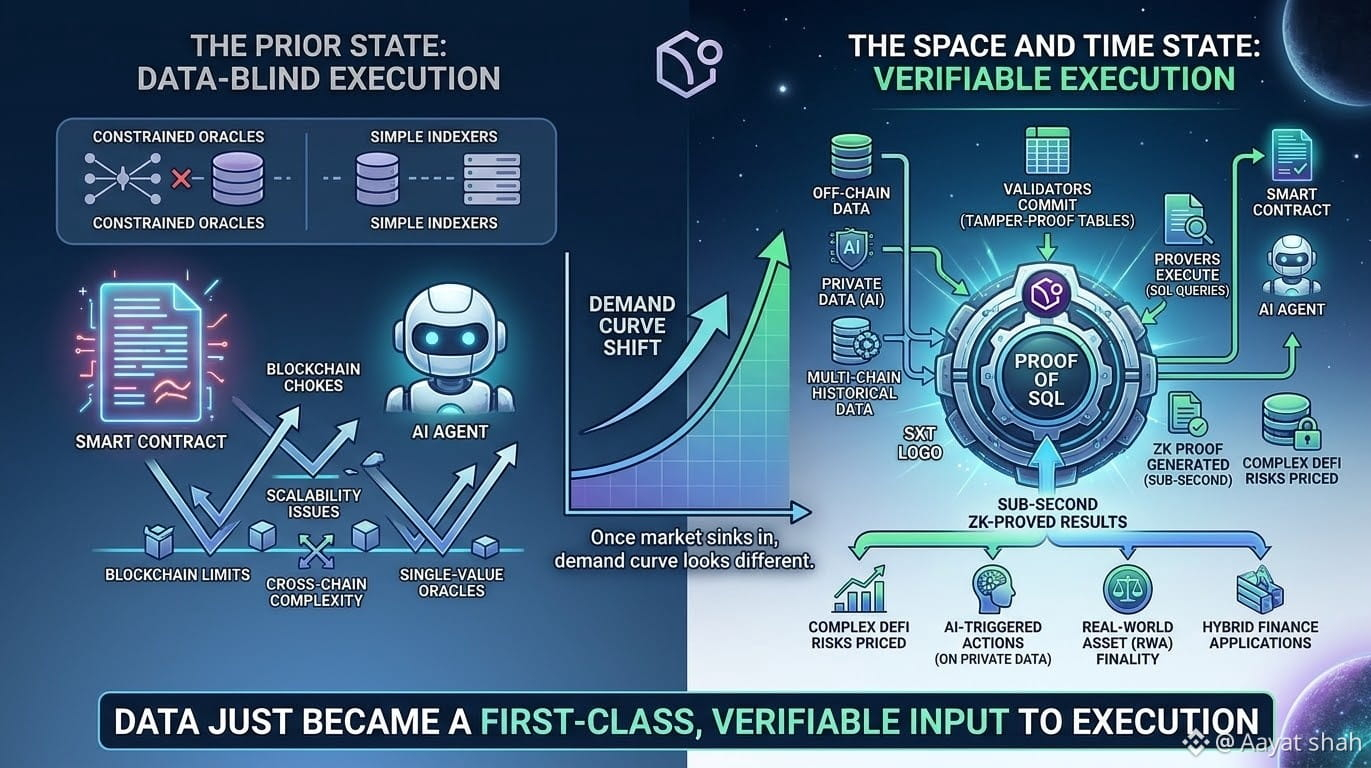
Smart contracts have always been constrained by what they can see. They can settle value and enforce simple rules, but they choke on anything that requires history, cross-chain context, or external datasets at scale. Oracles patch the gap with single values. Indexers give you readable tables. Neither lets a contract ask a complex question and receive a cryptographically guaranteed answer it can act on in the same block window.
SXT’s Proof of SQL changes the constraint itself. Validators commit to tamper-proof tables of multi-chain and off-chain data. Provers run SQL against those commitments and return both the result and a sub-second ZK proof that the computation was honest. The contract only needs to verify the proof. Suddenly the execution environment is no longer data-blind.
This is infrastructure for a different class of coordination. Protocols can price risk using actual historical behavior instead of proxies. AI agents can trigger onchain actions based on proven private-data calculations without ever seeing the raw records. Tokenized assets and hybrid finance systems gain the ability to reference real-world state with the same finality as a balance transfer.
The market keeps watching surface signals. The deeper layer is that data just became a first-class, verifiable input to execution. Once that sinks in, the demand curve looks different.
#sxt $SXT @SpaceandTime