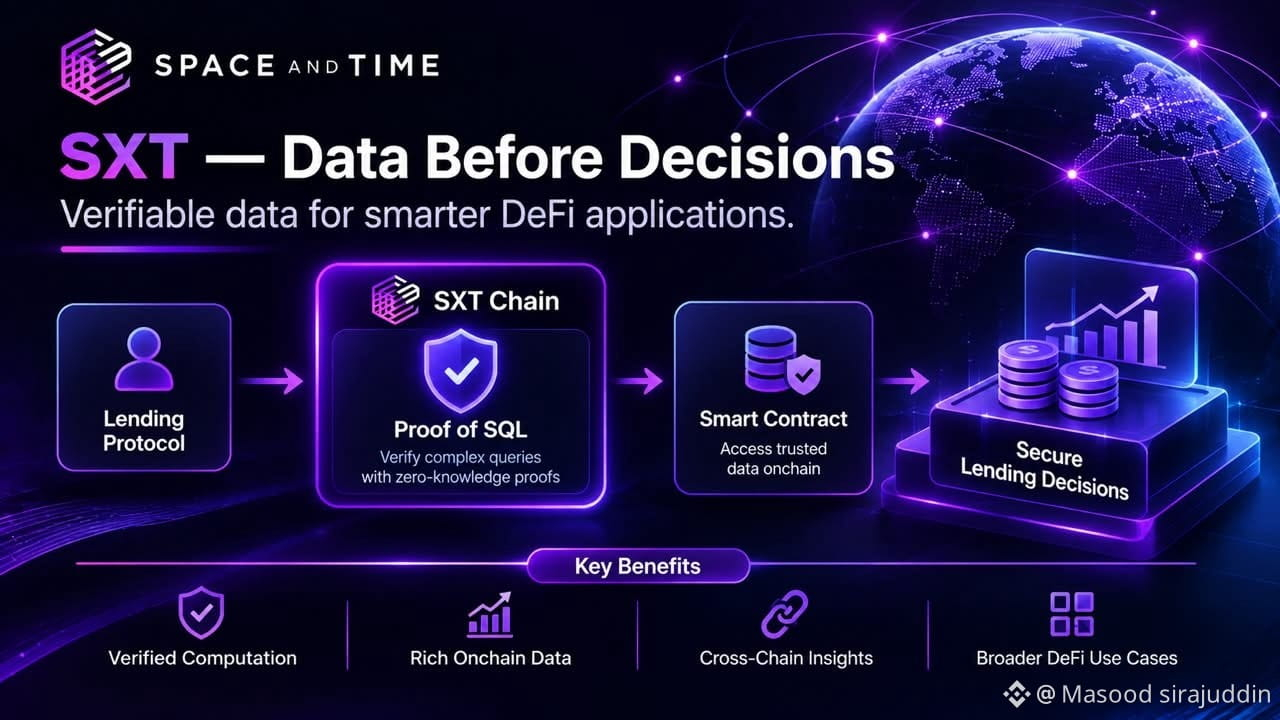
A lending protocol can calculate a position perfectly and still have a problem if the data feeding that calculation cannot be verified.
That’s one of the use cases I find interesting about @SpaceandTime
The SXT Chain whitepaper describes data-driven lending where smart contracts can query historical and current information, including collateral and activity across chains, while using Proof of SQL to verify the computation.
The important part isn’t just getting an answer.
A Prover node executes the SQL query and generates a zero-knowledge proof. The underlying tables are secured through cryptographic commitments maintained by SXT Chain validators. The smart contract can then verify the result instead of blindly trusting whoever supplied the database output.
That model could also extend beyond lending.
The whitepaper discusses wallet risk checks, whitelist and blacklist tables, tokenized assets, liquidity management, and other applications where a contract needs reliable data before taking an action.
I think this is a more useful way to look at SXT than simply calling it a blockchain data provider.
It is trying to make external computation usable by smart contracts without giving up verifiability.
The question is how many applications will actually need that extra layer as onchain logic becomes more data-heavy.