

TradFi stands for Traditional Finance. It refers to the conventional financial system that includes banks, stock markets, investment companies, insurance firms and government-regulated financial institutions.
In simple words, TradFi is the financial system people have used for decades, before cryptocurrency and decentralized finance (DeFi) became popular.
1. Examples of TradFi
Banks
Saving accounts, loans, deposits and money transfers.

tock Markets
Buying and selling shares of companies like Apple and Microsoft.

Investment Funds
Mutual funds, ETFs and pension funds.

Insurance Companies
Life, health, vehicle and business insurance.

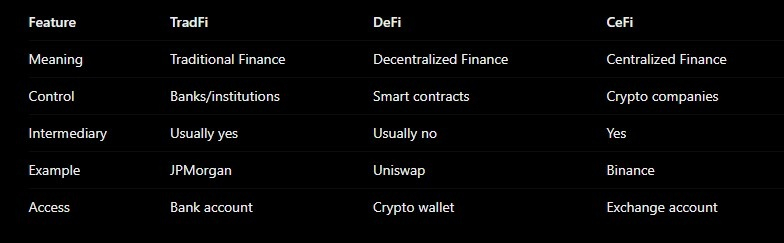
2. TradFi vs DeFi vs CeFi
3. Why is TradFi entering crypto?
Traditional financial institutions are increasingly exploring cryptocurrency because of:
Bitcoin ETFs and institutional investment.
Tokenization of real-world assets.
Blockchain-based payments.
Stablecoins and digital dollars.
Faster international settlements.
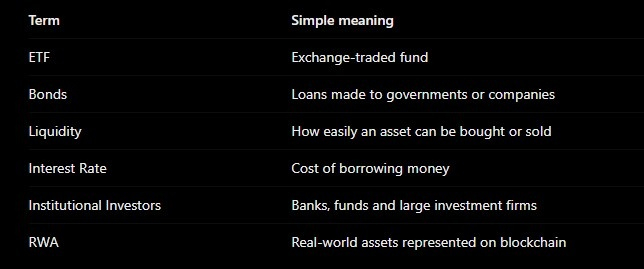
4. Important TradFi terms for crypto investors
5. Why should crypto investors understand TradFi?
TradFi has a major influence on cryptocurrency markets.
For example:
When the US Federal Reserve cuts interest rates, risk assets like Bitcoin may benefit.
When institutional investors buy Bitcoin ETFs, demand can increase.
When stock markets fall sharply, crypto can also experience selling pressure.

My suggestion: If you're following Bitcoin, Ethereum and crypto market news, understanding TradFi, Federal Reserve policy, interest rates and institutional ETF flows will help you understand why crypto prices move.