

#kavasaysabnormalactivitylimitedtokavalend
Following the 40%–50% flash crash triggered by the Kava Lend protocol exploit on November 14, 2026, KAVA/USDT has broken out of its multi-month market structure, entering a high-volatility price discovery zone to the downside.
Because the collapse was driven by fundamental sell-side saturation (the attacker dumping ~49.2 million bridged KAVA tokens onto BNB Smart Chain) rather than standard technical price action, historical moving averages have been invalidated. The market is currently attempting to build a temporary stabilization base.
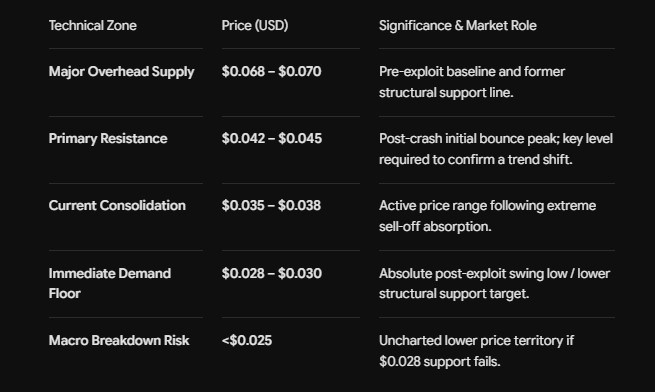
1. Key Technical Chart Level Map
2. Detailed Technical Breakdown
A. Resistance Barriers (Upside Reclaim Targets)
$0.042 – $0.045 (Immediate Resistance): This zone represents the initial hourly relief bounce high following the crash. To signal short-term technical recovery, KAVA must register a daily candle close above $0.042. Until then, any intraday upward moves remain vulnerable to relief-rally shorting.
$0.068 – $0.070 (Major Resistance Wall): The pre-attack support area now acts as dense overhead supply. Overcoming this level would require full fundamental resolution (e.g., compensation plans for affected pools and restoration of exchange deposits).
B. Support Zones & Liquidity Base
$0.035 – $0.037 (Immediate Local Support): KAVA tested a low near $0.037 during the initial sell-off and is attempting to construct a tight consolidation range between $0.035 and $0.038.
$0.028 – $0.030 (Crucial Line in the Sand): Analysts point to $0.028 as the key lower macro support floor. Holding above $0.028 keeps the door open for a gradual accumulation phase. A daily breakdown below $0.028 would risk another wave of capitulation.
C. Momentum Indicators
Relative Strength Index (RSI): The 14-period daily RSI dropped heavily into deeply oversold territory (~20–30). While oversold conditions often invite short-term tactical relief bounces, RSI divergence alone is insufficient for a reversal signal without volume absorption.
Exchange Restraints: With major exchanges like Upbit, Bithumb, and Coinone temporarily pausing deposits/withdrawals, overall spot market order books remain thin, amplifying price slippage in both directions.
💡 Tactical Execution Guidance
Avoid High Leverage: High volatility and thin order-book liquidity mean high risk of liquidation wicks in both directions.
Monitor Exchange Status: Track official exchange announcements regarding the reopening of KAVA deposits/withdrawals, as sudden deposit unlocks could trigger secondary sell pressure.
Wait for Structural Confirmation: Conservative traders typically wait for a daily close back above $0.042 before considering spot re-entry positions.