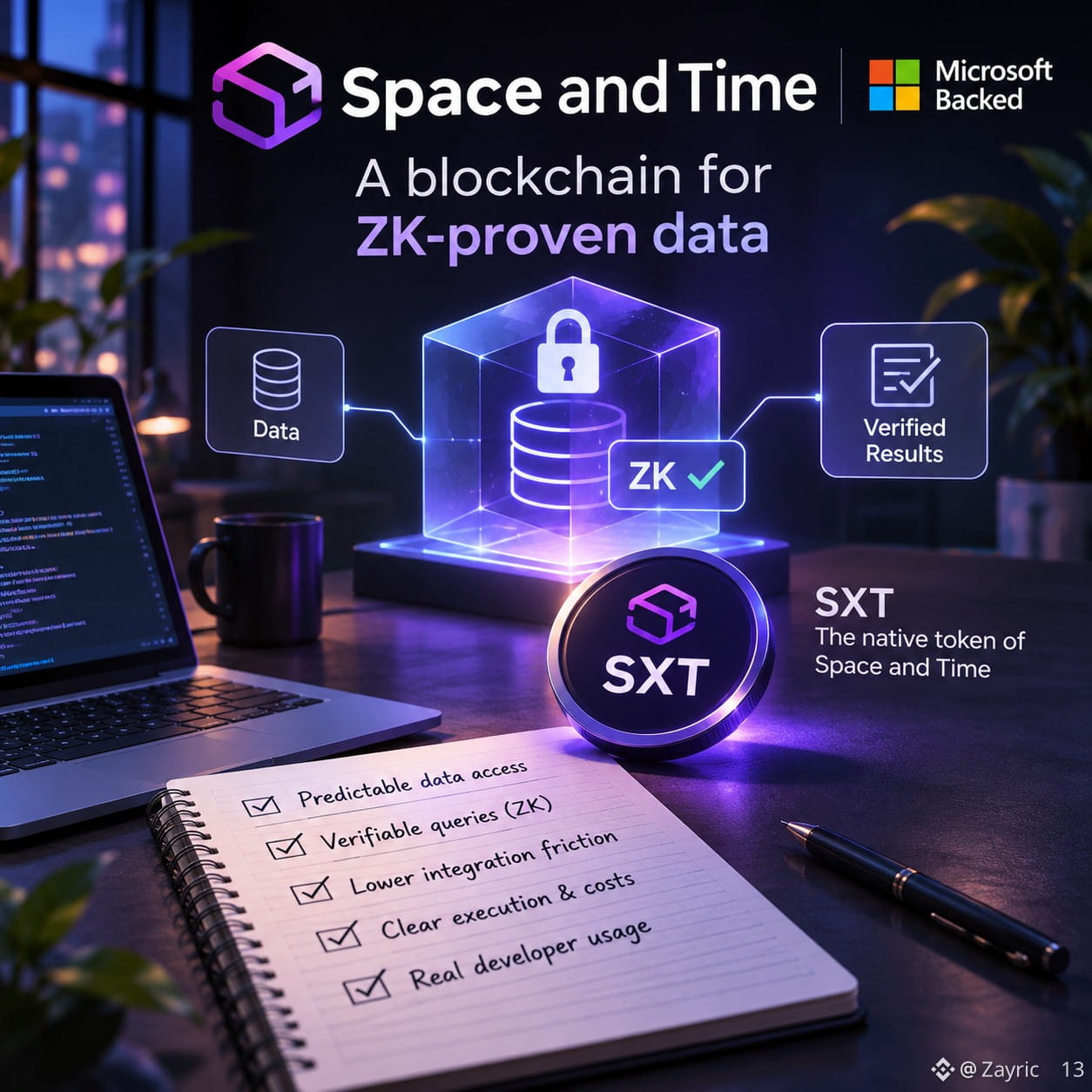

I find Space and Time interesting because it focuses on a problem that becomes more important as blockchain applications handle increasingly complex data: how can users trust the information behind an outcome without simply trusting the system providing it?
Space and Time approaches this through ZK-proven data, with the goal of making data queries verifiable rather than relying entirely on conventional trust assumptions. Microsoft backing is also part of its background, but I think the more important question is how reliably the infrastructure works in everyday use.
For developers, the practical experience matters more than the technical description. Data needs to be accessible, query results need to be predictable, and verification should not introduce unnecessary friction into existing workflows. Even a strong architecture can struggle if integrating it requires too much effort or if costs and execution behavior are difficult to understand.
I also pay attention to the operational side. Infrastructure becomes useful when developers can build around consistent behavior, understand where verification happens, and know what responsibilities remain on their side. These details rarely attract attention, but they influence whether a system becomes part of a real application or remains an interesting technical experiment.
SXT serves as the native token of the Space and Time network. Still, I see the underlying infrastructure as the more important subject to understand.
For me, meaningful progress here is measured through dependable data access, practical verification, and the discipline required to make complex systems usable without hiding their limitations.#sxt $SXT @SpaceandTime