

The @DocCompound Analysis
The Bitcoin correction is becoming more difficult to dismiss as ordinary volatility.
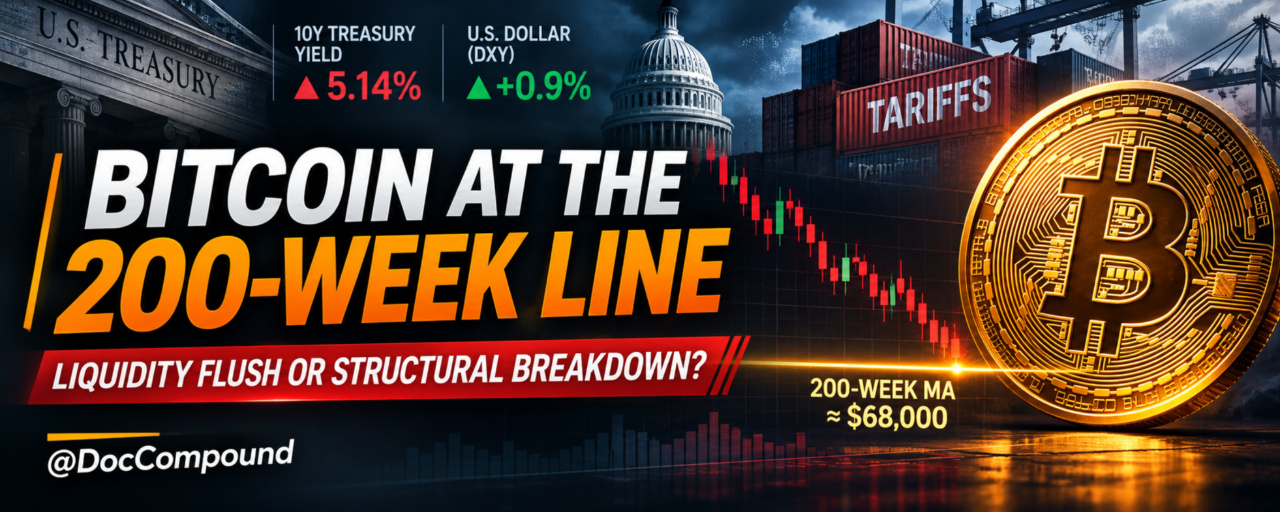
On November 13, Bitcoin fell to approximately $67,500, briefly moving below its 200-week moving average for the first time since August.
At the same time:
The US dollar strengthened.
Treasury yields remained elevated.
Institutional ETF outflows continued.
Derivatives liquidations exceeded $1.6 billion across crypto markets.
The question is no longer simply how far Bitcoin can fall.
Is this a temporary liquidity flush, or are we witnessing a deeper deterioration in Bitcoin's market structure?
1. The macro environment is working against Bitcoin
Bitcoin is not trading in isolation.
On November 13, CoinDesk reported that Bitcoin and Ethereum fell to their lowest levels in approximately 12 weeks as traders priced in the possibility of a Federal Reserve rate increase in December.
The US Dollar Index moved above 103, reaching its highest level since April 2025.
Higher yields and a stronger dollar create an unfavorable environment for speculative assets because investors have more incentive to hold dollar-denominated assets with conventional yields. [1]
This creates three interconnected pressures:
Higher yields: Increase the opportunity cost of holding non-yielding assets.
Stronger dollar: Can reduce demand for dollar-priced risk assets.
Monetary tightening expectations: Can restrict liquidity and reduce speculative appetite.
Bitcoin's weakness is therefore not just a cryptocurrency-specific event. It is also a reflection of broader financial conditions.
2. The liquidation problem: forced selling accelerates volatility
On November 13, crypto liquidations exceeded $1.6 billion, according to CoinDesk.
This is important because leveraged positions can amplify market movements.
Consider the sequence:
Price declines → leveraged long positions approach liquidation → exchanges automatically close positions → additional selling pressure → price declines further.
However, there is another important development.
CryptoSlate reported that Bitcoin futures open interest reached approximately 704,000 BTC, its highest level since September 24, while spot liquidity was thinning. [2]
This combination deserves attention.
High futures exposure alongside weak spot liquidity means that the market can remain vulnerable to sudden price movements.
Liquidations explain the acceleration of selling. They do not necessarily explain the underlying direction of the market.
We need to see whether spot buyers return after the forced selling subsides.
3. Institutional demand is weakening
The ETF data is one of the clearest warning signals.
US spot Bitcoin ETFs recorded approximately $1.88 billion in net outflows during the first eight trading sessions of November, according to data compiled from Farside Investors and SoSoValue. [3]
That is a substantial withdrawal of capital.
Why does this matter?
Institutional investment products have become an important part of Bitcoin's demand structure.
When ETF inflows are strong, they can provide additional buying demand. When outflows persist, the market loses an important source of support.
I would watch for three developments:
ETF outflows slowing.
Sustained net inflows returning.
Bitcoin stabilizing despite continued market uncertainty.
A recovery accompanied by improving institutional flows would be more convincing than one driven primarily by short covering.
4. The 200-week moving average: Bitcoin's critical long-term test
This is arguably the most important technical development.
Bitcoin's 200-week moving average
$67,857
November 13, 2026 — Firsthand Bitcoin data
November 13 reported low
$67,500
200-week moving average
$67,857
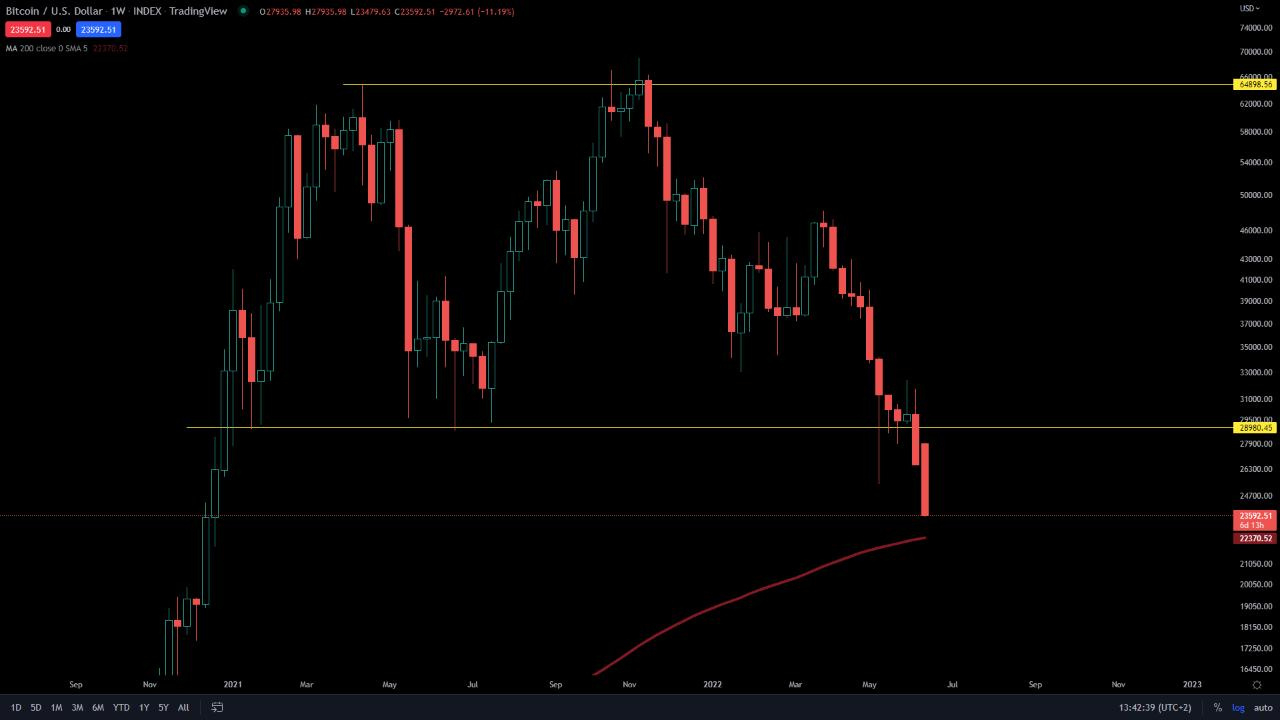
The reported low was below the moving average. The figures are from different market-data snapshots and should not be treated as an exact closing-price comparison. [4]
The 200-week moving average represents Bitcoin's long-term price trend across approximately four years.
It has historically been watched as a major cycle reference.
But it is not guaranteed support.
CoinTelegraph reported that Bitcoin touched approximately $67,500 on November 13, below the reported 200-week average of $67,993. An analyst also highlighted $57,700 as a possible downside scenario if weekly RSI falls below 41.5. This is a conditional analyst scenario, not a price prediction. [5]
The important distinction:
A brief move below the average is a warning.
A sustained weekly breakdown is more serious.
A recovery above it, supported by stronger spot demand, would improve the technical picture.
I would not make an investment decision based on one moving average alone.
5. Two possible market scenarios
Scenario A: Liquidity flush
Forced liquidations subside.
Futures positioning becomes less crowded.
Spot buyers return.
ETF outflows stabilize.
Bitcoin reclaims the 200-week average.
This would suggest that the correction was amplified by leverage and temporary liquidity conditions.
Scenario B: Structural breakdown
ETF outflows persist.
Spot liquidity remains weak.
Bitcoin fails to reclaim the 200-week average.
Lower highs and lower lows continue.
Restrictive macro conditions remain in place.
This would suggest that the market is transitioning into a deeper bearish phase.
The distinction is not simply the magnitude of the decline.
It is whether sustainable demand returns.
6. My perspective as a long-term Bitcoin accumulator
I do not believe every correction should trigger panic.
But I also do not believe every correction is automatically an opportunity.
My approach is to distinguish price volatility from changes in the investment thesis.
I continue to monitor:
Bitcoin's long-term market structure.
Institutional ETF flows.
Spot demand versus futures activity.
Global liquidity and monetary policy.
The dollar and Treasury yields.
The sustainability of Bitcoin's long-term investment thesis.
A lower price can improve an entry opportunity, but only if the underlying investment thesis remains intact.
I would rather accumulate through a disciplined process than attempt to predict the exact bottom.
Final thoughts
Bitcoin is approaching an important technical and psychological level.
The liquidation data suggests that leverage has amplified the decline. The ETF data suggests that institutional demand has weakened. The macro environment provides an additional source of pressure.
These factors should not be examined independently.
My current interpretation is that Bitcoin is experiencing both a liquidity-driven correction and a broader deterioration in short-term market conditions. Whether this becomes a structural breakdown depends on what happens next.
I am watching demand, not just the candles.
Accumulate systematically. Allocate deliberately. Compound patiently.
Not financial advice. This article reflects market research and personal investment analysis. Cryptocurrency investments carry substantial risk, including the potential loss of principal.