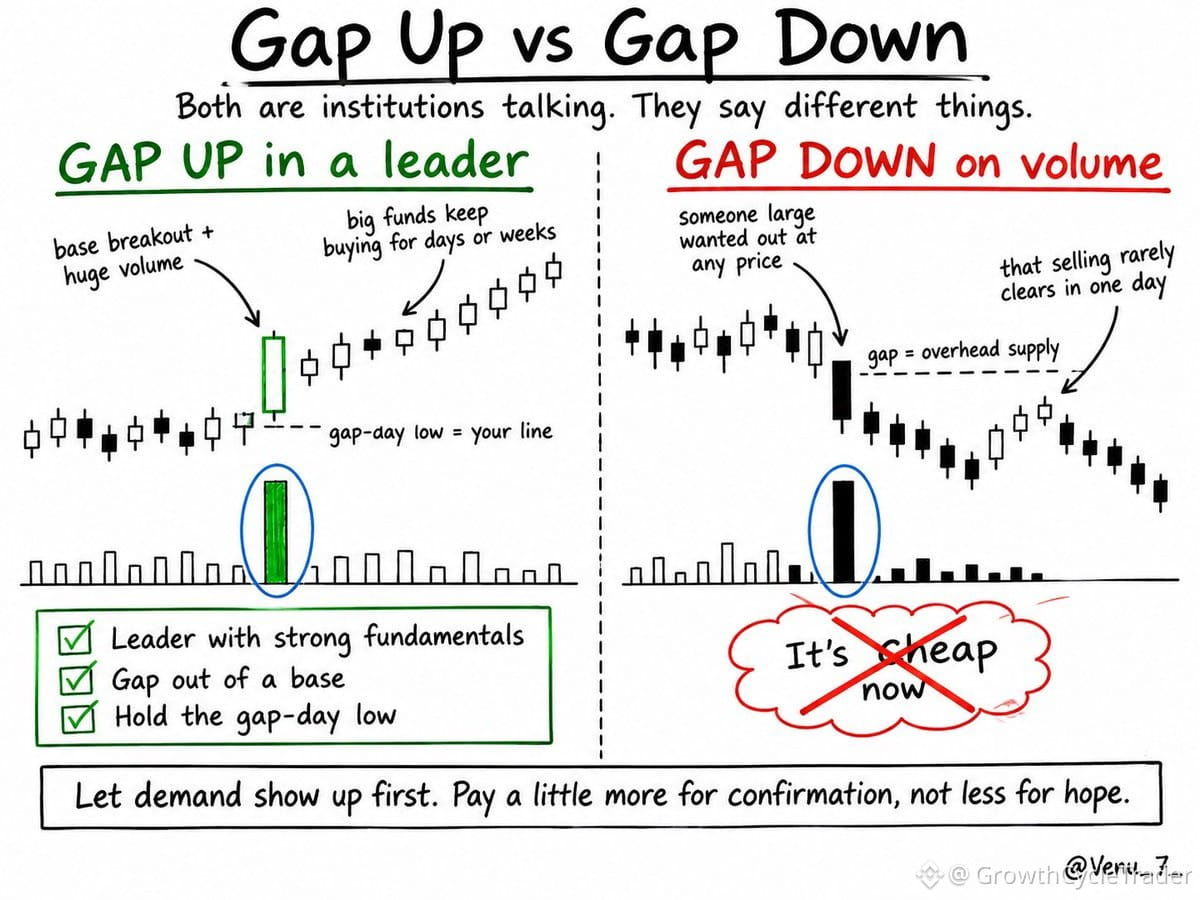
One of the biggest mistakes in trading is confusing a stock getting cheaper with a stock becoming a better opportunity.
A gap up and a gap down can both reveal institutional activity — but they tell very different stories.
Gap up on heavy volume, in a leader, out of a base:
• Strong earnings and institutional demand can fuel sustained buying
• Big funds build positions over days or weeks, not just one session
• The gap-day low becomes a key risk-management level
• Power Earnings Gaps breaking out of Stage 1 bases can mark the start of powerful Stage 2 uptrends
Gap down on heavy volume:
• Signals significant selling pressure and institutional distribution
• Overhead supply can limit recovery attempts
• A stock down 30%, 50%, or 70% doesn't automatically make it cheap
• Weak stocks can remain weak much longer than you expect
I know many traders love buying gap downs. That's their approach, and I respect it.
But my framework combines Stage Analysis and CANSLIM. I prefer focusing on gap ups backed by strong fundamentals, institutional demand, and leadership in the right sectors.
I'd rather buy strength with confirmation than get married to a stock, keep buying gap downs, and hope it eventually recovers.
Of course, not every gap up succeeds, and not every gap down leads to further weakness. Context, valuations, and risk management still matter.
The goal isn't to buy the cheapest stock. It's to identify potential market leaders and participate in their strongest trends.
I'd rather miss the first 10-20% of a new uptrend than spend months waiting for a broken stock to recover.