At first, I thought Microsoft-backed blockchain projects like $SXT were just another institutional adoption narrative… but the more I look at Space and Time, the more something feels off. 🧠
Maybe we're focusing on the wrong part.
The interesting shift isn't simply traditional tech moving toward blockchain. It's that the data behind financial decisions may eventually need to prove it's correct, not just ask users to trust whoever controls the database.
And that's where I think the mechanism gets interesting.
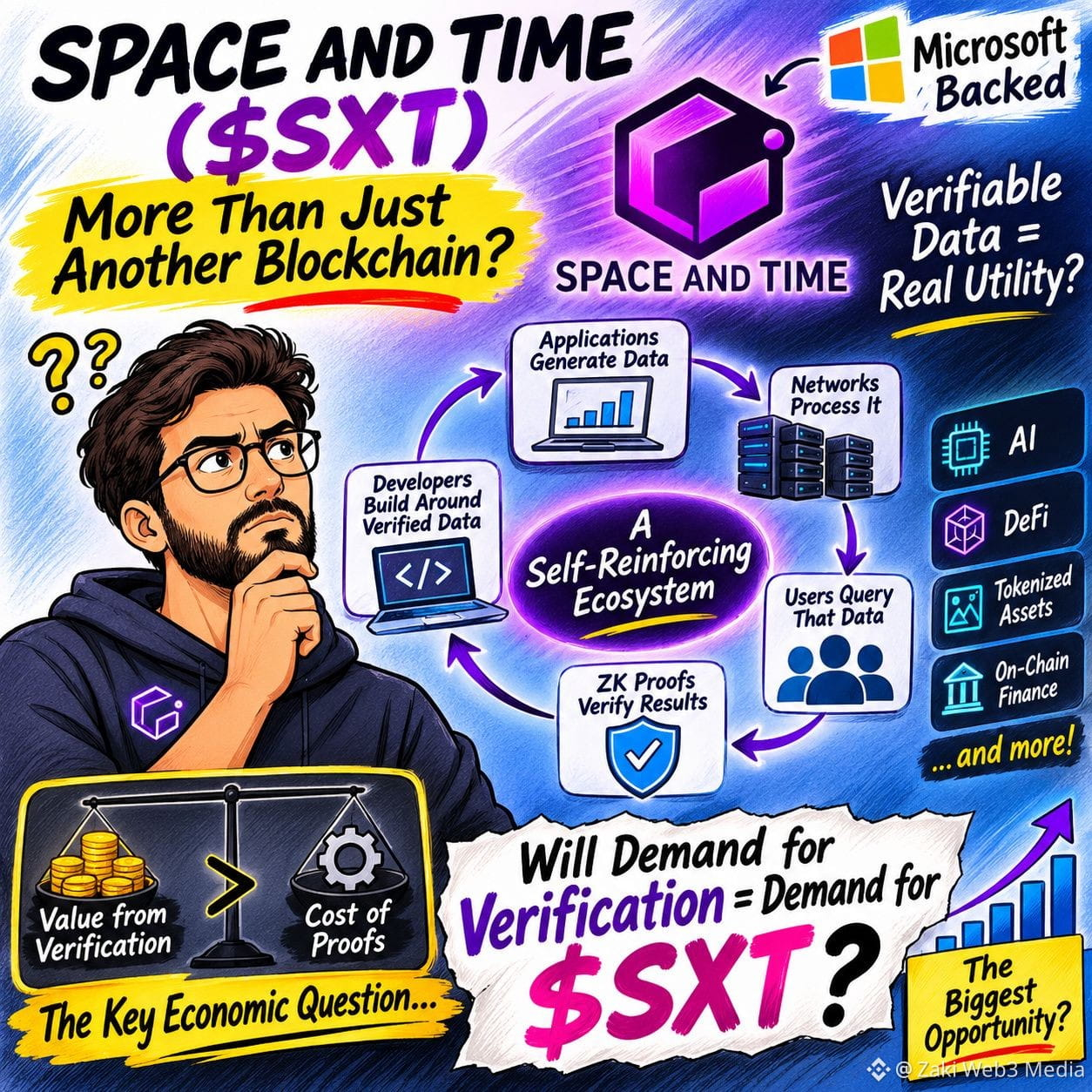
Applications generate data → networks process it → users query that data → ZK proofs verify the results → developers build applications around information they can independently verify.
It's a loop. More useful applications create demand for reliable data, reliable verification attracts developers, and developer activity can create more network usage.
But here's the part I can't ignore.
The system only works economically if the value generated by verification exceeds the cost of producing and verifying those proofs.
Otherwise, developers have very little reason to leave conventional infrastructure behind.
With AI, tokenized assets, and on-chain finance competing for attention in 2026, verifiable data feels like infrastructure that could become increasingly important.
What's interesting is that while liquidity keeps rotating between AI, DeFi and consumer narratives, the infrastructure quietly connecting these sectors might end up being the more durable part of the cycle.
But there's a contradiction here.
Space and Time could become genuinely useful infrastructure without $SXT necessarily capturing proportional value from that adoption.
That's what I'm watching.
Maybe the biggest opportunity isn't whether blockchain data becomes verifiable…
It's whether the demand for verification eventually becomes demand for the token itself.
And honestly, I'm not sure the market has figured out that distinction yet. 🤔
#sxt $SXT @SpaceandTime