
#huangrisksousteroverreportedaffairwithsubordinate
🚨 NVIDIA'S LEADERSHIP CRISIS: A CORPORATE SHOCK, NOT AN AI COLLAPSE
What Jensen Huang's reported ouster risk means for Wall Street, Bitcoin & AI crypto tokens
📅 11 November 2026 | Market Intelligence Brief
NVIDIA is facing a potentially defining moment in its corporate history.
Reports that the board is considering Jensen Huang's removal have pushed the world's leading AI-chip company into a serious leadership and governance crisis. The controversy involves reported personal relationships, an internal investigation and wider national-security concerns.
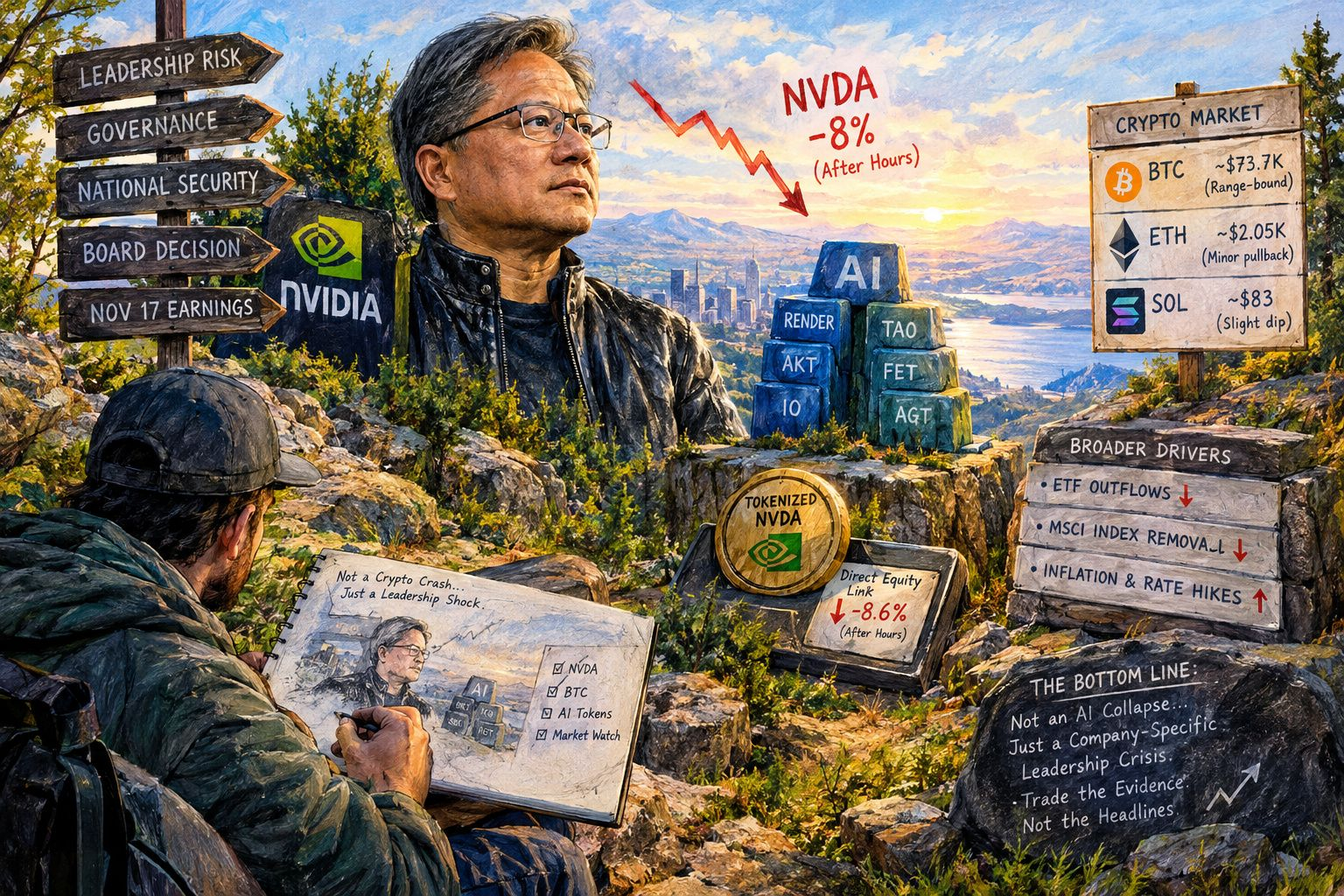
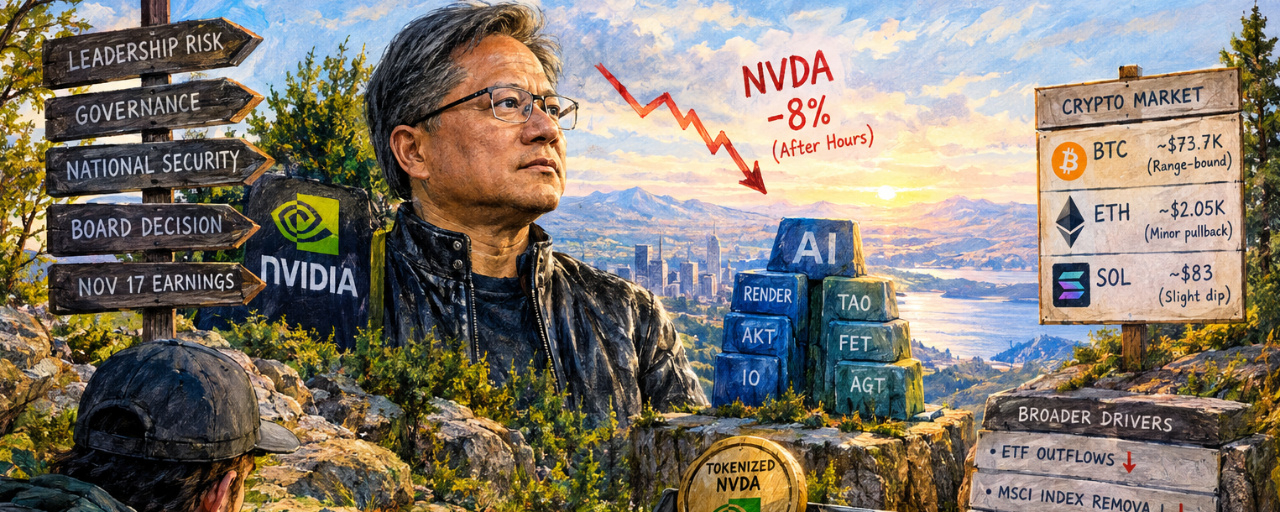
NVIDIA shares fell approximately 8%–8.6% in after-hours trading, with investors suddenly having to consider a question that was barely imaginable before:
What happens to a $4 trillion AI powerhouse if the person who built its vision is no longer at the helm?
But there is a bigger market question:
Does NVIDIA's leadership crisis threaten the AI trade, or is this simply a company-specific shock?
Let's separate the headlines from the actual market signals.
1️⃣ NVIDIA: THE REAL RISK IS LEADERSHIP UNCERTAINTY
Jensen Huang is not an ordinary CEO. Since co-founding NVIDIA in 1993, he has become central to its AI strategy, ecosystem relationships and long-term vision.
The board's reported consideration of his future introduces three immediate risks:
Leadership risk: Uncertainty over succession and strategic continuity.
Governance risk: Questions about executive conduct, conflicts of interest and board oversight.
Geopolitical risk: Additional scrutiny surrounding the separate investigation into alleged links to Chinese intelligence and potential chip shipments.
However, investors must distinguish allegations and reported board deliberations from established findings or a formally announced CEO removal.
The next major catalyst is NVIDIA's November 17 earnings report. Investors will be looking beyond revenue and guidance toward management stability and the board's response.
My interpretation: NVIDIA's competitive position does not disappear overnight if Huang leaves. Its engineering talent, customers, software ecosystem and AI infrastructure commitments remain important. But a leadership vacuum could increase the uncertainty discount applied to its valuation.
2️⃣ WALL STREET: A LEADERSHIP SHOCK DOES NOT EQUAL AN AI DEMAND COLLAPSE
The important distinction is between a company's leadership crisis and the industry's underlying demand.
The AI infrastructure trade has other participants:
AMD — competing semiconductor demand.
CoreWeave — AI cloud and GPU infrastructure.
Data-centre operators — continued investment in computing capacity.
Hyperscalers — long-term AI infrastructure spending.
CoreWeave's earnings-driven market reaction provides an important counterpoint: demand for AI computing infrastructure is not determined by NVIDIA's management headlines alone.
If NVIDIA weakens while competitors and infrastructure providers remain strong, capital could rotate within the AI sector rather than leave it entirely.
But if the controversy begins affecting chip shipments, customer confidence, financing or US-China export policy, the impact could extend well beyond NVIDIA.
Watch the semiconductor sector's relative performance, not just NVDA's individual price movement.
3️⃣ CRYPTO MARKET: WHY BTC IS NOT FOLLOWING NVIDIA DOWN
Here is where the market distinction becomes particularly interesting.
Despite NVIDIA's after-hours weakness, Bitcoin was holding around $74,000, while Ethereum traded near $2,050 and Solana around $83.
The immediate reaction suggests that crypto traders are not treating this event as a systemic collapse of the AI investment cycle.
However, crypto already has its own significant headwinds:
📉 Bitcoin ETF flows: US spot Bitcoin ETFs recorded approximately $95 million in net outflows on November 10, extending the withdrawal streak to four consecutive sessions.
🏦 Institutional pressure: MSCI's decision to remove Strategy from its USA Index, effective November 30, adds another source of uncertainty for Bitcoin-treasury equity exposure.
📊 Inflation and interest rates: Hotter-than-expected October US inflation has increased market expectations of a December Federal Reserve rate hike, putting pressure on risk appetite.
This distinction matters:
NVIDIA's controversy is a company-specific catalyst. ETF withdrawals, inflation and monetary-policy expectations are broader crypto-market drivers.
BTC, therefore, has more immediate reasons to move independently of NVIDIA.
4️⃣ AI CRYPTO TOKENS: A POTENTIAL ROTATION, NOT A UNIFORM SELL-OFF
The AI-token sector needs to be evaluated by its actual economic exposure rather than its narrative.
GPU & decentralized compute
RENDER
AKT
IO
These projects are exposed to the broader GPU-compute narrative. NVIDIA volatility can affect sentiment, but their business propositions are not identical to NVIDIA's chip sales.
If decentralized GPU demand continues expanding, a temporary decline in NVIDIA shares does not automatically invalidate their long-term thesis.
AI models & decentralized intelligence
TAO
FET
These tokens represent different parts of the AI ecosystem. Their valuations depend on network adoption, token economics, developer activity and liquidity, not simply NVIDIA's stock price.
A governance scandal at NVIDIA is not evidence that decentralized AI demand is deteriorating.
Important trading distinction: Do not interpret an AI-token rally as proof of fundamental strength. Check spot volume, derivatives open interest, funding rates and actual network activity before treating relative strength as sustainable.
5️⃣ TOKENIZED NVIDIA SHARES: THE MOST DIRECT CRYPTO CONNECTION
There is one area where the connection is much more direct.
Securitize launched tokenized US equity exposure, including NVIDIA, in October 2026.
Unlike AI-themed cryptocurrencies, tokenized NVIDIA exposure is designed to reflect the economics of the underlying equity.
Therefore, a sharp fall in NVDA can translate directly into downside risk for these instruments.
However, tokenized shares are not the same as ordinary cryptocurrencies. Investors must consider issuer structure, redemption rights, trading hours, liquidity, jurisdictional restrictions and the possibility of tracking deviations.
Do not assume every tokenized NVDA instrument is available on Solana or trades at exactly the same price as the underlying share.
6️⃣ MARKET SCENARIOS: WHAT TRADERS SHOULD WATCH
🟢 BULLISH SCENARIO
Board uncertainty is resolved without disrupting operations.
NVIDIA maintains its AI demand outlook.
AMD and other infrastructure companies continue showing strong demand.
Bitcoin stabilizes and ETF outflows begin reversing.
AI tokens retain spot-market strength.
Potential outcome: AI-related risk appetite recovers, with selective opportunities in compute and decentralized AI tokens.
🔴 BEARISH SCENARIO
Huang's removal becomes formal and succession remains unclear.
The investigation expands into material national-security or export-control consequences.
NVIDIA's earnings guidance disappoints.
AI infrastructure financing and semiconductor sentiment weaken.
Bitcoin ETF withdrawals continue alongside tighter monetary-policy expectations.
Potential outcome: Broader risk-off positioning, weaker AI-token liquidity and increased volatility in crypto derivatives.
🟡 NEUTRAL / ROTATION SCENARIO
NVIDIA remains under pressure.
Other semiconductor and AI infrastructure companies demonstrate resilience.
BTC remains range-bound.
AI tokens show mixed performance.
Potential outcome: Capital rotates between AI equities, decentralized compute, AI-agent tokens and other crypto narratives instead of exiting the entire sector.
🎯 FINAL VERDICT: FOLLOW THE MONEY, NOT THE HEADLINE
The NVIDIA story is a reminder that even the most influential technology companies are exposed to governance, leadership and geopolitical risks.
But one CEO's potential departure does not erase the global demand for artificial intelligence.
Likewise, an NVIDIA sell-off does not automatically create a bearish Bitcoin signal.
My central conclusion:
NVIDIA faces a genuine company-specific leadership and governance risk.
The AI infrastructure investment thesis remains separate from the fate of one executive, although prolonged disruption could affect it.
Bitcoin's immediate direction is more closely connected to liquidity, ETF flows, inflation and institutional positioning.
AI crypto tokens may experience headline-driven volatility, but their fundamental performance must be assessed individually.
Tokenized NVIDIA exposure carries a more direct equity-price transmission risk.
⚠️ The trade to avoid: Blindly shorting every AI token because NVIDIA is falling.
📌 The opportunity to monitor: Identify which AI and decentralized-compute projects retain real demand and liquidity even when traditional AI equities face pressure.
The next major checkpoint is November 17: NVIDIA's earnings, management commentary and any meaningful board developments.
The market is not necessarily questioning whether AI has a future. It is questioning how much leadership uncertainty one of the industry's most important companies can absorb.