
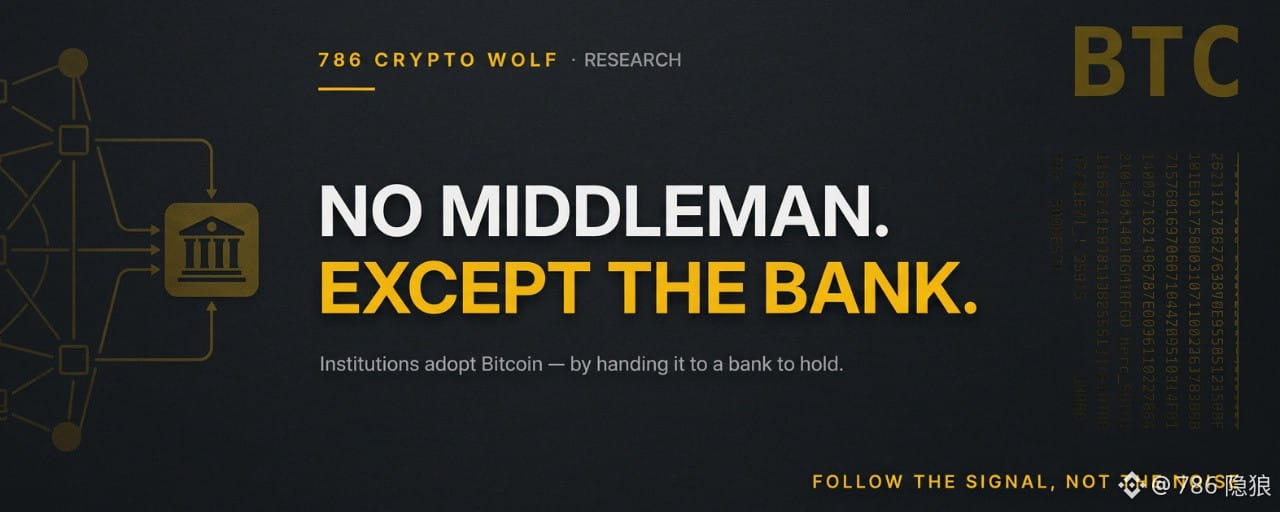


The most “bullish” crypto headline of the week is also its quietest surrender.
On November 11, Deutsche Bank — one of the largest banks on earth — switched on crypto custody for its institutional clients. Hedge funds, asset managers, corporations and sovereign institutions can now hand their Bitcoin, Ether and stablecoins to the bank to hold. Germany first, the rest of the EU under MiCA next, Asia in 2027.
The market read it as what it looks like: adoption. Another pillar. Institutions are in. And they’re not wrong.
But look at what “institutions are in” actually requires.
An institution will not touch Bitcoin until someone it trusts agrees to hold it. Not a promise of it — the actual keys. And the entity the financial world trusts most to hold things is the one Bitcoin was designed to make unnecessary: a bank.
So the headline everyone is cheering — “banks are custodying crypto” — is, underneath, a reversal. The asset built to remove the middleman is now held by the middleman. Self-custody was the whole point. Institutional crypto is custodial by definition.
That’s not a scandal. It’s the trade. Institutions don’t want to be their own bank; they want a bank. Deutsche Bank is simply the one that said yes first, at scale.
Here’s the part the “bullish milestone” posts skip.
When you deposit euros at Deutsche Bank, a deposit-guarantee scheme stands behind them up to a limit. If the bank fails, you’re covered. Custodied crypto is not a deposit. It’s an asset the bank holds for you — and it carries no such insurance. You get the bank’s name, its security, its reputation. You do not get the safety net that makes a bank deposit a bank deposit.
So the institution re-introduces the intermediary crypto was built to remove — and gives up the one protection that intermediary normally provides. Middleman back. Backstop gone.
Now the honest part, because it cuts two ways.
Read it one way, this is maturation: real custody, real regulation (BaFin, MiCA), real institutional money finally able to participate safely. Genuinely good for the asset class.
Read it another way, it’s crypto quietly becoming the thing it was built to replace — a system where a few trusted institutions hold everyone’s value, under rules written by regulators, with retail left out entirely (this launch skips retail).
Both are true. Adoption and decentralization are not the same direction. This week, they moved apart.
Every step toward “institutional adoption” is a step toward re-intermediation. The more crypto succeeds at being accepted, the more it resembles the banking system it set out to route around. That may not be failure — it might be inevitable. But it’s worth naming, because the people cheering “banks are in!” are cheering the exact outcome Bitcoin’s whitepaper was a rejection of.
If a bank now holds the Bitcoin, writes the rules with the regulator, and leaves retail outside — what, exactly, did Bitcoin decentralize?
🐺 786 CRYPTO WOLF · RESEARCH
Follow the signal, not the noise.
$BTC
#DeutscheBank #bitcoin #cryptocustody #AlphaWolfHQ #786CryptoWolf