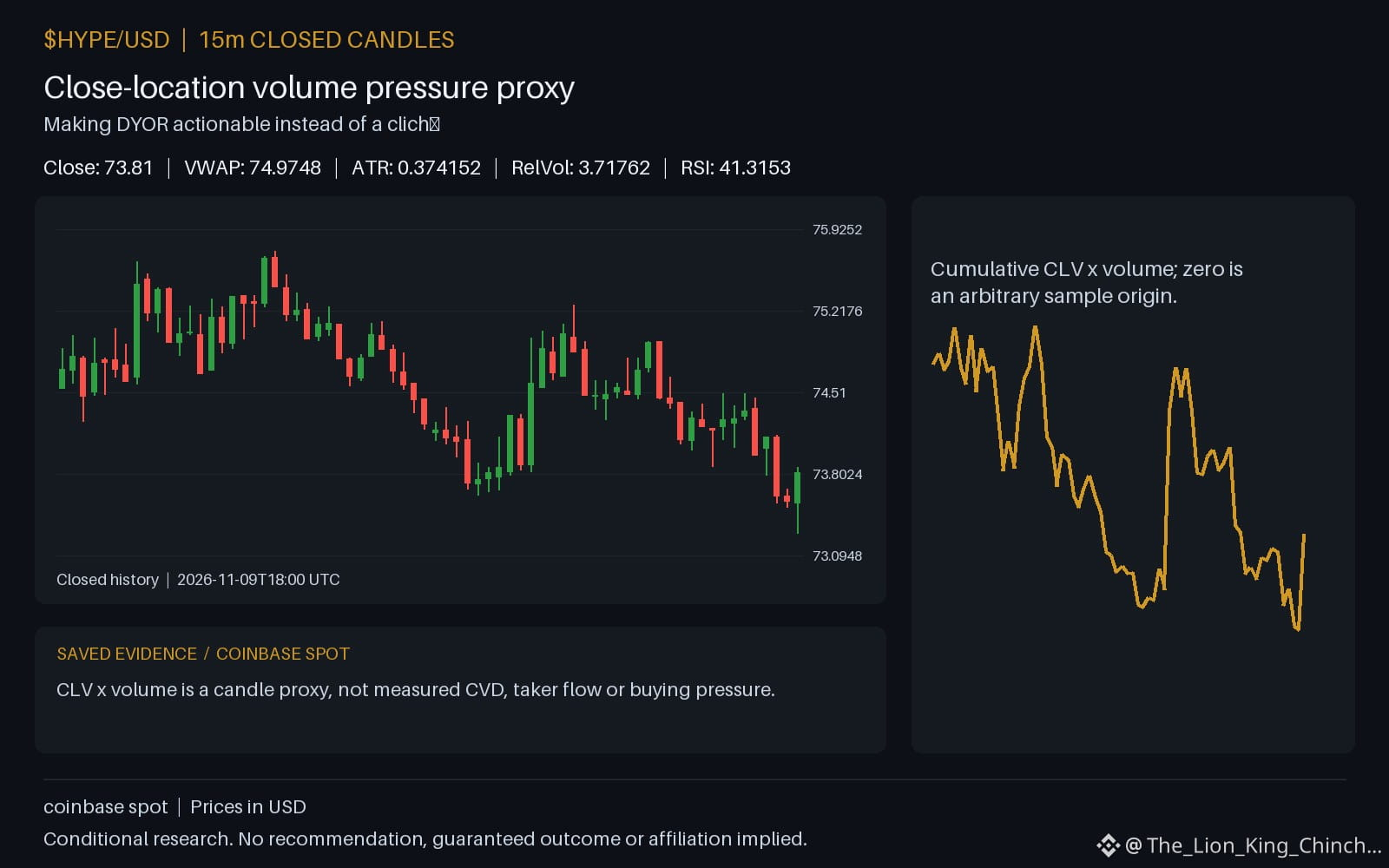
$HYPE: Moving Beyond the DYOR Cliché
A common assumption in crypto content is that telling readers to Do Your Own Research provides sufficient protection. However, without a specific method, this phrase functions more as a legal shield than a helpful tool. When a ticker like $HYPE shows a daily change of 1.40129 and an hourly direction described as down, a trader might feel pressured to act. This urgency often stems from social proof or the incentive structures of platforms where creators are rewarded for high engagement.
The counterexample to consider is the relationship between volume and price direction. Currently, $HYPE has volume above its baseline while trading at 73.81. If the RSI is 41.3153 and the MACD stands at -0.193896 against a signal of -0.125718, a researcher must ask if the activity reflects a sustainable trend or a temporary spike. Instead of following the crowd, a practical check is to compare these technical levels against the daily VWAP of 74.9748.
What could change the reading is a shift in the daily trend. If the price moves toward the resistance at 74.95 or the support at 73.51, the interpretation of the current hourly momentum may flip. Separating evidence from persuasion requires acknowledging these boundaries. Incentives like Write to Earn can create a dilemma where quantity overrides clarity. To remain objective, treat every observation as a hypothesis rather than a certainty. 💡
Probabilistic market research, not a recommendation or guaranteed return.
The comparison to keep in mind: $ARB has hourly direction down and volume above its baseline; $ONDO has hourly direction up and volume above its baseline. This alone does not establish correlation.
Instead of just saying 'DYOR,' what is the single most practical check you tell friends to run on a chart themselves?
#HYPE #ARB #ONDO #CryptoCommunity #CryptoLearning