
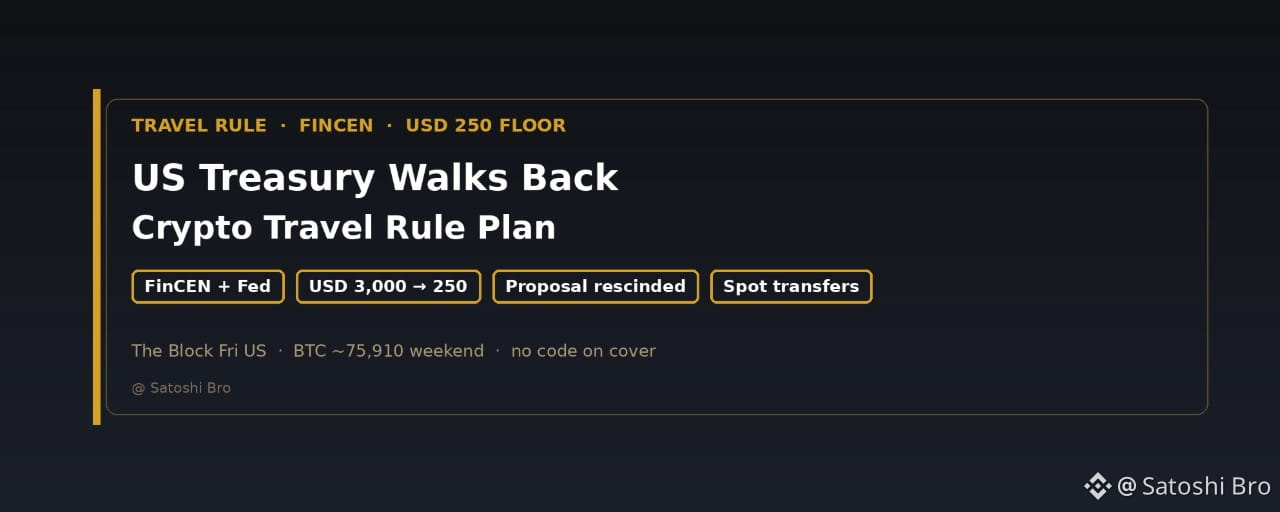

FinCEN and the Federal Reserve just pulled a 2020 crypto Travel Rule proposal that would have dropped the reporting floor from USD 3,000 to USD 250. For Spot traders who send normal-sized transfers, that matters more than another weekend price tick: the lower bar would have pushed a lot of ordinary moves into the same paperwork lane as large wires. The Block covered the walk-back on Friday US time. Binance Spot stayed quiet through the weekend while the policy story changed.
Educational only, not financial advice. Policy points below come from The Block's November 6 dispatch; Spot prices later in this article are a live Binance check from Saturday November 7, 2026. Rounded numbers are approximate; always read the last print on your own screen.
👉 Sign up on Binance with THEBESTCODE
Affiliation note: the sign-up link above uses my code THEBESTCODE.
Eligible new users can also work through the welcome bonus of up to 19800 USDT on the same task list that ships with every sign-up code. Finish those tasks on your own schedule after the account is Verified. THEBESTCODE is a sign-up / welcome path only — it does not change Spot or Futures fee rates.
Earlier the same week, a separate Treasury AML cut-off on a peer venue was covered in US Treasury Cuts Off MEXC What Traders Should Know. The broader US policy doubt tape that already printed BTC near 75K sits in Bitcoin Slips to 75K on US Crypto Regulation Doubts. This article stays on the Travel Rule walk-back and what it changes for day-to-day Spot transfers.
What The Block reported on the Travel Rule walk-back
Primary source: The Block / Sarah Wynn (Regulation, November 6, 2026). Stick to these checked points — do not invent extra rule text.
On Friday, the Treasury's Financial Crimes Enforcement Network and the Federal Reserve Board of Governors rescinded the proposed Travel Rule expansion first floated in 2020.
That proposal would have required financial institutions to collect information on convertible virtual currency (CVC) transfers of USD 250 or more, cutting the threshold from USD 3,000.
In the withdrawal filing, FinCEN said more than five years had passed, the CVC industry had changed, and additional public input would be helpful.
FinCEN also wrote that any future amendments to the Recordkeeping Rule and Travel Rule related to CVC should be considered in light of recent developments so they are "fit for purpose."
When the rule was first proposed, FinCEN had argued that bad actors were increasingly using smaller transactions to move illicit funds.
Crypto groups such as Coin Center had warned that dropping the floor from USD 3,000 to USD 250 would pull more ordinary transfers into "warrantless financial surveillance."
Coin Center said Friday it was glad to see the proposal rescinded, and noted Treasury had already withdrawn proposed unhosted-wallet and cryptocurrency-mixing rules last month.
Crypto Council for Innovation CEO Ji Hun Kim called the withdrawal the "right call," saying the proposal had not moved for years for good reason and that lowering the cross-border threshold from USD 3,000 to USD 250 would have placed undue burden on institutions.
This is a reporting-threshold story, not a hack story and not a Spot breakout story. Keep Elliptic / breach headlines off the center of this page.
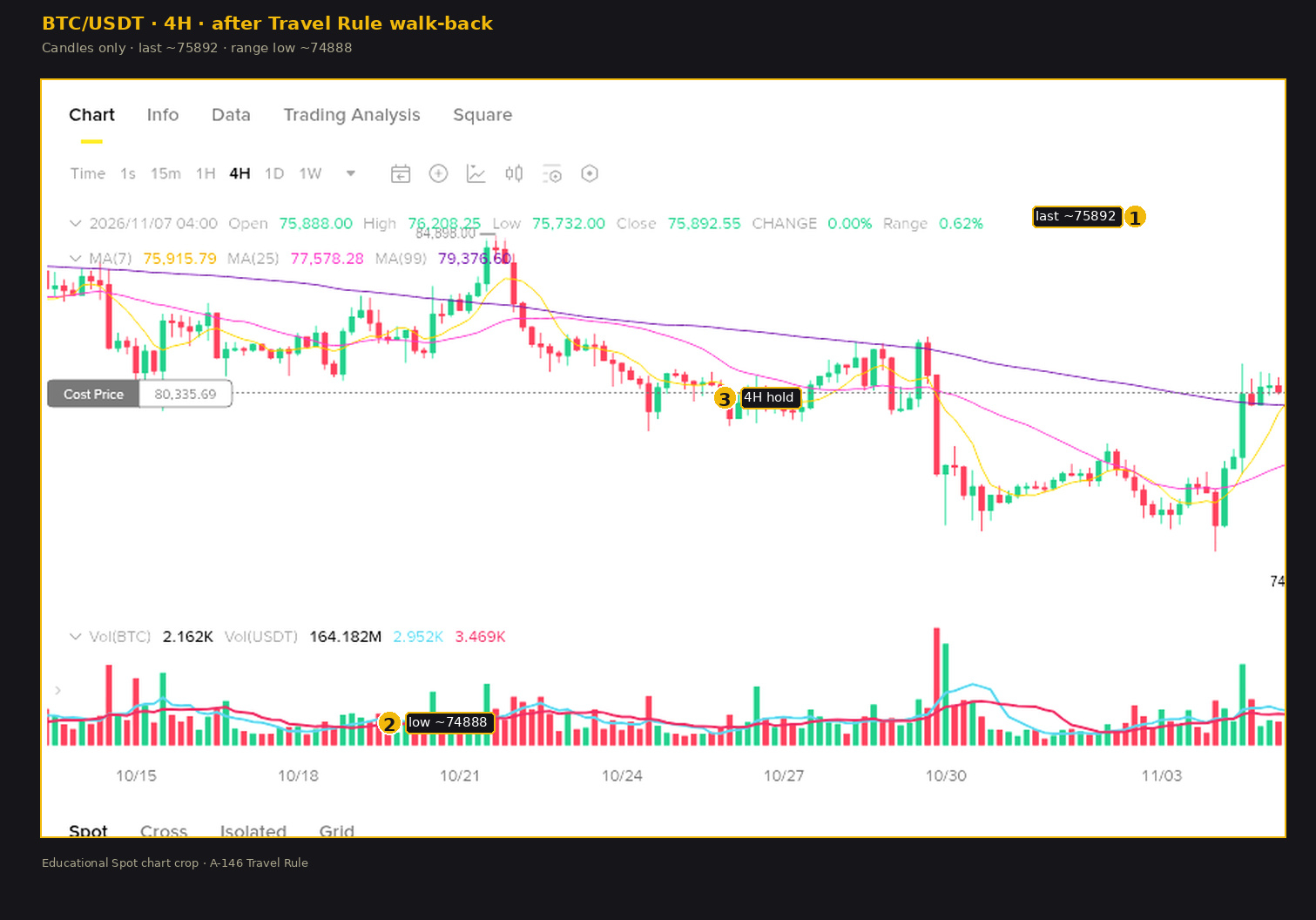
Live Spot numbers while the rule was pulled
Approximate Binance Spot prints around 07:15 Asia/Shanghai, Saturday November 7, 2026:
Bitcoin (BTCUSDT): last ~75910 USDT (+0.666% 24h), high ~76416, low ~74888. Still mid-75K to mid-76K range — no panic print tied to the walk-back itself.
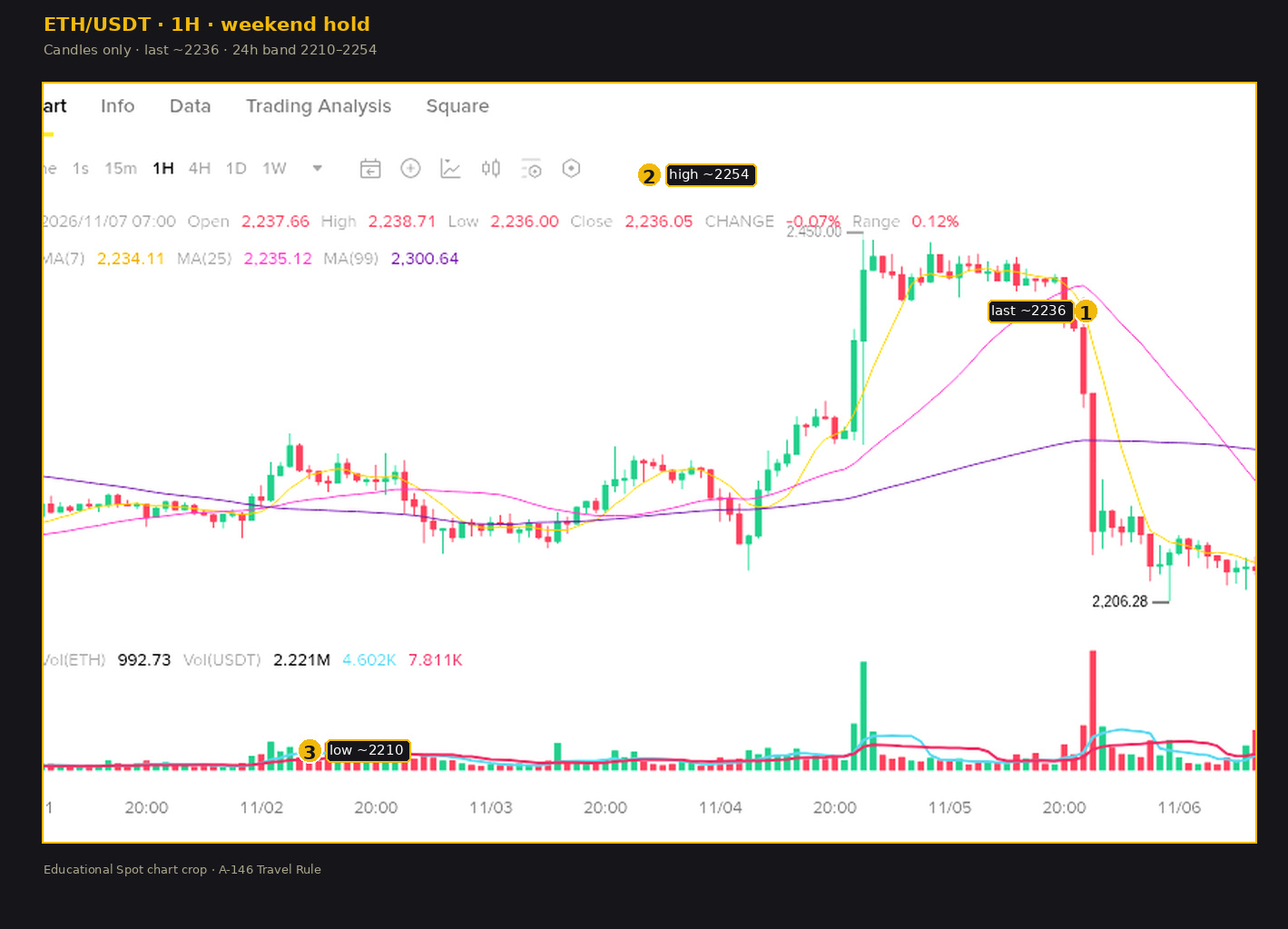
Ether (ETHUSDT): last ~2237 USDT (+0.942%), high ~2254, low ~2210.
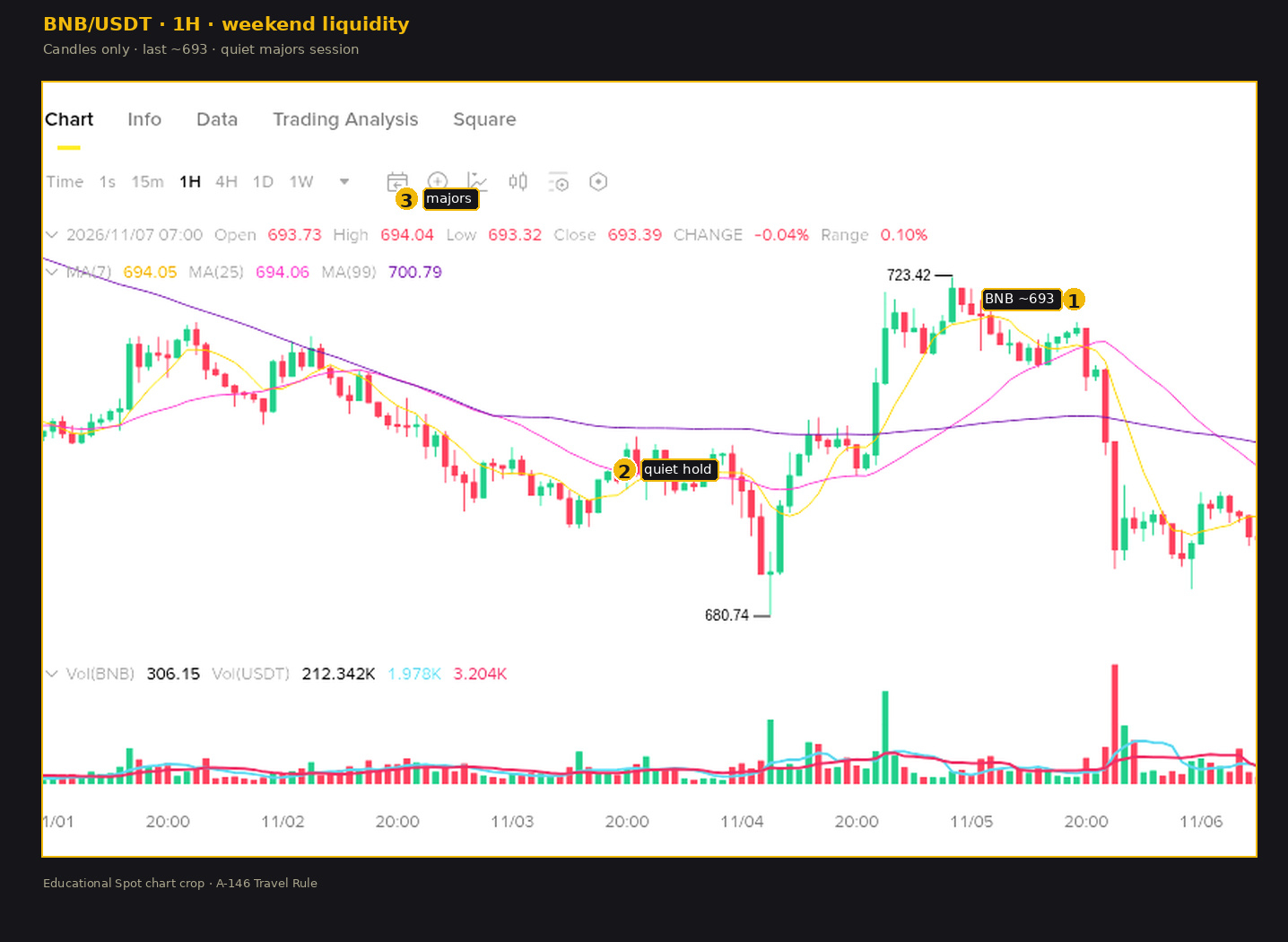
BNB (BNBUSDT): last ~694 USDT (+1.221%), high ~700, low ~684.
A calm Saturday book does not mean Travel Rule policy is irrelevant. It means liquid Spot can keep quoting while agencies close an old proposal. Do not treat "BTC held ~75910" as proof that transfer paperwork rules never change again. The filing leaves the door open for fresh proposals later; it only kills this 2020 draft.
If you already read the peer-venue AML cut-off piece from the same news day, keep that enforcement story separate from this threshold walk-back. Same Treasury lane, different tool.
What the USD 3,000 vs USD 250 gap means for Spot users
Work the numbers the way a Spot desk would, not the way a press release would.
Assume you move USD 800 of BTC from an exchange wallet to another financial institution that would have fallen under the proposed Travel Rule collection rules:
Under the existing USD 3,000 floor, that USD 800 transfer sits below the classic travel-rule collection trigger the 2020 draft wanted to replace.
Under the withdrawn USD 250 floor, the same USD 800 transfer would have cleared the bar by more than 3× and entered the collect-and-transmit lane.
A USD 400 weekend top-up to a trading wallet, a USD 600 P2P settlement, or a USD 1,200 coin move between two KYC'd venues would all have been "in scope" under USD 250 while staying under the old USD 3,000 line.
Scale it to weekend Spot size near the live prints above:
About 0.0105 BTC at ~75910 USDT is roughly USD 800 — a routine transfer size, not a whale wire.
About 0.36 ETH at ~2237 USDT is roughly USD 800 again.
About 1.15 BNB at ~694 USDT is the same notional.
Those are ordinary Spot user sizes. The policy fight was about whether institutions must treat those moves like large wires for information collection. Pulling the draft keeps the higher floor in place for now; it does not erase AML duties that already exist, and it does not bless every transfer as invisible.
What Spot users should not invent from this headline:
That FinCEN "approved" any exchange, including Binance.
That Travel Rule obligations for larger transfers vanished.
That self-custody, mixing, or unhosted-wallet rules are permanently closed — Coin Center noted those other proposals were withdrawn last month, which is a separate filing track, not a free pass forever.
Why venue choice still matters after a walk-back
When agencies pull an old draft, traders still need a venue where Spot books, fee schedules, and transfer rails are checkable before size goes in. Favour honesty over slogans. We publish on Binance Square, so the comparison should favour Binance where checked facts support it: deep Spot books on majors (the BTC / ETH / BNB prints above), public fee pages you can open before you size, and product status screens that do not require inventing a US banking licence or a FinCEN blessing.
Practical checklist after a Travel Rule headline:
Confirm your account residency and product access still match how you fund and withdraw. A walk-back does not rewrite country product maps overnight, but support queues get noisier when policy news hits.
Prefer Spot size you can explain and carry when the catalyst is regulatory drafting, not a chart breakout. Isolated margin, if you use it at all, keeps a forced close inside one pair.
Map transfer sizes you actually use against USD 3,000 and USD 250 so you know which future draft would touch your habit. If most of your moves sit between those two lines, you are exactly the cohort the 2020 proposal would have expanded into.
Keep fee math separate from policy math. Transparent Spot fees on a liquid book still matter more for day-one cost than a rescinded draft. Check the fee schedule on screen; do not invent a discount this code does not provide.
Separate three stories from the same news week: (a) this Travel Rule walk-back, (b) the peer-venue AML cut-off covered in the MEXC piece linked above, (c) the earlier US regulation doubt tape that already printed near 75K. Mixing all three into one oversized long is how quiet weekends get expensive.
THEBESTCODE stays available as the sign-up / welcome path in the intro link if you are opening a fresh Binance account while you run that checklist — welcome tasks up to 19800 USDT for eligible users, once, on the published task list. Again: no Spot or Futures fee-cut claim for this code.
Handles and clocks this walk-back left on the board
USD 3,000: existing Travel Rule / recordkeeping threshold the 2020 draft wanted to cut.
USD 250: proposed new floor FinCEN and the Fed just withdrew.
Five-plus years: age of the proposal FinCEN cited as a reason to pull it and seek fresh input.
~75910 / ~2237 / ~694: Binance Spot BTC / ETH / BNB around 07:15 Asia/Shanghai Saturday — quiet majors while the filing hit the wire Friday US time.
Unhosted-wallet and mixing proposals: separate drafts Coin Center said Treasury withdrew last month — related surveillance lane, not this Travel Rule text.
Nothing here is financial advice. Transfer rules, venue access, and Spot books can change faster than a checklist can save size you already parked without reading the live product screen.
If you are opening an account around this tape, also check the current Binance welcome bonus campaign before your first deposit.
FAQ
What did FinCEN and the Fed withdraw?
Per The Block (Sarah Wynn, November 6, 2026), FinCEN and the Federal Reserve Board of Governors rescinded the 2020 Travel Rule proposal that would have required institutions to collect information on CVC transfers of USD 250 or more, instead of the higher USD 3,000 floor.
Why did they walk it back?
FinCEN said more than five years had passed, the convertible virtual currency industry had changed, and additional public input would be helpful. Future amendments, it said, should be "fit for purpose" in light of recent developments.
Does this mean crypto transfers are unregulated now?
No. The withdrawal kills this draft expansion. Existing Travel Rule and Bank Secrecy Act duties for larger transfers and other AML rules still apply. Coin Center also noted other proposals (unhosted wallets / mixing) were withdrawn last month — that is not a blank cheque.
Is this the same story as the MEXC Treasury cut-off?
No. The MEXC piece is an AML enforcement action against a peer venue. Here the story is the rescinded 2020 reporting-threshold proposal. Same news week, different tool.
Did Bitcoin dump when the proposal was pulled?
On the Saturday Asia/Shanghai check used here, Binance Spot BTC was near 75910 USDT, about +0.67% over 24 hours. A quiet print does not rewrite transfer rules; it just means liquid Spot kept quoting.
How should Spot traders use this news?
Map your real transfer sizes against USD 3,000 and USD 250, keep venue and fee checks honest on screen, and do not invent licence claims. If you need a fresh account path, THEBESTCODE is the sign-up / welcome code in the intro — welcome tasks up to 19800 USDT for eligible users, once.