
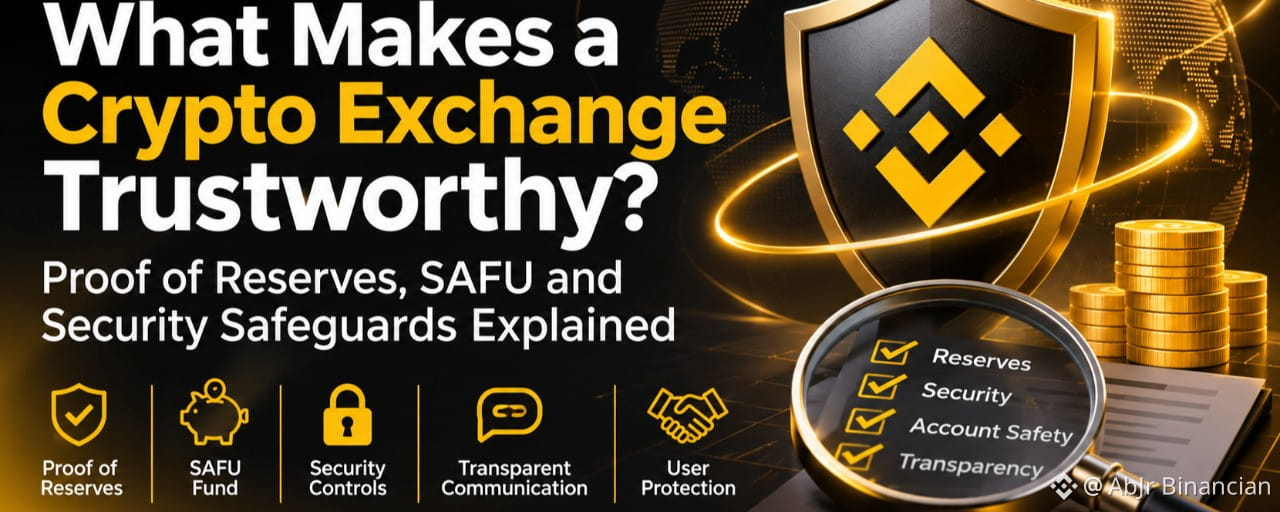
Choosing a crypto exchange is not simply about comparing trading fees, available tokens, or how quickly an app processes orders. When you deposit money or hold digital assets on a centralized exchange, you are also trusting that company with custody, security, operational controls, and the ability to respond when something goes wrong.
A trustworthy exchange should be able to demonstrate that it holds sufficient assets, protects accounts and wallets, communicates honestly, and accepts responsibility when its own systems fail.
Binance offers several examples of safeguards users can examine, including Proof of Reserves (PoR), the Secure Asset Fund for Users (SAFU), and published security incident updates. These are useful starting points, but users should understand their limitations rather than treating any single feature as a guarantee.
Can You Verify the Exchange’s Reserves and Your Account Balance?
One of the first questions to ask is whether an exchange can demonstrate that it holds the assets it claims to hold on behalf of customers.
Proof of Reserves (PoR) is a transparency mechanism designed to provide evidence that an exchange's on-chain assets are sufficient to cover specified customer balances. A credible PoR system should make it possible for users to check more than a general statement from the company.
Binance uses two important cryptographic technologies in its Proof of Reserves system:
Merkle Trees: These organize account-balance information into a structure that allows an individual user to check whether their account was included in the reported liabilities.
zk-SNARKs: Zero-knowledge proofs help verify that the underlying balance data has been processed according to the system's rules without publicly exposing individual users' private account information.
This means users do not have to rely entirely on an exchange's announcement. They can access their own verification information and independently check whether their balance was included in a particular snapshot.
How to verify your Binance account balance
Binance provides a dedicated account-verification process:
Log in to your Binance account through the official website.
Navigate to Profile → Wallet → Verification.
Select a published Proof of Reserves snapshot.
Check the verification type, Record ID, covered assets, and balance information.
Download the verification data and follow Binance's instructions to run the verification tool.
Binance provides a detailed walkthrough here: How to Verify Your Account Balance on Binance.
You can also review the exchange's published reserve information through the Binance Proof of Reserves page.
An important distinction: PoR is not a complete financial audit. It is generally based on a snapshot taken at a particular time. It does not automatically establish that every liability, off-chain obligation, or operational risk has been accounted for. Users should also examine how frequently the information is updated, which assets are covered, and whether the verification process is independently scrutinized.
What Security Controls and Independent Assessments Does It Have?
An exchange can have sufficient reserves and still be vulnerable to account takeovers, compromised devices, insider threats, or attacks against its infrastructure.
That is why users should look beyond reserve figures and examine the security controls protecting the platform.
Useful evidence includes:
Account protection: Two-factor authentication (2FA), withdrawal-address management, anti-phishing codes, and login notifications.
Wallet security: Cold storage, controlled hot-wallet exposure, transaction authorization procedures, and monitoring for unusual withdrawals.
Access management: Restricted employee permissions, device security, credential management, and internal access reviews.
Threat detection: Systems that identify suspicious account activity, unusual transactions, and abnormal system behavior.
Independent assessments: Security reviews, penetration testing, and audits conducted by qualified external specialists.
Binance offers several account-level protections, including 2FA, withdrawal-address whitelisting, and anti-phishing codes. These features help users reduce the risk of unauthorized access, although they cannot eliminate every threat.
The exchange has also published information about its Proof of Reserves technology and the cryptographic methods behind it. However, users should distinguish between a cryptographic reserve-verification process and an independent cybersecurity assessment. They answer different questions.
Independent assessments matter because a company should not be the only party evaluating the effectiveness of its own security systems. Users should look for information about the assessment's scope, the organization conducting it, the date, and whether the findings resulted in documented improvements.
In its November 3, 2026 incident report, Binance said it was engaging independent cybersecurity experts to review the recent security incident, validate its findings, and recommend additional safeguards. That review is an important step, but it should not be described as completed until its results are published.
How Does It Protect Users When Something Goes Wrong?
Even well-resourced exchanges can experience security incidents. What matters next is whether the company can contain the damage, communicate clearly, and take responsibility for eligible losses.
Binance established the Secure Asset Fund for Users (SAFU) in July 2018 as an emergency reserve intended to protect users in extreme situations, including certain security breaches and platform-level incidents.
The fund was built using a portion of trading fees and is designed to provide an additional layer of protection beyond the exchange's ordinary security measures.
Can users verify the SAFU fund?
Binance has published wallet information that allows the public to inspect SAFU-related holdings on the blockchain.
For example, users can view the Bitcoin address provided by Binance through this public blockchain explorer.
The fund's composition and management arrangements can change. Binance's published SAFU information should therefore be checked for the latest wallet addresses, assets, and fund details rather than assuming that one address represents the entire current reserve.
Does SAFU cover every type of loss?
No. This is an important distinction.
SAFU is not a universal insurance policy for every loss experienced by every customer. Binance's published terms state that eligible losses may include losses resulting from compromised login credentials where a vulnerability or deficiency in Binance's systems or security protocols contributed to the incident.
Binance retains discretion over the eligibility of claims and the use of SAFU funds. Its published FAQ also states that users who believe they qualify for compensation should contact Binance Support within 90 days of the eligible loss.
Users should read the latest terms before assuming that a particular incident or personal trading loss qualifies.
Read the Binance SAFU FAQ for more information.
What does a real security incident reveal?
A company's response to an actual incident can tell users more about its accountability than a general security promise.
Binance's response to its October 29, 2026 security incident provides a recent example.
In its November 3 preliminary report, Binance disclosed that approximately $6.34 billion in digital assets had been impacted. The company said it would absorb the financial impact rather than pass the losses to users. It also reported that approximately 98% of the affected token assets had been replenished as of October 31.
The company described several response measures, including rebuilding affected wallet systems and internal tools, replacing affected devices, disabling associated credentials, strengthening wallet-service controls, and improving behavioral anomaly detection. It also said it was working with law enforcement, blockchain intelligence firms, and industry partners to trace and freeze affected assets.
These are substantial claims, so users should follow the published updates and subsequent independent review rather than treating an initial company statement as the final assessment.
You can examine the November 3 incident findings and response report and the November 4 recovery update.
How Transparently Does It Communicate During Security Incidents?
Security incidents are stressful for users. During an outage or suspected breach, uncertainty can create additional risks: people may fall for fake support accounts, phishing links, or misleading social-media posts.
A trustworthy exchange should communicate in a way that helps users understand what is happening without making unsupported promises.
Look for four things:
1. Timely updates
The exchange should acknowledge a serious incident promptly and explain which services or users may be affected. Silence or vague reassurances make it harder for customers to make informed decisions.
2. Clearly separated facts and investigation findings
Companies should distinguish confirmed information from preliminary assessments. If the cause of an incident is still being investigated, they should say so instead of presenting speculation as fact.
3. A clear restoration process
If deposits, withdrawals, or other services are suspended, the exchange should explain why, what checks are being performed, and how services will return.
During the October 2026 incident, Binance temporarily suspended withdrawals while conducting security reviews and later announced a phased resumption beginning November 1. This illustrates why a temporary restriction can be part of containment, although users should still evaluate how long access is restricted and how clearly the exchange communicates the process.
4. Documented improvements and follow-up reporting
A meaningful response does not end when services return. Users should expect information about what happened, which weaknesses were identified, what was changed, and whether independent specialists reviewed the findings.
Binance's November 3 report described several infrastructure and access-control changes and announced an independent cybersecurity review. Its November 4 update also reported a new Proof of Reserves snapshot covering 44 tokens, with the full zero-knowledge proof still being generated at the time of the announcement.
These updates are useful evidence of the company's response process. The ongoing investigation and review also mean that the full picture should be assessed as further findings become available.
For users, the practical lesson is simple: follow verified exchange announcements, check service status through official channels, and never share passwords, 2FA codes, or recovery phrases with anyone claiming to provide emergency support.
Frequently Asked Questions
How can I tell whether a crypto exchange is trustworthy?
Start by checking whether the exchange provides verifiable evidence rather than relying on marketing claims.
Look for transparent reserves, a clear explanation of customer liabilities, independent security assessments, strong account and wallet protections, reliable withdrawal processes, and a documented incident-response policy.
You should also examine the exchange's regulatory status in the jurisdictions where it operates. A company may be authorized in one country but not in another, so verify the relevant legal entity and the services it is permitted to provide.
Finally, review its track record. How does it respond to outages, security incidents, customer complaints, and withdrawal problems? Consistent accountability matters.
Does Proof of Reserves guarantee safety?
No. Proof of Reserves provides useful evidence about specified assets and customer balances at a particular point in time, but it does not eliminate every financial or operational risk.
Depending on its methodology, a PoR report may not fully account for off-chain liabilities, outstanding obligations, or changes that occur after the snapshot. It also does not prove that an exchange cannot be hacked or that withdrawals will always be available.
Treat PoR as one important part of a broader trust assessment—not as a guarantee.
Is SAFU the same as insurance?
No. SAFU is an emergency reserve fund established by Binance, not a blanket insurance policy covering every customer loss. Eligibility depends on the applicable terms and Binance's assessment of the incident.
Should I keep all my crypto on an exchange?
Not necessarily. Centralized exchanges can be convenient for trading, converting assets, and accessing other services, but keeping substantial holdings on an exchange introduces custodial risk.
For long-term holdings, some users prefer self-custody, provided they understand how to secure their private keys and recovery phrases. The right approach depends on your experience, security practices, and intended use.
Final Thoughts
Trust in a crypto exchange should be based on evidence, not slogans.
Proof of Reserves helps users examine whether reported customer balances are backed by assets. Security controls reduce the likelihood of unauthorized access. SAFU provides an additional emergency reserve for eligible incidents. Transparent communication and documented remediation show whether a company is prepared to take responsibility when its systems fail.
Binance has made these mechanisms visible through public reserve-verification tools, SAFU information, and incident updates. Its October 2026 security incident also demonstrates why users should continue asking difficult questions, monitor recovery progress, and wait for independent reviews where investigations are still ongoing.
Ultimately, no exchange can promise zero risk. A more useful question is whether it provides verifiable safeguards, communicates honestly, and demonstrates accountability when those safeguards are tested.
Disclaimer: This article is for educational purposes only and does not constitute financial, investment, or legal advice. Exchange features, reserve figures, fund arrangements, and eligibility terms may change. Always verify information through official sources before making decisions.
#CryptoSecurity #ProofOfReserves #Binance #safu #cryptoeducation