
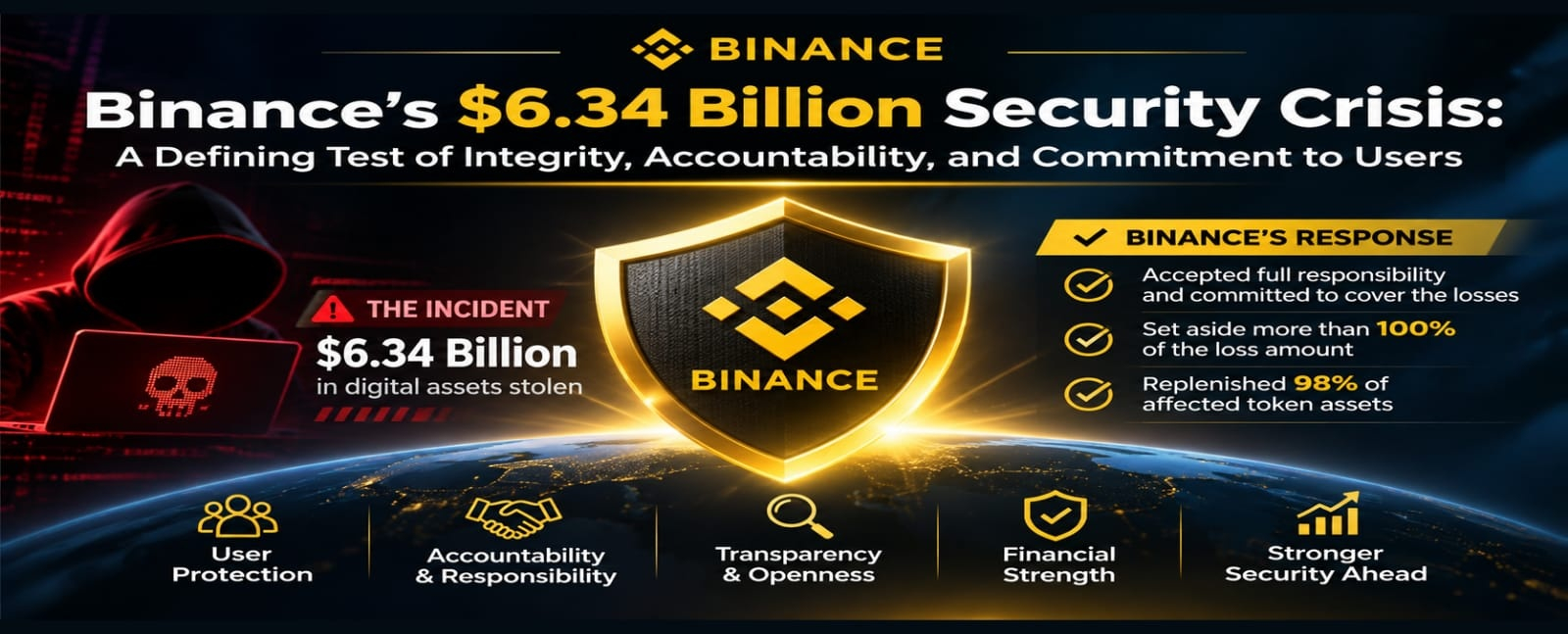

When 6.34 billion disappears, the true value of a company is measured not only by its financial strength, but by its integrity, responsibility, and commitment to the people who trust it.
On October 29, 2026, Binance experienced one of the largest cryptocurrency security breaches in history, involving approximately $6.34 billion in digital assets.
The incident shocked the cryptocurrency industry, raised serious cybersecurity concerns, and naturally created uncertainty among users.
Yet beyond the magnitude of the attack, another important story deserves recognition: the way Binance responded to an extraordinary crisis and placed its financial resources behind its commitment to protect customers.
In an industry where confidence can disappear within minutes, Binance demonstrated that corporate integrity must be supported by meaningful actions, not merely reassuring statements.
1. Integrity Is Tested During a Crisis, Not During Success
Every major financial institution speaks about security, responsibility, and customer protection.
However, these commitments only reveal their true value when an organization faces a situation that threatens its reputation, operations, and financial stability.
A $6.34 billion cybersecurity incident represents an extraordinary challenge for any organization.
Binance faced a defining choice: allow customers to bear the consequences of the security failure, or accept financial responsibility and protect their interests.
Binance chose to accept responsibility.
The company publicly committed to absorbing the financial impact of the stolen assets rather than transferring those losses to its users.
This decision deserves recognition because corporate integrity is fundamentally about honoring obligations, especially when doing so becomes costly.
A company's reputation should never be measured solely by its profitability, trading volume, or market position.
It should also be measured by its willingness to stand behind its commitments when circumstances become difficult.
2. Putting Customers Before Financial Interests
Perhaps the most significant aspect of Binance's response was its decision to prioritize customer asset protection.
According to its official announcements, Binance committed resources from its Secure Asset Fund for Users (SAFU) and corporate treasury to cover the stolen funds.
By November 3, Binance reported that it had set aside more than 100% of the amount necessary to cover the losses.
It also reported that 98% of the affected token assets had been replenished as of October 31, with the remaining less-liquid assets still being purchased.
This distinction matters. Replenishing stolen assets using company resources is not the same as recovering funds from the attackers.
Nevertheless, the willingness to mobilize billions of dollars in corporate resources represents a substantial financial commitment.
Customers should not have to absorb the consequences of failures within an exchange's own security infrastructure.
By publicly accepting this principle, Binance established an important example of customer-centered crisis management.
Protecting users should never be treated as a secondary commercial consideration.
It must remain a fundamental obligation of every institution entrusted with other people's assets.
3. Transparency: The Foundation of Long-Term Trust
Integrity is not simply about compensating customers.
It also requires honesty, openness, and accountability when things go wrong.
Binance acknowledged the seriousness of the breach, apologized for the disruption, and publicly released preliminary findings concerning the attack.
The company described how attackers exploited weaknesses involving compromised employee systems and internal wallet infrastructure.
It also acknowledged that suspending withdrawals was insufficient to immediately prevent all unauthorized transfers because additional malicious blockchain authorizations remained active.
Such disclosures are important.
An organization that acknowledges its vulnerabilities provides a stronger foundation for rebuilding confidence than one that attempts to minimize its failures.
The company has also committed to independent cybersecurity reviews and further improvements to its internal controls.
Those reviews remain essential because genuine transparency requires external validation, not simply internal assurances.
True transparency means being willing to explain what went wrong, what has been corrected, and what still requires improvement.
4. Financial Strength Matters, but Integrity Determines How It Is Used
Financial reserves are important for any cryptocurrency exchange.
However, substantial reserves alone do not guarantee responsible behavior.
The more important question is how management chooses to use those resources when customer interests are at risk.
Binance's decision to allocate significant financial resources toward replacing stolen assets demonstrates a willingness to translate financial capacity into customer protection.
Its response illustrates a distinction between having the resources to address a crisis and choosing to deploy those resources responsibly.
The company's financial commitment does not erase the seriousness of the original security failure.
However, it provides meaningful evidence of management's willingness to accept the consequences rather than leave affected customers exposed.
Financial strength creates the ability to protect customers. Integrity creates the willingness to do so.
Both are necessary for sustainable confidence in a financial institution.
5. Professional Crisis Management and Collective Responsibility
Binance's response extended beyond financial compensation.
Following the attack, the company coordinated with law enforcement, blockchain intelligence specialists, token issuers, and other industry participants to trace and restrict stolen assets.
By November 3, Binance reported that approximately $2.85 billion in assets had been frozen or intercepted.
These assets should not automatically be considered recovered, but their restriction represents a significant containment effort.
The company also reported rebuilding affected wallet systems, replacing compromised devices, revoking credentials, enhancing security monitoring, and strengthening internal controls.
These measures reflect an important management principle:
An effective crisis response must address the immediate financial consequences while also correcting the underlying weaknesses that allowed the crisis to occur.
Professional responsibility extends beyond solving today's problem.
It requires reducing the likelihood and potential consequences of tomorrow's failures.
6. Why Binance's Response Matters to the Entire Cryptocurrency Industry
Cryptocurrency adoption depends heavily on public confidence.
Millions of individuals and institutions depend on exchanges to safeguard their digital assets and provide reliable access to financial markets.
A major security breach at one of the industry's largest platforms can therefore affect perceptions of the broader cryptocurrency ecosystem.
Binance's commitment to absorbing the financial losses sends an important message:
Customer protection should be an institutional obligation, not an optional gesture.
The same principle should apply across the cryptocurrency industry, regardless of an exchange's size or market position.
Strong platforms must combine financial resilience, responsible governance, operational security, transparent reporting, and accountable leadership.
When these principles are consistently applied, they help strengthen confidence not only in individual exchanges but also in the long-term development of digital finance.
7. Integrity Does Not Mean Perfection
Recognizing Binance's response should not be confused with overlooking the security vulnerabilities that made the attack possible.
A breach of this magnitude raises legitimate questions about internal controls, employee access, system architecture, threat detection, and incident response procedures.
Those questions deserve independent investigation and clear answers.
The ultimate assessment of Binance's response will depend on whether all affected assets are fully replenished, whether independent security reviews validate the corrective measures, and whether customers receive sustained transparency.
However, acknowledging these unresolved issues does not diminish the significance of the commitments Binance has already made.
Instead, it reinforces an essential principle of corporate governance:
Integrity does not mean an organization will never experience failure. It means the organization accepts responsibility, addresses the consequences, learns from the experience, and fulfills its obligations.
8. A Defining Moment for Binance's Leadership
In business, the most important leadership decisions are often made under exceptional pressure.
The October 29 incident placed Binance in a situation where financial losses, cybersecurity vulnerabilities, customer confidence, and institutional reputation were all at stake.
Its decision to prioritize the protection of customer assets, commit billions of dollars in company resources, cooperate with investigators, and disclose preliminary findings deserves professional recognition.
The full effectiveness of these actions will become clearer as the recovery and independent review processes progress.
Nevertheless, the response provides a meaningful example of how corporate responsibility can be demonstrated during an unprecedented financial and operational crisis.
Final Thoughts: Trust Is Earned When Responsibility Becomes Costly
As a Binance user and an observer of the cryptocurrency industry, I believe this incident highlights an important distinction between commercial success and institutional integrity.
Anyone can celebrate success during favorable market conditions.
A company's character becomes far more visible when it faces an extraordinary challenge and must choose between protecting its own short-term financial interests and fulfilling its responsibilities to customers.
Binance has made a substantial commitment to protecting its users following a $6.34 billion security breach.
That commitment deserves acknowledgment, while its execution and long-term security improvements deserve continued scrutiny.
The greatest achievement of any financial institution is not the volume it trades, the profit it generates, or the market share it controls.
It is the confidence it earns from the people who entrust it with their money.
And that confidence must be protected through responsible actions, transparent decisions, and genuine accountability.
Trust is earned over years, tested in moments of crisis, and preserved through integrity.


#Binance #SAFU #BinanceSquare #CryptoSecurity #CorporateIntegrity #Accountability #Leadership #CustomerProtection #Blockchain #Cryptocurrency #CyberSecurity #Trust