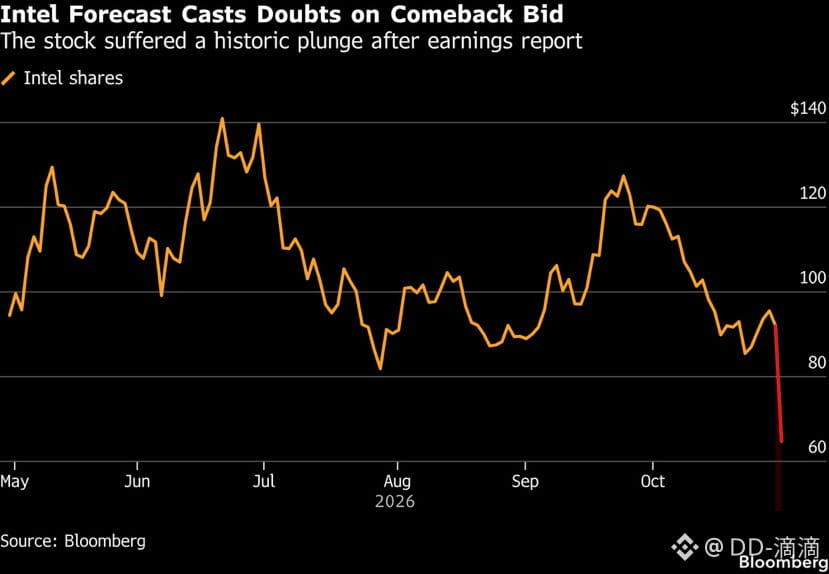

$INTC dropped nearly 29% on Friday, its worst day since 1974, erasing roughly $140 billion. $GOOGL fell about 13% the day before, its worst session on record, wiping out around $500 billion.
$INTC beat on the quarter but guided Q4 revenue to $15-16 billion versus roughly $17 billion expected and EPS of $0.25 versus $0.43. Management pointed to a weak PC market and rising memory prices that are squeezing client demand. Data center and AI revenue still grew strongly, up nearly 80%.
GOOGL also missed on revenue and earnings. Cloud more than doubled, but search advertising growth slowed as AI Mode reduced traditional ad monetization. Capex hit $51.4 billion in the quarter, pushing free cash flow negative.
The selloff has been amplified by heavy hedge-fund de-grossing, the largest in a decade according to Morgan Stanley data, with short interest rising across many semiconductor and related names.
PC weakness at Intel looks tied to memory cost pressure and may linger into the first half of next year. Server and AI infrastructure demand has not shown the same break. Hyperscalers continue signing longer memory LTAs, and the Marvell-Lumentum deal has raised the strategic value of remaining independent laser suppliers as buyers look for alternatives outside a competitor’s control.
The gap between strong data-center results and weak PC guidance, plus the cash-flow impact of elevated AI spending, is what the market is currently pricing. Volatility remains high.
$INTC beat on the quarter but guided Q4 revenue to $15-16 billion versus roughly $17 billion expected and EPS of $0.25 versus $0.43. Management pointed to a weak PC market and rising memory prices that are squeezing client demand. Data center and AI revenue still grew strongly, up nearly 80%.
GOOGL also missed on revenue and earnings. Cloud more than doubled, but search advertising growth slowed as AI Mode reduced traditional ad monetization. Capex hit $51.4 billion in the quarter, pushing free cash flow negative.
The selloff has been amplified by heavy hedge-fund de-grossing, the largest in a decade according to Morgan Stanley data, with short interest rising across many semiconductor and related names.
PC weakness at Intel looks tied to memory cost pressure and may linger into the first half of next year. Server and AI infrastructure demand has not shown the same break. Hyperscalers continue signing longer memory LTAs, and the Marvell-Lumentum deal has raised the strategic value of remaining independent laser suppliers as buyers look for alternatives outside a competitor’s control.
The gap between strong data-center results and weak PC guidance, plus the cash-flow impact of elevated AI spending, is what the market is currently pricing. Volatility remains high.