
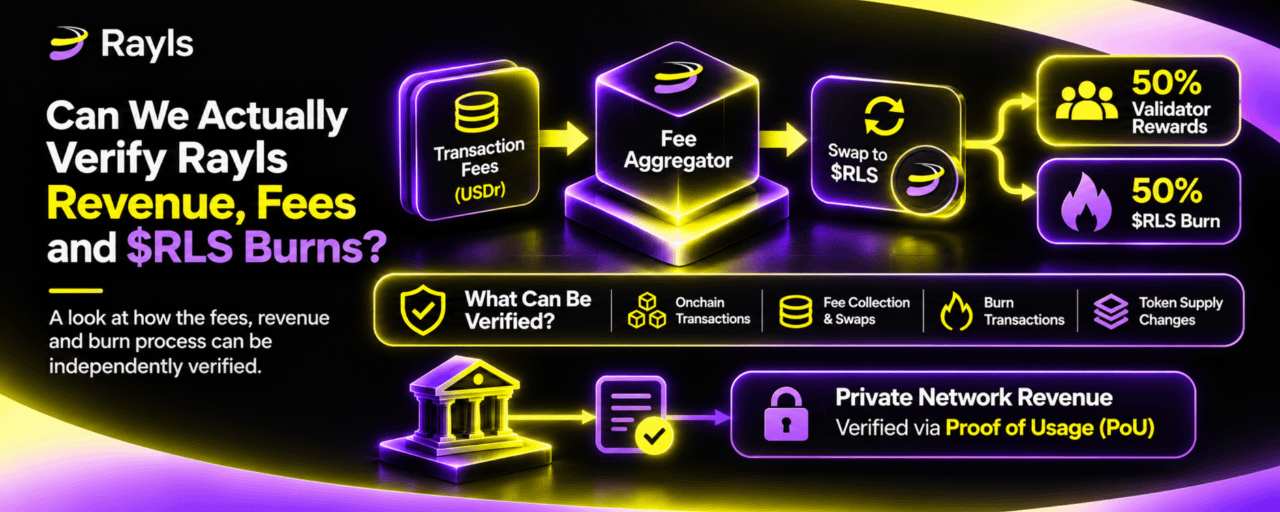

Whenever a blockchain project shares numbers about revenue, transaction fees or token burns, I think there is one important question worth asking:
Can anyone verify these numbers independently, or do we simply have to trust what the dashboard shows?
I wanted to understand how this works with Rayls, especially because its ecosystem includes both public blockchain activity and private institutional networks.
Here's what I found.
1. Where do transaction fees come from?
On the Rayls Public Chain, users pay transaction fees in USDr.
According to Rayls' tokenomics documentation, collected fees go through a Fees Aggregator contract.
At the end of each 24-hour epoch, the accumulated USDr is swapped for $RLS through an onchain liquidity pool.
The resulting $RLS is divided into two parts:
50% goes towards validator rewards.
50% goes towards the burn mechanism.
This is useful because the process involves onchain transactions that researchers can inspect rather than relying entirely on reported figures.
2. How can someone check the $RLS burns?
This is where things get interesting.
Rayls documents a process in which the burn allocation is bridged back to Ethereum and accumulated before being burned in batches.
But there is an important difference between tokens allocated for burning and tokens that have actually been burned.
To verify a burn independently, someone should:
Find the relevant Ethereum transaction.
Check the amount involved.
Inspect the burn contract or transaction event.
Compare the token's total supply before and after.
A transfer to a burn address alone should not automatically be treated as proof of a completed burn. The actual contract behaviour matters.
3. What about revenue from private institutional networks?
This is probably the more interesting challenge.
Unlike public blockchain transactions, institutional activity may happen on private ledgers. That means anyone cannot simply open a public block explorer and inspect every transaction.
Rayls addresses this through its Proof of Usage (PoU) mechanism.
The idea is to capture fee information generated through private institutional network activity and publish cryptographic proofs to the Rayls Public Chain.
This creates a way to provide evidence of private-network usage without making every underlying institutional transaction publicly visible.
However, there is still an important distinction.
Verifying that a proof has been published is not necessarily the same as independently reproducing the complete revenue calculation.
For that, researchers need to understand the proof data, verification rules and how the reported amounts are calculated.
4. What can we actually verify?
I would separate the information into three categories.
Publicly verifiable:
Public-chain transactions and fee payments.
Fees collected by the relevant contracts.
USDr-to-$RLS swaps.
Validator reward distributions.
Ethereum burn transactions and token supply changes.
Requires additional investigation:
Whether private-network revenue figures reconcile with the published usage proofs.
Whether all reported fees are represented correctly.
Whether reported revenue matches actual treasury receipts.
Should not be assumed:
That every dashboard figure represents money already received by the treasury.
That tokens allocated for burning have already been permanently removed.
That a published proof automatically verifies every economic figure displayed.
5. Why does independent verification matter?
For me, transparency is not just about displaying impressive numbers.
It is about allowing someone outside the project to understand how those numbers were produced.
Rayls has an interesting approach because it combines public-chain records, Ethereum-based token movements and cryptographic proofs for private institutional activity.
But each requires a different verification method.
A public transaction can be inspected directly. A private-network revenue figure needs additional evidence and reconciliation.
Understanding that difference is important before making conclusions about network adoption, revenue growth or the economic impact of $RLS burns.
Final thoughts
I think one question should always be asked when looking at blockchain metrics:
Can I reproduce this number using evidence, or am I only reading a reported figure?
A dashboard can make information easier to understand, but independent verification is what makes that information more meaningful.
That's the difference between seeing blockchain activity and actually being able to investigate it.
#Rayls #Blockchain #RLS