

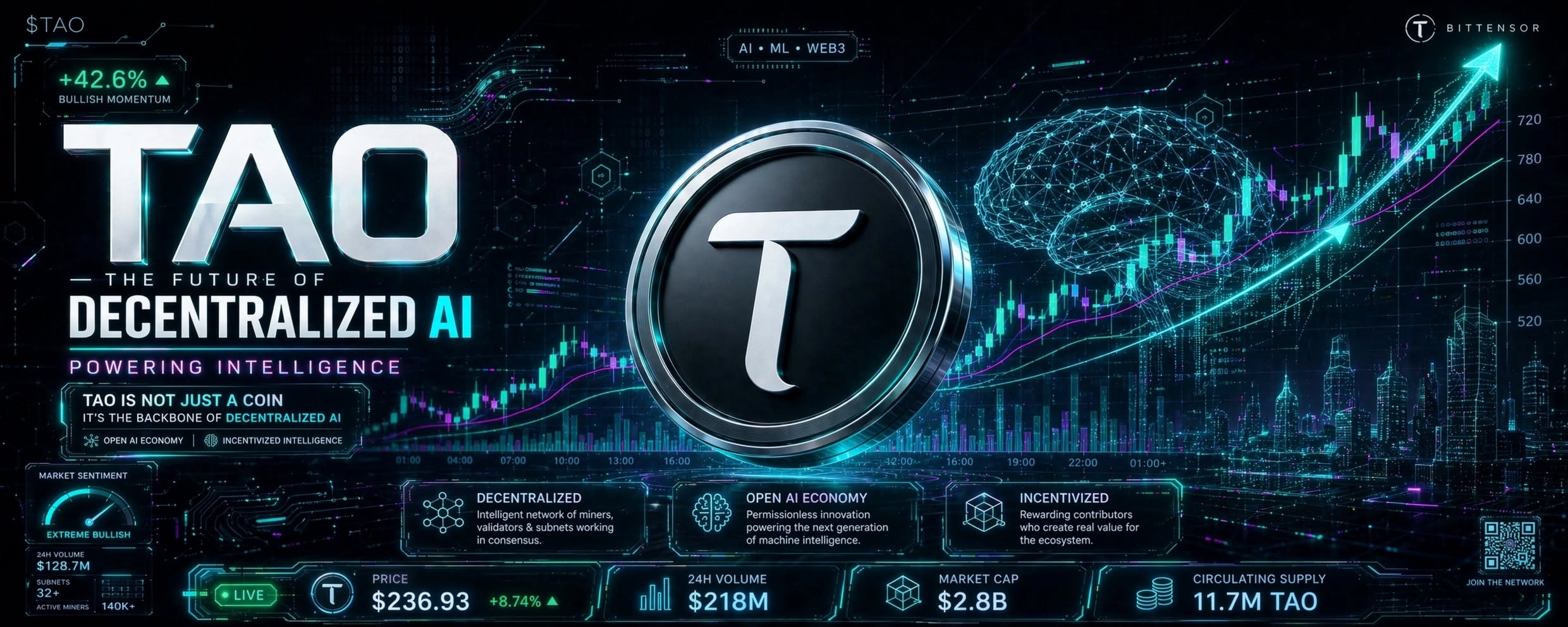

1. What is Bittensor $TAO ?
Bittensor is an open-source decentralized blockchain protocol that creates a decentralized AI marketplace. Instead of AI being controlled by Google, OpenAI, Microsoft — Bittensor lets a global community of developers, miners and validators compete to build and improve AI models. It's often called "Bitcoin for AI". It was created by Jacob Steeves, former Google AI engineer, using Proof of Intelligence (PoI).
2. Basic Info & Tokenomics
• Ticker: $TAO • Max Supply: 21 Million (same as Bitcoin, fair-launched, no pre-mine) • Current Price: ∼$236.93, Volume ∼$218M, Market Cap ∼$2.8B • Circulating: ∼11.7M TAO • Halving: First halving happened Dec 14, 2025, cutting emissions by 50% to 0.5 TAO per block — enhances scarcity. • Emission Split: 41% Miners, 41% Validators, 18% Subnet Owners
3. How it Works — Subnets & dTAO
The network is divided into subnets. Each subnet is an independent marketplace for a specific AI task — text generation, image creation, speech recognition, prediction markets, protein folding etc.
The biggest change was dTAO (Dynamic TAO) launched Feb 13, 2025. Under dTAO, each subnet has its own Alpha Token that trades against TAO in an AMM pool. TAO emissions are allocated proportionally based on the price of each subnet token. This creates a market-driven system where investors can stake TAO into the best-performing subnets. By early 2026, network grew from 32 subnets to over 100+ subnets, and in May 2026 doubled capacity from 128 to 256 slots (Robin expansion).
4. Pros of TAO
• Strongest and most mature DeAI project in 2026 • Bitcoin-like scarcity + strong AI narrative • Open, permissionless innovation — anyone can contribute models/compute/data and earn • Grayscale filed for spot TAO ETF on NYSE Arca (Oct 23, 2026) — institutional interest • Q1 2026 subnet revenue ∼$43M showing real usage • eTAO system activated Oct 20, 2026 allows dynamic reward splits
5. Cons of TAO
• High volatility — AI sector swings, 20% weekly moves common • Subnet revenue ($43M) still overshadowed by ∼$148M annual token emissions — inflation pressure • Economics hard to value, uneven incentives, SN51 getting larger share of emissions • Regulatory uncertainty for AI-blockchain hybrids • Trading 73% below ATH $757
6. Future Outlook
TAO's future is a tug-of-war. Bull case: If decentralized AI becomes a major crypto narrative and subnet demand turns into durable revenue, analysts target $600, $900, even $1,400 (973% upside) and $1,338 by 2030. Base case 2026 is $250-$320 with $300 resistance. Bear case $180-$220.
Catalysts: Bitcoin-like halving scarcity, Grayscale TAO ETF decision expected around Aug 2026, AI Crypto Sector +54% in Sept 2026 with TAO +37%, and projected $600B decentralized AI market by 2030.
In short: TAO is not just a meme coin — it's infrastructure for the AI economy. High risk, high reward.
No Financial Advice!