


By Muhammad Hassan Zubairu
The blockchain industry has always emphasized private-key security.
But what happens when an attacker can exploit the infrastructure surrounding a wallet without evidence of directly stealing its private keys?
Binance's latest Security Incident Update provides an important opportunity to examine this question.
On October 29, 2026, Binance experienced unauthorized withdrawals involving its hot-wallet infrastructure. The exchange estimated the financial impact at approximately $6.3 billion.
Let's examine five important lessons from this incident.
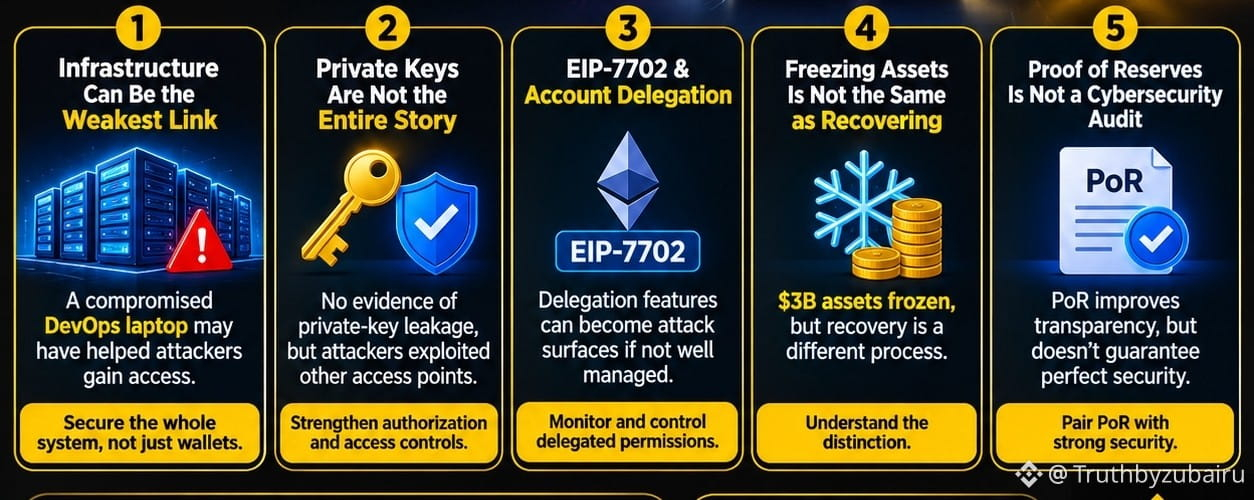
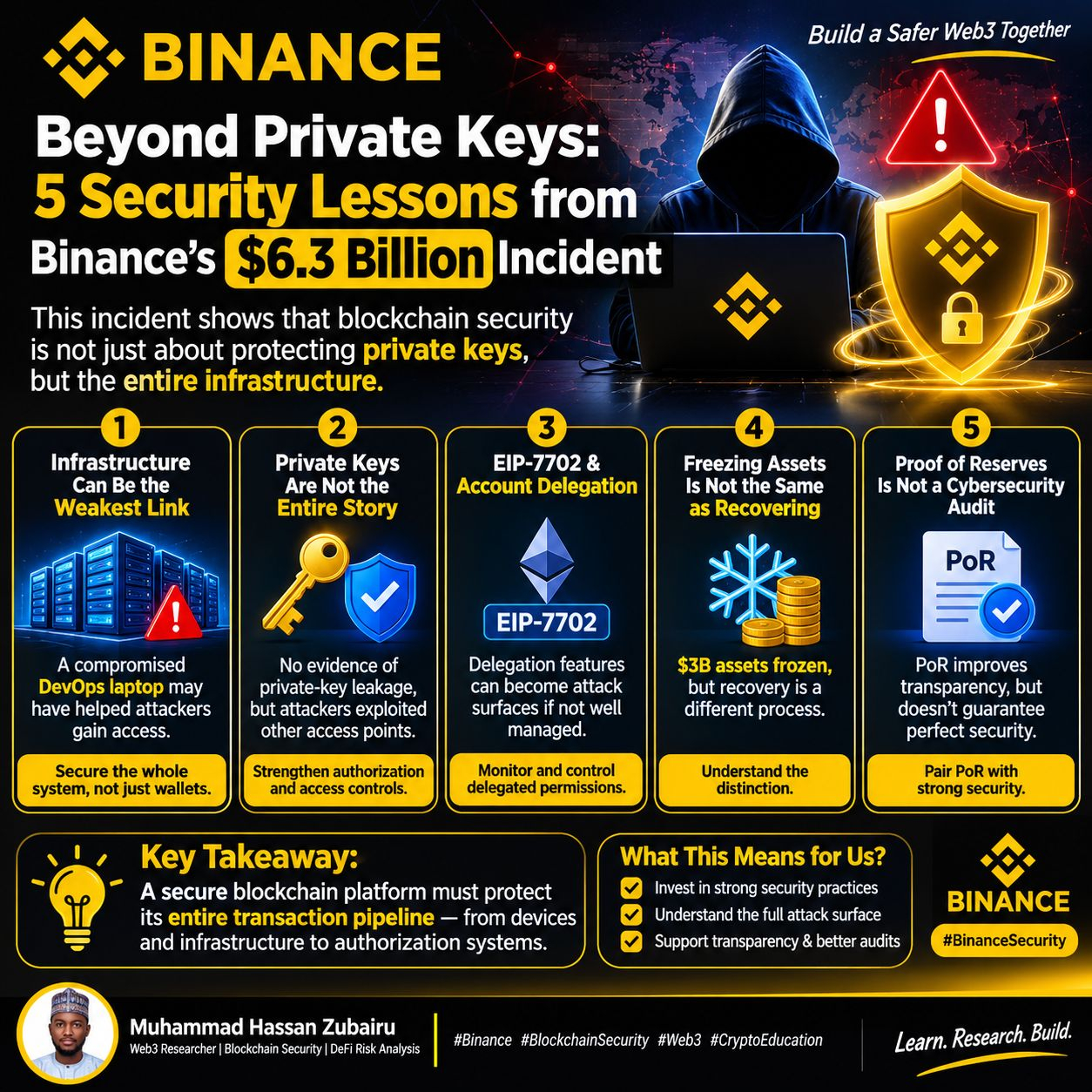
1. Infrastructure Can Become the Weakest Link
Binance's initial investigation suggested that a compromised DevOps engineer's laptop may have enabled access to a service container.
Further investigation uncovered additional points of compromise.
This highlights a major security principle:
A secure wallet does not automatically mean a secure infrastructure.
Employee devices, internal services, cloud environments and authorization workflows all form part of the security perimeter.
2. Private Keys Are Not the Entire Security Story
Binance reported no evidence of wallet private-key leakage at the time of its update.
This is significant.
Cryptographic security protects the keys, but transaction systems also require secure authorization, access controls and monitoring.
A weakness in these surrounding systems may create opportunities for unauthorized activity.
3. EIP-7702 and Account Delegation
CoinDesk's technical reporting discussed Ethereum's EIP-7702 account-delegation feature in connection with the incident.
Account delegation introduces powerful capabilities, but delegated permissions must be managed carefully.
For researchers, the important question is:
What happens when legitimate authorization mechanisms are abused through compromised infrastructure?
The complete technical explanation still requires Binance's verified post-incident report.
4. Freezing Assets Is Not the Same as Recovering Them
Binance reported approximately $3 billion in affected assets frozen on-chain.
It also committed more than $6.34 billion in resources to cover the losses.
These developments are important, but three terms must remain separate:
- Frozen: Movement has been restricted.
- Recovered: Assets have been successfully returned.
- Replenished: Replacement funds have been prepared.
Understanding this distinction is essential when evaluating security incidents.
5. Proof of Reserves Is Not a Cybersecurity Audit
Binance plans to publish an updated Proof of Reserves snapshot by November 2, 2026.
Proof of Reserves helps users assess the reported backing of their balances.
However, it cannot independently prove that an exchange has secure employee devices, protected infrastructure or flawless withdrawal authorization.
Transparency and cybersecurity are complementary, not interchangeable.
Final Thoughts
The biggest lesson from this incident is that blockchain security must be viewed as a complete system.
Private-key management matters.
But so do infrastructure security, access control, authorization, monitoring and incident response.
A platform is not secure simply because its private keys are protected. Its entire transaction pipeline must be protected.
I will be following Binance's technical investigation and subsequent post-mortem for further research.
What do you think is the most underestimated security risk for centralized exchanges: private-key management, infrastructure access or transaction authorization?
Share your thoughts below.
---
Researcher: Muhammad Hassan Zubairu
Focus: Web3 Research | Blockchain Security | DeFi Risk Analysis
#Binance #BinanceSquare #BlockchainSecurity #Web3 #CryptoEducation