

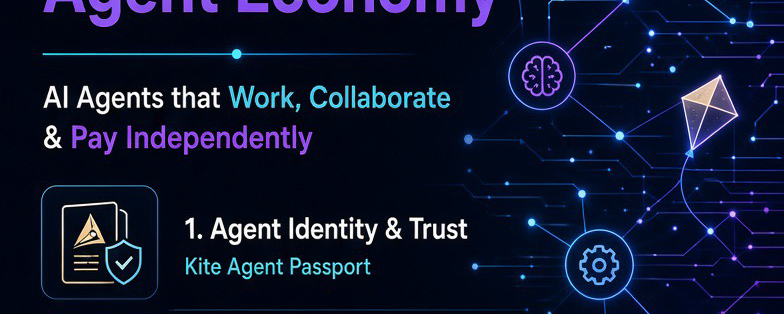


Kite Is Building the Financial Infrastructure for the Agent Economy
The next big evolution of AI may not just be about smarter models. It could be about AI agents that can actually work, collaborate, make decisions and pay for services independently.
This is where @KITE AI is positioning itself.
Today, most AI agents can perform impressive tasks, but there is still a major limitation. They need reliable identity, permission management and payment infrastructure before they can operate independently at scale.
Think about a future where one AI agent researches a market, another analyzes the data, and a third executes a service. These agents should be able to communicate, verify each other’s actions and pay each other without requiring human approval for every small transaction.
That is the agent economy Kite wants to make possible.
What makes Kite different?
Kite is building an AI-native payment blockchain with three important components.
1. Agent Identity and Trust
Through Kite Agent Passport, users can create identities and define exactly what their agents are allowed to do. Spending limits, permissions and access controls help keep autonomous activity within user-defined boundaries.
2. Payments Built for AI Agents
Traditional payment systems were designed around human transactions. AI agents may need thousands of small payments for data, computing resources and services.
Kite supports stablecoin-based payments and payment channels designed for fast, low-cost settlement. This makes machine-to-machine transactions more practical.
3. A Connected Agent Ecosystem
Agents should not operate in isolation. Kite is working towards an ecosystem where developers can build, deploy, discover and connect AI services across different platforms.
Recent Progress Makes the Story More Interesting
Kite Mainnet went live in May 2026, bringing its blockchain and Agent Passport infrastructure into production.
The project has also expanded its ecosystem integrations, including Coinbase x402, PayPal PYUSD and Google Cloud AP2.
In October, Kite introduced improvements to its Passport dashboard, expanded Arc mainnet support and continued improving its developer tools.
These developments matter because the agent economy needs more than an interesting idea. It needs infrastructure that developers and businesses can actually use.
Why $KITE Deserves Attention
The $KITE token is connected to the network’s broader economic model. Its roles include staking, network security, governance and participation in the ecosystem’s incentive structure.
As more developers build applications and agents begin using payment infrastructure, actual network activity becomes an important metric to watch.
My perspective is simple.
AI agents are moving beyond chat interfaces and becoming tools that can perform real economic activities. But for this transformation to scale, they need identity, trust, payments and coordination.
Kite is building around these fundamental requirements rather than treating AI as just another blockchain narrative.
The agent economy is still developing, but the infrastructure being built today could become an important part of how autonomous digital services interact tomorrow.
I believe this is a sector worth watching closely.