


THE AI BOOM. THE $40 TRILLION DEBT NIGHTMARE. THE FED. AND A MARKET THAT MAY BE RUNNING OUT OF ROOM FOR ERROR.
Wall Street wants you to believe the bull market still has plenty of fuel left.
But beneath the surface, the warning signs are getting harder to ignore.
The S&P 500 is struggling around its 50-day moving average. AI hardware and semiconductor stocks have suffered sharp declines. Bank stocks are showing weakness after earnings. Credit markets are becoming increasingly unsettled. Meanwhile, rising Treasury yields, widening corporate credit spreads, a stronger U.S. dollar, and higher volatility are tightening financial conditions.
This is not proof that a crash is inevitable.
It is a warning that the margin for error is shrinking.
And when an expensive market starts losing momentum, the consequences can become brutal.
THE $7,500 LINE: WHERE CONFIDENCE COULD COLLAPSE
According to the technical analysis discussed by CNBC’s Michael Santoli, JPMorgan strategist Jason Hunter identified the S&P 500’s 7,500 area as a critical downside level.
A sustained break below that threshold could undermine confidence that the market is merely experiencing another routine correction.
The central question is simple: Is Wall Street preparing for another powerful rally, or is the market quietly building the conditions for a deeper and more correlated sell-off?
The answer matters because markets rarely collapse simply because investors suddenly become afraid.
They collapse when too many investors discover that their confidence was built on assumptions that no longer hold.
2018 PROVED THAT STRONG EARNINGS CANNOT GUARANTEE A SAFE MARKET

Investors have plenty of reasons to remain optimistic. Historical patterns following U.S. midterm elections have often favored equities, and analysts expect strong corporate earnings growth.
But history has a brutal lesson.
In the fourth quarter of 2018, the S&P 500 suffered a peak-to-trough decline of approximately 19%, even as annual earnings growth remained above 20%.
Read that again.
Corporate earnings were growing. Yet the stock market was collapsing.
Why?
Because earnings do not exist in a vacuum. Interest rates, valuations, liquidity, monetary policy, and investor positioning can overwhelm even impressive corporate results.
A company can report record profits while its stock price falls.
A booming industry can become a disastrous investment when expectations have already become too aggressive.
And a bull market can turn vicious when investors suddenly realize that the price they paid was based on a future that may not arrive as quickly as promised.
THE AI TRADE: WALL STREET’S BIGGEST STRENGTH COULD BECOME ITS BIGGEST VULNERABILITY
For months, artificial intelligence has helped fuel enormous enthusiasm across technology stocks, semiconductor companies, and data-center infrastructure.
But what happens when investors stop rewarding the promise of AI and start demanding undeniable financial returns?
What happens when massive capital expenditures meet disappointing earnings?
What happens when a handful of heavily owned technology stocks fail to justify the expectations embedded in their valuations?
The market could face a dangerous repricing.
CNBC’s analysis highlights the recent weakness in AI hardware and semiconductor shares, alongside aggressive repositioning by hedge funds away from technology exposure.
That does not mean AI is a failure. The technology may continue transforming the global economy for decades.
But technological revolutions do not guarantee that every investor buying into the hype will make money.
The internet changed the world. That did not prevent the dot-com bubble from destroying enormous amounts of shareholder wealth.
The same principle applies to AI: A revolutionary technology can coexist with disastrously overpriced stocks.
THE FED IS NOW PART OF THE MARKET’S BIGGEST GAMBLE
Financial conditions are tightening as Treasury yields rise, credit spreads widen, volatility increases, and the dollar strengthens.
That combination can make borrowing more expensive, pressure corporate valuations, and weaken the appetite for risk.
The debate now centers on how Federal Reserve Chair Kevin Warsh will respond.
Some investors believe tighter market conditions could reduce the need for additional monetary tightening. Others fear the Fed could remain focused on inflation even as financial markets come under pressure.
Morgan Stanley strategist Mike Wilson has argued that acknowledging the tightening could reassure interest-rate-sensitive parts of the market. Ignoring it, by contrast, could revive uncomfortable memories of Jerome Powell’s 2018 “autopilot” episode.
Bank of America economist Aditya Bhave has also maintained a less-consensus forecast for an October rate increase, illustrating how divided expectations have become.
The danger is not simply that the Fed raises rates.
The danger is that investors have positioned themselves around one expected policy path, only to discover that the central bank intends to follow another.
Markets hate uncertainty.
Leveraged investors hate it even more.
WHEN CASH BUFFERS SHRINK, LOSSES CAN BECOME MORE VIOLENT
Another warning in Santoli’s analysis concerns investor cash holdings relative to margin debt.
The reported relationship has fallen well below levels observed in 2000.
There are important caveats: certain trading strategies can inflate margin borrowing without representing equivalent directional leverage, and cash held in bank deposits may not be fully captured by the measure.
Nevertheless, the broader concern deserves attention.
When investors have substantial exposure to risky assets but limited immediately available purchasing power, a sharp sell-off can become more difficult to absorb.
Forced selling can accelerate declines. Falling prices can trigger additional risk reductions. And investors who expected to buy the dip may discover that their own portfolios are under pressure.
This is how an ordinary correction can become a much uglier feedback loop.
Not every decline triggers a financial crisis.
But assuming that liquidity will always appear exactly when the market needs it is a dangerous way to invest.
BONDS ARE BECOMING A MORE SERIOUS COMPETITOR
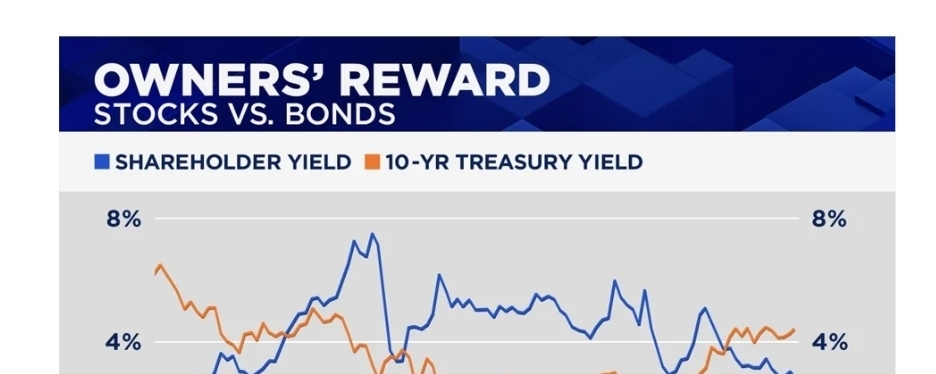
Santoli also highlights another uncomfortable development: the combined shareholder yield from dividends and stock buybacks has fallen below the yield on the 10-year U.S. Treasury.
This does not automatically make stocks unattractive. Equities offer potential earnings growth, while bonds carry their own interest-rate and inflation risks.
But the comparison changes the calculation.
When government bonds offer relatively attractive income, investors have a stronger alternative to taking equity risk.
Stocks must justify their valuations against that alternative.
If earnings disappoint, yields rise further, or risk premiums expand, investors may demand lower stock prices before they are willing to buy again.
THE REAL THREAT: A MARKET THAT HAS RUN OUT OF EASY EXCUSES
The bullish case remains alive.
Strong earnings, continued AI investment, favorable seasonal patterns, and improving market breadth could help equities recover and establish another advance.
But the bearish case can no longer be dismissed with a lazy slogan about buying every dip.
The market is confronting a dangerous combination of weakening technical momentum, crowded technology exposure, tighter financial conditions, monetary-policy uncertainty, and diminishing cash cushions.
And the historical lesson from 2018 is clear: Strong earnings alone cannot protect investors from a brutal repricing of risk.
The critical question is not whether the bull market has already ended.
It is whether investors are adequately prepared for the possibility that it could.
Because the most dangerous moment in a bull market is not always when everyone is terrified.
Sometimes, it is when confidence remains high, valuations leave little room for disappointment, and almost everyone assumes that the next rally is just around the corner.
WALL STREET DOES NOT NEED A CATASTROPHE TO GET HURT.
Sometimes, all it takes is one disappointing earnings season, one unexpected policy decision, or one critical support level breaking at the wrong time.
Watch the S&P 500’s 7,500 area. Watch semiconductor earnings. Watch Treasury yields, credit spreads, and the Fed’s response.
These are not guarantees of a crash.
They are the pressure points that could determine whether this bull market survives another test—or enters a much more dangerous phase.
The market can keep climbing.
But blind confidence is not a strategy.
And history has never promised that investors will be warned before the bill comes due.
#SP500 #StockMarket #WallStreet #FederalReserve #ArtificialIntelligence #AIEconomy #Macroeconomics #FinancialMarkets #MarketCrash #Investing