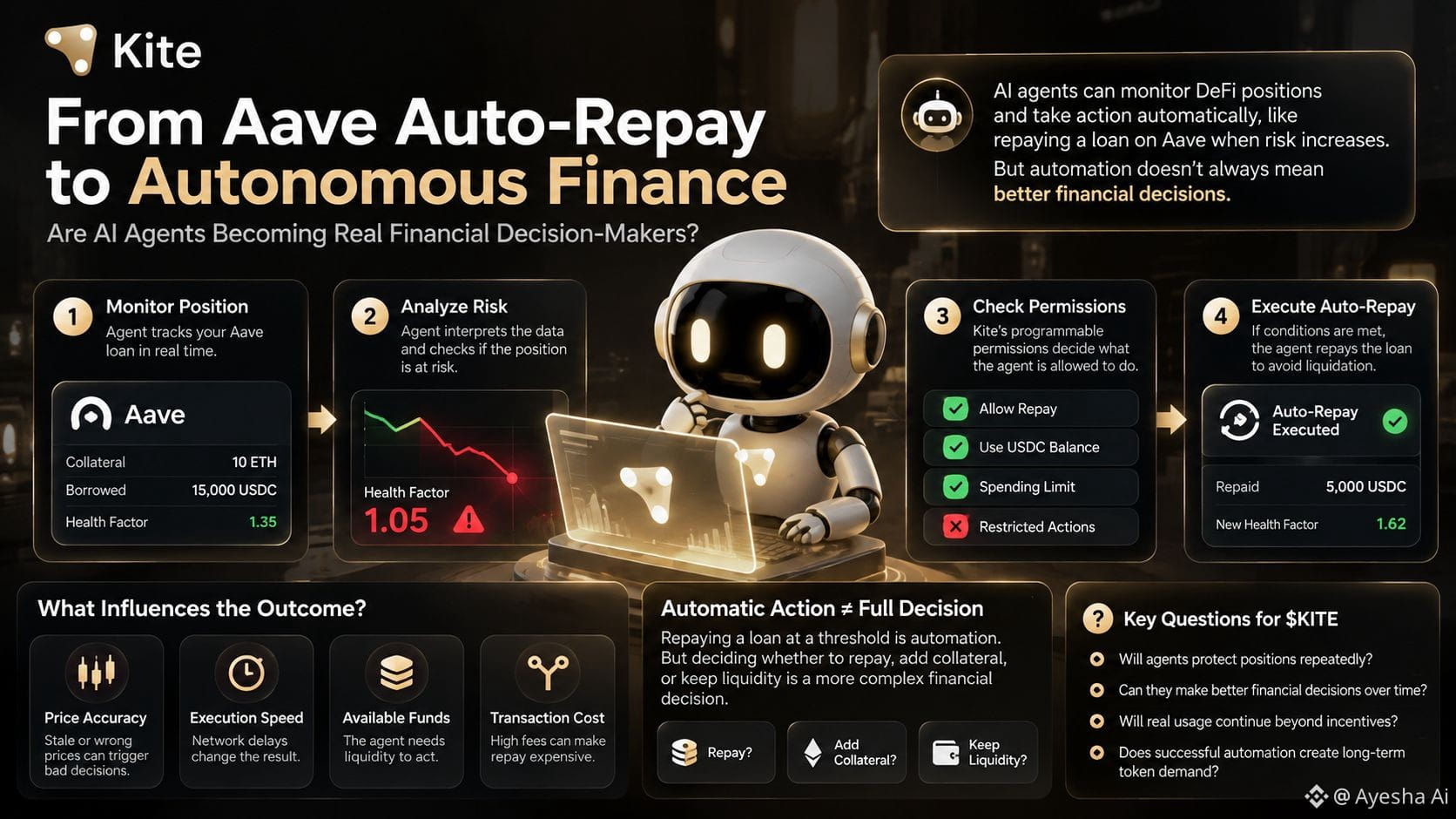
Kite AI $KITE — From Aave Auto-Repay to Autonomous Finance: Are AI Agents Becoming Real Financial Decision-Makers?
A loan can be perfectly healthy in the morning and dangerously close to liquidation by evening. I've seen enough sudden market moves to know that reacting late is sometimes more expensive than making the wrong trade.
That made me look differently at Kite AI's Aave auto-repay use case.
An agent monitors a borrowing position, checks its health, and potentially triggers repayment when predefined conditions are met. Sounds simple. But notice where the decision actually happens.
Aave provides the position data. The agent interprets the risk. Kite's programmable permissions can determine what the agent is allowed to execute. Then the transaction still depends on available funds, execution costs, and network conditions.
One stale price or delayed transaction changes the outcome.
I'm also wondering whether automatic repayment really makes an agent a financial decision-maker. Following a liquidation threshold is one thing. Deciding whether to repay, add collateral, or preserve liquidity is something else entirely.
And for $KITE , successful automation doesn't automatically mean lasting token demand.
I'd rather measure how many positions agents protect repeatedly without human intervention.
Because an agent can follow every permission correctly and still make a financially expensive decision.
#KiteBBW @KITE AI 中文