

I’ve been watching SOL more closely as October 21 approaches because Alpenglow gives the market a concrete event to evaluate rather than another vague roadmap promise.
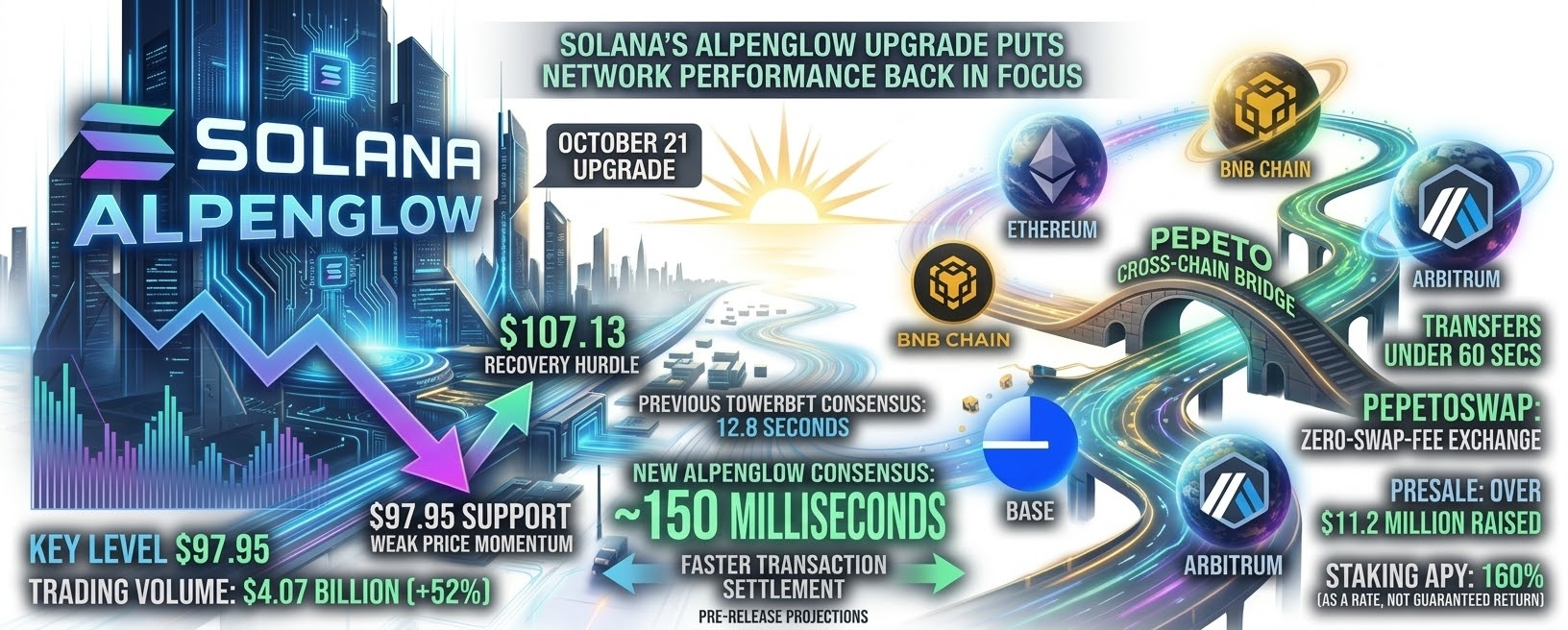
The upgrade is expected to replace Solana’s existing TowerBFT consensus system, with the stated goal of reducing transaction settlement times substantially. The commonly cited figure is a move from roughly 12.8 seconds toward around 150 milliseconds.
That is a meaningful technical change, but I think the more interesting question is how quickly improved infrastructure translates into actual network activity.

Alpenglow Is the Main Catalyst This Week
Alpenglow is positioned as one of Solana’s most significant protocol upgrades in several years.
The focus is straightforward: faster confirmation and improved responsiveness for applications that depend on rapid settlement. That matters particularly for trading, DeFi and other use cases where latency can directly affect the user experience.
I don’t think an upgrade automatically means a higher token price. Markets eventually care about whether technical improvements attract developers, users and capital.
That is where the October 21 launch becomes important.
SOL Is Entering the Upgrade With Weak Price Momentum
The timing is interesting because SOL has already experienced a difficult October.
SOL is trading around $102.83, with the $97.95 region acting as an important technical level in the referenced analysis. RSI around 35 suggests momentum is weak and the market is approaching oversold territory.
The downside scenario becomes more significant if SOL loses that support decisively. The next major area highlighted is around $83.50.
On the other hand, reclaiming approximately $107.13, near the 50-day average, would give buyers an early indication that the selling pressure is easing.
For me, those levels matter more than trying to predict the exact reaction to Alpenglow.
Trading Activity Is Already Picking Up
There is one encouraging detail beneath the weak price action.
SOL trading volume reportedly increased to around $4.07 billion, representing a 52% increase in the cited October 14 data.
Higher volume ahead of a major protocol event can mean several things. Traders may be positioning for the upgrade, short-term participants may be reacting to volatility, or both could be happening simultaneously.
I wouldn’t automatically interpret rising volume as bullish accumulation. It simply tells me that market attention is increasing.
Where Pepeto Fits Into the Story
Pepeto enters this discussion from a different angle.
Rather than competing directly with Solana, the project is positioned around cross-chain movement and interoperability. Its stated bridge connects Ethereum, BNB Chain, Solana, Base and Arbitrum, with transfers designed to complete in under 60 seconds.
The project also describes PepetoSwap as a zero-swap-fee exchange, with users still responsible for applicable network gas costs.
These are useful ideas in principle because fragmented liquidity remains one of the practical problems across multiple blockchain ecosystems.
But I would separate product claims from demonstrated adoption. A bridge being technically available is not the same thing as having sustained users, liquidity and transaction volume.
Presale Numbers Need Context
The supplied figures put Pepeto’s presale above $11.2 million, with the token price cited at $0.0000001901.
Those numbers indicate significant presale participation, but they shouldn't be treated as proof of future performance. Presale capital, staking yields and stage-based pricing all involve substantial risk, particularly for a meme-oriented asset.
The cited 160% APY is also a rate, not a guaranteed return. High advertised yields generally come with corresponding token, liquidity or market risks.
That distinction matters when comparing a presale project with an established network such as Solana.
The Technical Picture Comes Before the Narrative
My approach to SOL here is fairly simple.
If $97.95 continues to hold, the market has a reasonable technical foundation for attempting a recovery. A move above $107.13 would strengthen that case, while higher levels around $125 and potentially $150 become relevant only if momentum and liquidity return.
If the $97.95 support fails decisively, I would be much more cautious about assuming Alpenglow will immediately reverse the trend.
A successful protocol upgrade can improve fundamentals without producing an immediate price reaction. Crypto markets have never been particularly respectful of our carefully prepared narratives.
My Takeaway
October 21 gives SOL a genuine catalyst, but I’m more interested in what happens after the upgrade than in the headline itself.
Alpenglow could improve Solana’s settlement experience and make the network more attractive for applications where speed matters. The real test will be whether that technical improvement translates into sustained activity.
Meanwhile, projects such as Pepeto are trying to address a different problem: moving liquidity between ecosystems more efficiently.
I see the two stories as complementary rather than interchangeable. Solana is working on the infrastructure underneath applications, while cross-chain projects are attempting to make fragmented blockchain environments easier to navigate.
For SOL, the immediate chart remains clear: $97.95 is the important downside reference, while $107.13 is the first meaningful recovery hurdle. The upgrade may change the narrative, but price still needs to confirm it.
#OpenAIAgentTookFundsFromUnownedTestnetWallet #solana #ETHDropsBelow2400USDT #BrentHits$110ForFirstTimeSinceMay